

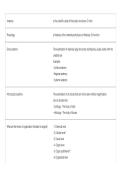
Anatomy is the scientific study of the body's structures. Or form.
Physiology is thestudy of the chemistryand physics of thebody. Or function.
Gross anatomy The examination of relatively large structures and features, usually visible with the
unaided eye
Examples:
▫ Surface anatomy
▫ Regional anatomy
▫ Systemic anatomy
Microscopic anatomy The examination of structures that can not be seen without magnification.
Can be divided into:
▫ Cytology - The study of cells
▫ Histology - The study of tissues
What are the levels of organization (Smallest to largest) • 1. Chemical level
• 2. Cellular level*
• 3. Tissue level
• 4. Organ level
• 5. Organ systemlevel**
• 6. Organismal level
, Integumentary System • Organs - Skin, accessory structures, hair, and nails
• Functions - External support, protection of the body, temperature regulation,
barrier for immune function
Skeletal System • Organs - Bones, cartilage, joints
• Functions - Internalsupport, protection oforgans, flexibleframework for
bodymovement, forms bloodcells, and mineral storage
Muscular System • Organs - Skeletalmuscles, and tendons
• Functions - Locomotion, support, and body heat production
Nervous System • Organs - Brain, spinal cord, peripheral nerves
• Functions - Detects and processes sensory information, directs responses to that
stimuli by coordinating activities of other organ systems
Physiology is thestudy of the chemistryand physics of thebody. Or function.
Gross anatomy The examination of relatively large structures and features, usually visible with the
unaided eye
Examples:
▫ Surface anatomy
▫ Regional anatomy
▫ Systemic anatomy
Microscopic anatomy The examination of structures that can not be seen without magnification.
Can be divided into:
▫ Cytology - The study of cells
▫ Histology - The study of tissues
What are the levels of organization (Smallest to largest) • 1. Chemical level
• 2. Cellular level*
• 3. Tissue level
• 4. Organ level
• 5. Organ systemlevel**
• 6. Organismal level
, Integumentary System • Organs - Skin, accessory structures, hair, and nails
• Functions - External support, protection of the body, temperature regulation,
barrier for immune function
Skeletal System • Organs - Bones, cartilage, joints
• Functions - Internalsupport, protection oforgans, flexibleframework for
bodymovement, forms bloodcells, and mineral storage
Muscular System • Organs - Skeletalmuscles, and tendons
• Functions - Locomotion, support, and body heat production
Nervous System • Organs - Brain, spinal cord, peripheral nerves
• Functions - Detects and processes sensory information, directs responses to that
stimuli by coordinating activities of other organ systems


