

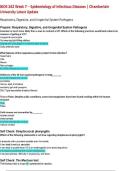
BIOS 242 Week 7 – Epidemiology of Infectious Diseases | Chamberlain University | Latest Updated Study Guide
Master the advanced concepts of infectious disease transmission, outbreak investigation, pathogen epidemiology, and disease prevention with this comprehensive BIOS 242 Week 7 – Epidemiology of Infectious Diseases Study Guide designed specifically for students enrolled in Fundamentals of Microbiology at Chamberlain University. This latest updated study resource provides a detailed review of the major epidemiological principles, infectious disease processes, pathogenic microorganisms, and public health concepts covered during Week 7 coursework, discussions, laboratory activities, quizzes, and examinations. This study guide is carefully structured to help students understand how infectious diseases emerge, spread, and impact populations. It combines microbiology fundamentals with epidemiological concepts, allowing learners to develop a deeper understanding of disease surveillance, transmission patterns, outbreak investigations, prevention strategies, and pathogen-host interactions. The material aligns closely with Chamberlain University learning objectives and provides targeted support for academic success in BIOS 242. A major focus of Week 7 is the epidemiology of infectious diseases affecting various body systems, including the respiratory, digestive, urinary, reproductive, nervous, and circulatory systems. Students will explore the causative agents of common infectious diseases and learn how pathogens establish infection, evade host defenses, and spread within communities. The guide explains important disease processes while emphasizing the relationship between microbial virulence factors and clinical outcomes. The resource provides an in-depth review of epidemiological terminology essential for understanding infectious disease control. Learners will study incidence, prevalence, morbidity, mortality, endemic diseases, epidemics, pandemics, outbreaks, reservoirs, vectors, transmission routes, and host susceptibility factors. These concepts are presented in a simplified format that supports retention and exam preparation. Understanding these terms is critical for interpreting public health data and analyzing disease trends within populations. Students will examine the major modes of disease transmission, including direct contact, indirect contact, droplet transmission, airborne spread, vector-borne transmission, vehicle transmission, and zoonotic infections. Detailed explanations help learners understand how infectious agents move between hosts and the environmental factors that influence disease spread. The guide highlights practical examples of outbreak scenarios and demonstrates how epidemiologists trace sources of infection during investigations. The study material also explores respiratory pathogens responsible for diseases such as influenza, tuberculosis, streptococcal pharyngitis, pneumonia, and other respiratory infections. Students will learn the mechanisms of pathogen transmission, disease symptoms, diagnostic methods, prevention strategies, and treatment approaches. The guide reviews protective features of the respiratory system and explains how pathogens overcome these natural defenses to establish infection. Another important component of Week 7 focuses on digestive system pathogens and foodborne illnesses. Learners will review infections caused by organisms such as Escherichia coli, Helicobacter pylori, Clostridium difficile, Salmonella, and other gastrointestinal pathogens. The guide explains microbial virulence factors, toxin production, routes of contamination, food safety practices, and disease prevention measures. Students will gain a better understanding of how gastrointestinal infections impact public health worldwide. The study guide further examines urinary and reproductive system infections, including urinary tract infections (UTIs), sexually transmitted infections (STIs), candidiasis, syphilis, gonorrhea, chlamydia, and other urogenital diseases. Students will learn risk factors, transmission mechanisms, clinical manifestations, laboratory diagnosis, treatment options, and prevention strategies associated with these infections. Special emphasis is placed on healthcare-associated infections and antimicrobial resistance concerns. In addition to bacterial diseases, the guide covers viral, fungal, protozoan, and parasitic pathogens commonly discussed during Week 7. Learners will compare pathogen classifications, life cycles, pathogenicity, transmission methods, and disease outcomes. The resource helps students distinguish between different categories of microorganisms and understand their unique epidemiological characteristics. Public health principles are integrated throughout the material to strengthen students’ understanding of disease prevention and control. Topics include vaccination programs, infection prevention protocols, community health initiatives, quarantine procedures, isolation measures, surveillance systems, contact tracing, and outbreak response strategies. These concepts demonstrate how healthcare professionals and public health organizations work together to reduce disease transmission and protect populations. The guide also reviews important laboratory applications and diagnostic procedures used in epidemiology and microbiology. Students will explore pathogen identification techniques, specimen collection methods, culture procedures, laboratory safety protocols, and biosafety practices. These laboratory concepts support practical learning objectives and help students connect theoretical knowledge to clinical applications. To support exam preparation, the study guide includes organized notes, review questions, self-assessment exercises, pathogen summaries, disease comparison charts, and concept reviews. The material emphasizes high-yield content frequently tested in quizzes, discussion boards, laboratory activities, and examinations. Complex topics are simplified into clear explanations that promote understanding rather than memorization alone. This updated study resource is ideal for nursing students, allied health learners, microbiology students, healthcare professionals, and anyone seeking to strengthen their understanding of infectious disease epidemiology. Whether preparing for weekly assignments, laboratory exercises, discussion posts, midterm exams, or final assessments, students can use this guide to improve confidence and academic performance.
Document information
- Uploaded on
- May 31, 2026
- Number of pages
- 4
- Written in
- 2025/2026
- Type
- Exam (elaborations)
- Contains
- Questions & answers


