

APEX NIH STROKE SCALE GROUP A PATIENT 1-6 (COMPLETE) 2026/2027!! 2026/2027 2026/2027 | Page 1 | Passing Score: 90%
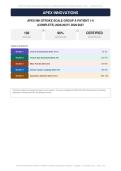
APEX INNOVATIONS
APEX NIH STROKE SCALE GROUP A PATIENT 1-6
(COMPLETE) 2026/2027!! 2026/2027
NIH STROKE SCALE -- Official Exam 2026/2027
100 90% CERTIFIED
QUESTIONS PASSING SCORE RECERTIFICATION
TABLE OF CONTENTS
Section 1 Level of Consciousness (Items 1a-1c) Q1-20
Section 2 Visual & Gaze Assessment (Items 2-4) Q21-40
Section 3 Motor Function (Items 5-6) Q41-60
Section 4 Sensory, Ataxia & Language (Items 7-9) Q61-80
Section 5 Dysarthria & Extinction (Items 10-11) Q81-100
Instructions: Select the single best answer for each question. This exam is designed for APEX NIH Stroke Scale Group A certification
preparation. Passing score: 90% (90 questions correct).
APEX NIH STROKE SCALE GROUP A PATIENT 1-6 (COMPLETE) 2026/2027!! 2026/2027 -- 2026/2027 | Passing Score: 90% | Page 1 of 49
,SECTION 1 | Level of Consciousness (Items 1a-1c) | Q1-Q20 | APEX NIH STROKE SCALE GROUP A PATIENT 1-6 (COMPLETE) 2026/2027!! 2026/2027
2026/2027
Q1 Question 1 of 100
A 68-year-old male arrives in the emergency department 90 minutes after sudden onset of left-sided weakness.
When the nurse approaches, the patient opens his eyes and turns his head toward the nurse without any verbal
prompt. He responds to questions but is slightly confused about the date. According to NIHSS Item 1a, what
score should be assigned?
A. Score 1 -- The patient is not alert but can be aroused by minor stimulation to obey, answer, or respond, which
corresponds to a score of 1 on Item 1a
B. Score 2 -- The patient requires repeated stimulation to attend and is obtunded with minor neurologic
questions unanswered
C. Score 0 -- The patient is alert and responding to the nurse, which indicates normal level of consciousness
D. Score 3 -- The patient responds only with reflex motor or autonomic effects or is totally unresponsive
Correct Answer: C
Rationale:
The patient is alert, opens his eyes spontaneously, and responds to questions appropriately, even though he is slightly
confused about the date. Item 1a scores the overall level of consciousness, and since the patient is awake and
responsive without needing stimulation, the correct score is 0. A score of 1 would require the patient to need
stimulation to arouse.
Q2 Question 2 of 100
A 72-year-old female with a suspected ischemic stroke is evaluated using the NIHSS. The examiner asks the
patient two orientation questions: the current month and her age. The patient correctly states her age but is
unable to state the current month. What is the correct score for NIHSS Item 1b?
A. Score 0 -- The patient answered one question correctly, demonstrating adequate orientation
B. Score 2 -- The patient is unable to answer either question accurately, indicating severe disorientation
C. Score 1 -- The patient answers one of the two orientation questions correctly, which corresponds to a score of
1 on Item 1b
D. Score 1 only if the patient also fails a third orientation question as verification
Correct Answer: C
Rationale:
Item 1b asks the patient to answer two orientation questions: the current month and their age. A score of 0 requires
both correct, a score of 1 means one correct answer, and a score of 2 means neither question is answered correctly.
Since the patient correctly stated her age but not the month, the score is 1.
APEX NIH STROKE SCALE GROUP A PATIENT 1-6 (COMPLETE) 2026/2027!! 2026/2027 -- 2026/2027 | Passing Score: 90% | Page 2 of 49
,Q3 Question 3 of 100
A 55-year-old male with acute stroke symptoms is asked to perform two commands: open and close the eyes,
and grip and release the non-paretic hand. He successfully opens and closes his eyes but is unable to grip and
release the hand due to paresis on that side. The examiner tries the other hand and the patient performs both
commands correctly. What is the NIHSS Item 1c score?
A. Score 0 -- The patient successfully performs both commands when tested with an appropriate hand, meeting
the criteria for full credit
B. Score 1 -- The patient was initially unable to perform one of the two commands, which indicates a partial
response
C. Score 2 -- The patient requires multiple attempts and substitution to perform the commands, indicating
significant impairment
D. Score 1 only, because the patient needed an alternative hand to complete the task
Correct Answer: A
Rationale:
Item 1c requires the patient to perform two commands: open/close eyes and grip/release the non-paretic hand. If the
initially chosen hand is paretic, the examiner should test the other hand. Since the patient successfully completed both
commands using the non-paretic hand, the score is 0. The item measures the ability to follow commands, not motor
function.
Q4 Question 4 of 100
A 79-year-old female is brought to the stroke unit after her family found her unresponsive this morning. The
patient does not open her eyes when the nurse calls her name. She does not respond to shaking but withdraws
her right arm when a painful stimulus (sternal rub) is applied. What is the correct NIHSS Item 1a score for this
patient?
A. Score 3 -- The patient demonstrates only reflex motor responses and does not interact with the examiner at
all
B. Score 1 -- The patient responds to painful stimulation, which qualifies as arousable with stimulation
C. Score 2 -- The patient requires repeated stimulation and responds only with reflex withdrawal to painful
stimuli, indicating obtunded consciousness
D. Score 2 only if the patient also fails to respond to verbal stimuli on a second attempt
Correct Answer: C
Rationale:
Item 1a score of 2 is assigned when the patient requires repeated stimulation to attend and is obtunded, needing
strong or painful stimuli to elicit a response. This patient does not respond to verbal stimuli and requires a painful
stimulus to elicit a withdrawal response, which is consistent with a score of 2. A score of 3 would require the patient to
show only reflex posturing or no response at all.
APEX NIH STROKE SCALE GROUP A PATIENT 1-6 (COMPLETE) 2026/2027!! 2026/2027 -- 2026/2027 | Passing Score: 90% | Page 3 of 49
, Q5 Question 5 of 100
A 63-year-old male presents with acute stroke symptoms. When asked the month, he says 'Tuesday,' and
when asked his age, he says 'I feel fine.' The patient is aphasic and unable to produce any correct answers to
the orientation questions. What NIHSS Item 1b score should be assigned?
A. Score 1 -- The patient attempts to answer the questions, which demonstrates partial orientation
B. Score 0 -- The patient is aphasic and orientation questions cannot be accurately scored in aphasic patients
C. Score 2 only if the patient also fails a third verification question administered by a second examiner
D. Score 2 -- The patient answers neither orientation question correctly, which corresponds to a score of 2 on
Item 1b
Correct Answer: D
Rationale:
Item 1b scores 0 for both correct, 1 for one correct, and 2 for neither correct. An aphasic patient who cannot produce
correct answers to either the month or age question receives a score of 2. Aphasia does not excuse the patient from
scoring; the inability to answer correctly, regardless of cause, results in the appropriate score based on actual
responses.
Q6 Question 6 of 100
A 70-year-old female with a history of TIA is being assessed using the NIHSS. She is alert and conversant but
has severe expressive aphasia. When asked the current month, she points to the calendar on the wall and
nods affirmatively. When asked her age, she writes '74' on a piece of paper. How should NIHSS Item 1b be
scored?
A. Score 1 -- The patient used nonverbal communication, which indicates partial impairment in responding to
orientation questions
B. Score 2 -- The patient was unable to verbalize answers to either question, indicating complete failure on Item
1b
C. Score 0 -- The patient communicated correct answers to both orientation questions using alternative means,
which is acceptable for scoring Item 1b
D. Score 1 because pointing and writing are not considered valid response methods for Item 1b scoring
Correct Answer: C
Rationale:
For aphasic patients, the examiner must make every effort to elicit answers using alternative communication methods
such as gesturing, pointing, or writing. Since the patient correctly communicated both answers (the month by pointing
to the calendar and her age by writing), the score is 0. Item 1b measures orientation, not verbal fluency.
APEX NIH STROKE SCALE GROUP A PATIENT 1-6 (COMPLETE) 2026/2027!! 2026/2027 -- 2026/2027 | Passing Score: 90% | Page 4 of 49
APEX INNOVATIONS
APEX NIH STROKE SCALE GROUP A PATIENT 1-6
(COMPLETE) 2026/2027!! 2026/2027
NIH STROKE SCALE -- Official Exam 2026/2027
100 90% CERTIFIED
QUESTIONS PASSING SCORE RECERTIFICATION
TABLE OF CONTENTS
Section 1 Level of Consciousness (Items 1a-1c) Q1-20
Section 2 Visual & Gaze Assessment (Items 2-4) Q21-40
Section 3 Motor Function (Items 5-6) Q41-60
Section 4 Sensory, Ataxia & Language (Items 7-9) Q61-80
Section 5 Dysarthria & Extinction (Items 10-11) Q81-100
Instructions: Select the single best answer for each question. This exam is designed for APEX NIH Stroke Scale Group A certification
preparation. Passing score: 90% (90 questions correct).
APEX NIH STROKE SCALE GROUP A PATIENT 1-6 (COMPLETE) 2026/2027!! 2026/2027 -- 2026/2027 | Passing Score: 90% | Page 1 of 49
,SECTION 1 | Level of Consciousness (Items 1a-1c) | Q1-Q20 | APEX NIH STROKE SCALE GROUP A PATIENT 1-6 (COMPLETE) 2026/2027!! 2026/2027
2026/2027
Q1 Question 1 of 100
A 68-year-old male arrives in the emergency department 90 minutes after sudden onset of left-sided weakness.
When the nurse approaches, the patient opens his eyes and turns his head toward the nurse without any verbal
prompt. He responds to questions but is slightly confused about the date. According to NIHSS Item 1a, what
score should be assigned?
A. Score 1 -- The patient is not alert but can be aroused by minor stimulation to obey, answer, or respond, which
corresponds to a score of 1 on Item 1a
B. Score 2 -- The patient requires repeated stimulation to attend and is obtunded with minor neurologic
questions unanswered
C. Score 0 -- The patient is alert and responding to the nurse, which indicates normal level of consciousness
D. Score 3 -- The patient responds only with reflex motor or autonomic effects or is totally unresponsive
Correct Answer: C
Rationale:
The patient is alert, opens his eyes spontaneously, and responds to questions appropriately, even though he is slightly
confused about the date. Item 1a scores the overall level of consciousness, and since the patient is awake and
responsive without needing stimulation, the correct score is 0. A score of 1 would require the patient to need
stimulation to arouse.
Q2 Question 2 of 100
A 72-year-old female with a suspected ischemic stroke is evaluated using the NIHSS. The examiner asks the
patient two orientation questions: the current month and her age. The patient correctly states her age but is
unable to state the current month. What is the correct score for NIHSS Item 1b?
A. Score 0 -- The patient answered one question correctly, demonstrating adequate orientation
B. Score 2 -- The patient is unable to answer either question accurately, indicating severe disorientation
C. Score 1 -- The patient answers one of the two orientation questions correctly, which corresponds to a score of
1 on Item 1b
D. Score 1 only if the patient also fails a third orientation question as verification
Correct Answer: C
Rationale:
Item 1b asks the patient to answer two orientation questions: the current month and their age. A score of 0 requires
both correct, a score of 1 means one correct answer, and a score of 2 means neither question is answered correctly.
Since the patient correctly stated her age but not the month, the score is 1.
APEX NIH STROKE SCALE GROUP A PATIENT 1-6 (COMPLETE) 2026/2027!! 2026/2027 -- 2026/2027 | Passing Score: 90% | Page 2 of 49
,Q3 Question 3 of 100
A 55-year-old male with acute stroke symptoms is asked to perform two commands: open and close the eyes,
and grip and release the non-paretic hand. He successfully opens and closes his eyes but is unable to grip and
release the hand due to paresis on that side. The examiner tries the other hand and the patient performs both
commands correctly. What is the NIHSS Item 1c score?
A. Score 0 -- The patient successfully performs both commands when tested with an appropriate hand, meeting
the criteria for full credit
B. Score 1 -- The patient was initially unable to perform one of the two commands, which indicates a partial
response
C. Score 2 -- The patient requires multiple attempts and substitution to perform the commands, indicating
significant impairment
D. Score 1 only, because the patient needed an alternative hand to complete the task
Correct Answer: A
Rationale:
Item 1c requires the patient to perform two commands: open/close eyes and grip/release the non-paretic hand. If the
initially chosen hand is paretic, the examiner should test the other hand. Since the patient successfully completed both
commands using the non-paretic hand, the score is 0. The item measures the ability to follow commands, not motor
function.
Q4 Question 4 of 100
A 79-year-old female is brought to the stroke unit after her family found her unresponsive this morning. The
patient does not open her eyes when the nurse calls her name. She does not respond to shaking but withdraws
her right arm when a painful stimulus (sternal rub) is applied. What is the correct NIHSS Item 1a score for this
patient?
A. Score 3 -- The patient demonstrates only reflex motor responses and does not interact with the examiner at
all
B. Score 1 -- The patient responds to painful stimulation, which qualifies as arousable with stimulation
C. Score 2 -- The patient requires repeated stimulation and responds only with reflex withdrawal to painful
stimuli, indicating obtunded consciousness
D. Score 2 only if the patient also fails to respond to verbal stimuli on a second attempt
Correct Answer: C
Rationale:
Item 1a score of 2 is assigned when the patient requires repeated stimulation to attend and is obtunded, needing
strong or painful stimuli to elicit a response. This patient does not respond to verbal stimuli and requires a painful
stimulus to elicit a withdrawal response, which is consistent with a score of 2. A score of 3 would require the patient to
show only reflex posturing or no response at all.
APEX NIH STROKE SCALE GROUP A PATIENT 1-6 (COMPLETE) 2026/2027!! 2026/2027 -- 2026/2027 | Passing Score: 90% | Page 3 of 49
, Q5 Question 5 of 100
A 63-year-old male presents with acute stroke symptoms. When asked the month, he says 'Tuesday,' and
when asked his age, he says 'I feel fine.' The patient is aphasic and unable to produce any correct answers to
the orientation questions. What NIHSS Item 1b score should be assigned?
A. Score 1 -- The patient attempts to answer the questions, which demonstrates partial orientation
B. Score 0 -- The patient is aphasic and orientation questions cannot be accurately scored in aphasic patients
C. Score 2 only if the patient also fails a third verification question administered by a second examiner
D. Score 2 -- The patient answers neither orientation question correctly, which corresponds to a score of 2 on
Item 1b
Correct Answer: D
Rationale:
Item 1b scores 0 for both correct, 1 for one correct, and 2 for neither correct. An aphasic patient who cannot produce
correct answers to either the month or age question receives a score of 2. Aphasia does not excuse the patient from
scoring; the inability to answer correctly, regardless of cause, results in the appropriate score based on actual
responses.
Q6 Question 6 of 100
A 70-year-old female with a history of TIA is being assessed using the NIHSS. She is alert and conversant but
has severe expressive aphasia. When asked the current month, she points to the calendar on the wall and
nods affirmatively. When asked her age, she writes '74' on a piece of paper. How should NIHSS Item 1b be
scored?
A. Score 1 -- The patient used nonverbal communication, which indicates partial impairment in responding to
orientation questions
B. Score 2 -- The patient was unable to verbalize answers to either question, indicating complete failure on Item
1b
C. Score 0 -- The patient communicated correct answers to both orientation questions using alternative means,
which is acceptable for scoring Item 1b
D. Score 1 because pointing and writing are not considered valid response methods for Item 1b scoring
Correct Answer: C
Rationale:
For aphasic patients, the examiner must make every effort to elicit answers using alternative communication methods
such as gesturing, pointing, or writing. Since the patient correctly communicated both answers (the month by pointing
to the calendar and her age by writing), the score is 0. Item 1b measures orientation, not verbal fluency.
APEX NIH STROKE SCALE GROUP A PATIENT 1-6 (COMPLETE) 2026/2027!! 2026/2027 -- 2026/2027 | Passing Score: 90% | Page 4 of 49


