

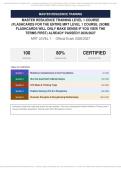
MASTER RESILIENCE TRAINING LEVEL 1 COURSE (FLASHCARDS FOR THE ENTIRE MRT LEVEL 1 COURSE. (SOME FLASHCARDS WILL ONLY MAKE SENSE IF YOU VIEW
THE TERMS FIRST) ALREADY PASSED!! 2026/2027 2026/2027 | Page 1 | Passing Score: 80%
MASTER RESILIENCE TRAINING
MASTER RESILIENCE TRAINING LEVEL 1 COURSE
(FLASHCARDS FOR THE ENTIRE MRT LEVEL 1 COURSE. (SOME
FLASHCARDS WILL ONLY MAKE SENSE IF YOU VIEW THE
TERMS FIRST) ALREADY PASSED!! 2026/2027
MRT LEVEL 1 · Official Exam 2026/2027
100 80% CERTIFIED
QUESTIONS PASSING SCORE RECERTIFICATION
TABLE OF CONTENTS
Section 1 Resilience Competencies & Core Foundations Q1-Q20
Section 2 Hunt the Good Stuff & Mental Games Q21-Q40
Section 3 ATC Model & Thinking Traps Q41-Q60
Section 4 Problem Solving & Put It In Perspective Q61-Q80
Section 5 Character Strengths & Strengthening Relationships Q81-Q100
Instructions: Select the single best answer for each question. This exam is designed for Master Resilience Training Level 1
Course certification preparation. Passing score: 80% (80 questions correct).
URSE (FLASHCARDS FOR THE ENTIRE MRT LEVEL 1 COURSE. (SOME FLASHCARDS WILL ONLY MAKE SENSE IF YOU VIEW THE TERMS FIRST) ALREADY PASSED!! 2026/2027 2026/20
, SECTION 1 | Resilience Competencies & Core Foundations | Q1-Q20 | MASTER RESILIENCE TRAINING LEVEL 1 COURSE (FLASHCARDS FOR THE
ENTIRE MRT LEVEL 1 COURSE. (SOME FLASHCARDS WILL ONLY MAKE SENSE IF YOU VIEW THE TERMS FIRST) ALREADY PASSED!! 2026/2027
2026/2027
Q1 Question 1 of 100
A 28-year-old sergeant returns from deployment and struggles with adjusting to garrison life.
During an MRT session, the instructor explains that resilience is not a fixed trait but a
combination of thoughts, behaviors, and actions that can be developed. This definition aligns
with which core MRT principle?
A. Resilience is a teachable set of competencies that can be strengthened through
deliberate practice
B. Resilience is an innate personality characteristic that some soldiers possess and others do not
C. Resilience is determined entirely by the severity of the stressor encountered
D. Resilience requires professional therapy and cannot be developed independently
Correct Answer: A
Rationale:
MRT teaches that resilience is a set of competencies that can be learned and strengthened through
practice, not an innate trait. The severity of the stressor influences the challenge but not the capacity for
resilience, and MRT specifically aims to build self-directed resilience skills.
Q2 Question 2 of 100
A 34-year-old staff sergeant is facilitating an MRT class and introduces the concept of the
resilience competency model. The model identifies several core competencies. Which
competency involves accurately identifying emotions in oneself and others?
A. Self-awareness, which includes recognizing one's own emotions, thoughts, and
behaviors and their impact on performance
B. Self-regulation, which involves controlling impulses and managing emotional responses
C. Optimism, which focuses on expecting positive outcomes regardless of circumstances
D. Mental agility, which involves considering multiple perspectives and adapting thinking
Correct Answer: A
Rationale:
Self-awareness is the competency that involves accurately identifying emotions in oneself and others and
understanding how they affect thoughts and behaviors. Self-regulation manages rather than identifies
emotions, optimism is about expectations, and mental agility is about flexible thinking.
URSE (FLASHCARDS FOR THE ENTIRE MRT LEVEL 1 COURSE. (SOME FLASHCARDS WILL ONLY MAKE SENSE IF YOU VIEW THE TERMS FIRST) ALREADY PASSED!! 2026/2027 2026/20
, Q3 Question 3 of 100
A 22-year-old private is attending the MRT Level 1 course and asks why the Army invested in
a resilience training program. The instructor explains that the program was developed in
response to which finding?
A. Psychological fitness, like physical fitness, can be trained proactively to enhance
readiness and reduce psychological health problems
B. Soldiers are inherently psychologically fragile and require constant professional mental health
oversight
C. Resilience training completely eliminates the need for any behavioral health services
D. Only soldiers with diagnosed mental health conditions benefit from resilience skills training
Correct Answer: A
Rationale:
The Army developed CSF/MRT based on the principle that psychological fitness, like physical fitness, can
be proactively trained to enhance readiness. MRT does not replace mental health services, it is not based
on inherent fragility, and it benefits all soldiers, not just those with diagnoses.
Q4 Question 4 of 100
A 31-year-old lieutenant is learning about the seven MRT competencies during the Level 1
course. The instructor explains that one competency involves effectively managing energy
and emotions to pursue goals. Which competency is being described?
A. Self-regulation, which involves managing impulses, emotions, and energy levels to
achieve desired outcomes
B. Connection, which involves building strong interpersonal relationships and social networks
C. Character strength, which involves identifying and leveraging one's top qualities
D. Mental agility, which involves considering multiple perspectives when interpreting events
Correct Answer: A
Rationale:
Self-regulation is the competency of managing impulses, emotions, and energy to pursue goals effectively.
Connection is about relationships, character strength is about leveraging personal qualities, and mental
agility is about flexible thinking.
URSE (FLASHCARDS FOR THE ENTIRE MRT LEVEL 1 COURSE. (SOME FLASHCARDS WILL ONLY MAKE SENSE IF YOU VIEW THE TERMS FIRST) ALREADY PASSED!! 2026/2027 2026/20
, Q5 Question 5 of 100
A 26-year-old specialist is practicing the skill of mental agility during an MRT workshop. The
instructor explains that mental agility involves which capability?
A. The ability to consider multiple perspectives, adapt thinking to different situations, and
avoid rigid thought patterns
B. The ability to solve mathematical problems quickly under pressure
C. The ability to maintain unwavering confidence in one's initial interpretation of events
D. The ability to suppress emotional responses during stressful situations
Correct Answer: A
Rationale:
Mental agility involves considering multiple perspectives and adapting thinking rather than being locked
into one interpretation. It is not about mathematical speed, unwavering confidence in initial interpretations
is the opposite of agility, and emotional suppression is self-regulation, not mental agility.
Q6 Question 6 of 100
A 40-year-old first sergeant attending MRT training asks the instructor to explain the
difference between optimism and realistic optimism as taught in the course. The instructor
clarifies that realistic optimism differs from blind optimism in which way?
A. Realistic optimism involves expecting positive outcomes while acknowledging current
challenges and actively working toward solutions, whereas blind optimism ignores reality
B. Realistic optimism means expecting the worst but hoping for the best in every situation
C. Realistic optimism and blind optimism are identical concepts used interchangeably in MRT
D. Realistic optimism applies only to professional settings, not personal life
Correct Answer: A
Rationale:
Realistic optimism expects positive outcomes while acknowledging challenges and taking action, unlike
blind optimism which ignores reality. Expecting the worst is pessimism, the two concepts are distinct in
MRT, and realistic optimism applies to all life domains.
URSE (FLASHCARDS FOR THE ENTIRE MRT LEVEL 1 COURSE. (SOME FLASHCARDS WILL ONLY MAKE SENSE IF YOU VIEW THE TERMS FIRST) ALREADY PASSED!! 2026/2027 2026/20
THE TERMS FIRST) ALREADY PASSED!! 2026/2027 2026/2027 | Page 1 | Passing Score: 80%
MASTER RESILIENCE TRAINING
MASTER RESILIENCE TRAINING LEVEL 1 COURSE
(FLASHCARDS FOR THE ENTIRE MRT LEVEL 1 COURSE. (SOME
FLASHCARDS WILL ONLY MAKE SENSE IF YOU VIEW THE
TERMS FIRST) ALREADY PASSED!! 2026/2027
MRT LEVEL 1 · Official Exam 2026/2027
100 80% CERTIFIED
QUESTIONS PASSING SCORE RECERTIFICATION
TABLE OF CONTENTS
Section 1 Resilience Competencies & Core Foundations Q1-Q20
Section 2 Hunt the Good Stuff & Mental Games Q21-Q40
Section 3 ATC Model & Thinking Traps Q41-Q60
Section 4 Problem Solving & Put It In Perspective Q61-Q80
Section 5 Character Strengths & Strengthening Relationships Q81-Q100
Instructions: Select the single best answer for each question. This exam is designed for Master Resilience Training Level 1
Course certification preparation. Passing score: 80% (80 questions correct).
URSE (FLASHCARDS FOR THE ENTIRE MRT LEVEL 1 COURSE. (SOME FLASHCARDS WILL ONLY MAKE SENSE IF YOU VIEW THE TERMS FIRST) ALREADY PASSED!! 2026/2027 2026/20
, SECTION 1 | Resilience Competencies & Core Foundations | Q1-Q20 | MASTER RESILIENCE TRAINING LEVEL 1 COURSE (FLASHCARDS FOR THE
ENTIRE MRT LEVEL 1 COURSE. (SOME FLASHCARDS WILL ONLY MAKE SENSE IF YOU VIEW THE TERMS FIRST) ALREADY PASSED!! 2026/2027
2026/2027
Q1 Question 1 of 100
A 28-year-old sergeant returns from deployment and struggles with adjusting to garrison life.
During an MRT session, the instructor explains that resilience is not a fixed trait but a
combination of thoughts, behaviors, and actions that can be developed. This definition aligns
with which core MRT principle?
A. Resilience is a teachable set of competencies that can be strengthened through
deliberate practice
B. Resilience is an innate personality characteristic that some soldiers possess and others do not
C. Resilience is determined entirely by the severity of the stressor encountered
D. Resilience requires professional therapy and cannot be developed independently
Correct Answer: A
Rationale:
MRT teaches that resilience is a set of competencies that can be learned and strengthened through
practice, not an innate trait. The severity of the stressor influences the challenge but not the capacity for
resilience, and MRT specifically aims to build self-directed resilience skills.
Q2 Question 2 of 100
A 34-year-old staff sergeant is facilitating an MRT class and introduces the concept of the
resilience competency model. The model identifies several core competencies. Which
competency involves accurately identifying emotions in oneself and others?
A. Self-awareness, which includes recognizing one's own emotions, thoughts, and
behaviors and their impact on performance
B. Self-regulation, which involves controlling impulses and managing emotional responses
C. Optimism, which focuses on expecting positive outcomes regardless of circumstances
D. Mental agility, which involves considering multiple perspectives and adapting thinking
Correct Answer: A
Rationale:
Self-awareness is the competency that involves accurately identifying emotions in oneself and others and
understanding how they affect thoughts and behaviors. Self-regulation manages rather than identifies
emotions, optimism is about expectations, and mental agility is about flexible thinking.
URSE (FLASHCARDS FOR THE ENTIRE MRT LEVEL 1 COURSE. (SOME FLASHCARDS WILL ONLY MAKE SENSE IF YOU VIEW THE TERMS FIRST) ALREADY PASSED!! 2026/2027 2026/20
, Q3 Question 3 of 100
A 22-year-old private is attending the MRT Level 1 course and asks why the Army invested in
a resilience training program. The instructor explains that the program was developed in
response to which finding?
A. Psychological fitness, like physical fitness, can be trained proactively to enhance
readiness and reduce psychological health problems
B. Soldiers are inherently psychologically fragile and require constant professional mental health
oversight
C. Resilience training completely eliminates the need for any behavioral health services
D. Only soldiers with diagnosed mental health conditions benefit from resilience skills training
Correct Answer: A
Rationale:
The Army developed CSF/MRT based on the principle that psychological fitness, like physical fitness, can
be proactively trained to enhance readiness. MRT does not replace mental health services, it is not based
on inherent fragility, and it benefits all soldiers, not just those with diagnoses.
Q4 Question 4 of 100
A 31-year-old lieutenant is learning about the seven MRT competencies during the Level 1
course. The instructor explains that one competency involves effectively managing energy
and emotions to pursue goals. Which competency is being described?
A. Self-regulation, which involves managing impulses, emotions, and energy levels to
achieve desired outcomes
B. Connection, which involves building strong interpersonal relationships and social networks
C. Character strength, which involves identifying and leveraging one's top qualities
D. Mental agility, which involves considering multiple perspectives when interpreting events
Correct Answer: A
Rationale:
Self-regulation is the competency of managing impulses, emotions, and energy to pursue goals effectively.
Connection is about relationships, character strength is about leveraging personal qualities, and mental
agility is about flexible thinking.
URSE (FLASHCARDS FOR THE ENTIRE MRT LEVEL 1 COURSE. (SOME FLASHCARDS WILL ONLY MAKE SENSE IF YOU VIEW THE TERMS FIRST) ALREADY PASSED!! 2026/2027 2026/20
, Q5 Question 5 of 100
A 26-year-old specialist is practicing the skill of mental agility during an MRT workshop. The
instructor explains that mental agility involves which capability?
A. The ability to consider multiple perspectives, adapt thinking to different situations, and
avoid rigid thought patterns
B. The ability to solve mathematical problems quickly under pressure
C. The ability to maintain unwavering confidence in one's initial interpretation of events
D. The ability to suppress emotional responses during stressful situations
Correct Answer: A
Rationale:
Mental agility involves considering multiple perspectives and adapting thinking rather than being locked
into one interpretation. It is not about mathematical speed, unwavering confidence in initial interpretations
is the opposite of agility, and emotional suppression is self-regulation, not mental agility.
Q6 Question 6 of 100
A 40-year-old first sergeant attending MRT training asks the instructor to explain the
difference between optimism and realistic optimism as taught in the course. The instructor
clarifies that realistic optimism differs from blind optimism in which way?
A. Realistic optimism involves expecting positive outcomes while acknowledging current
challenges and actively working toward solutions, whereas blind optimism ignores reality
B. Realistic optimism means expecting the worst but hoping for the best in every situation
C. Realistic optimism and blind optimism are identical concepts used interchangeably in MRT
D. Realistic optimism applies only to professional settings, not personal life
Correct Answer: A
Rationale:
Realistic optimism expects positive outcomes while acknowledging challenges and taking action, unlike
blind optimism which ignores reality. Expecting the worst is pessimism, the two concepts are distinct in
MRT, and realistic optimism applies to all life domains.
URSE (FLASHCARDS FOR THE ENTIRE MRT LEVEL 1 COURSE. (SOME FLASHCARDS WILL ONLY MAKE SENSE IF YOU VIEW THE TERMS FIRST) ALREADY PASSED!! 2026/2027 2026/20


