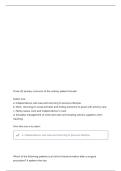
Three (3) primary concerns of the ostomy patient include:
Select one:
a. Independence, self-care and returning to previous lifestyle.
b. Work, returning to social activities and finding someone to assist with ostomy care.
c. Family issues, work and independence in care.
d. Sexuality, management of noise and odor and locating ostomy suppliers when
traveling.
Give this one a try later!
a. Independence, self-care and returning to previous lifestyle.
Which of the following patients is at risk for fistula formation after a surgical
procedure? A patient who has:
,Select one:
a. Experienced intraoperative hypothermia.
b. Had preoperative hyponatremia.
c. Undergone radiation therapy in the surgical area 20 years ago.
d. A preoperative serum prealbumin level of 18.0.
Give this one a try later!
c. Undergone radiation therapy in the surgical area 20 years ago.
The primary rationale for using a skin barrier paste is to:
Select one:
a. Fill or "caulk" irregular surfaces at the base of the stoma.
b. Increase the tack of the adhesive surface of the abdomen.
c. Protect the stoma from mechanical trauma.
d. Reduce the burning sensation associated with the use of skin barrier powders.
Give this one a try later!
a. Fill or "caulk" irregular surfaces at the base of the stoma.
Gary is experiencing a recurrence of his Crohn's Disease. Which of the following
symptoms is Gary most likely experiencing?
Select one:
a. Obstructive abdominal pain.
b. Absence of perianal disease.
c. Bloody stools with proctitis.
d. Vomiting.
Give this one a try later!
, a. Obstructive abdominal pain.
An incarcerated bowel is an emergent complication associated with:
Select one:
a. Mucocutaneous separation.
b. Stomal stenosis.
c. Parastomal hernia.
d. Peristomal pyoderma granulosum.
Give this one a try later!
c. Parastomal hernia.
Vinegar soaks to the stoma is an appropriate intervention to reduce or remove:
Select one:
a. Peyer's patches on the mucosa.
b. Urine odor.
c. Encrustations.
d. Caput Medusa.
Give this one a try later!
c. Encrustations.
When selecting a pouching system for a patient who has an enterocutaneous fistula,
the PRIMARY feature of the system that should guide your selection is:
, Select one:
a. A sizeable surface for cutting.
b. An opaque pouch film.
c. Built in convexity.
d. Anti-reflux valve.
Give this one a try later!
a. A sizeable surface for cutting.
When preparing a 35-year-old male for colon resection with a temporary ileostomy
due to refractory Crohn's disease, he asks about sexual function after surgery. You
explain that this procedure involves:
Select one:
a. Removal of the rectum only.
b. Moderate incidence of premature ejaculation.
c. Do not anticipate any sexual dysfunction.
d. High incidence of erectile dysfunction.
Give this one a try later!
c. Do not anticipate any sexual dysfunction.
A 60-year-old male is 6 weeks postop following a sigmoid colostomy for rectal
cancer. During a follow-up visit, he states that he has read about colostomy irrigation
and is eager to start. What should your NEXT step be?
Select one:
a. Ask the patient if chemotherapy or radiation therapy is planned.
b. Set up an appointment to begin teaching the irrigation technique as soon as
possible.
c. Instruct the patient to ask again at his 6 months postop visit.
d. Ask him if he prefers using a cone tip or a catheter for the procedure.
Select one:
a. Independence, self-care and returning to previous lifestyle.
b. Work, returning to social activities and finding someone to assist with ostomy care.
c. Family issues, work and independence in care.
d. Sexuality, management of noise and odor and locating ostomy suppliers when
traveling.
Give this one a try later!
a. Independence, self-care and returning to previous lifestyle.
Which of the following patients is at risk for fistula formation after a surgical
procedure? A patient who has:
,Select one:
a. Experienced intraoperative hypothermia.
b. Had preoperative hyponatremia.
c. Undergone radiation therapy in the surgical area 20 years ago.
d. A preoperative serum prealbumin level of 18.0.
Give this one a try later!
c. Undergone radiation therapy in the surgical area 20 years ago.
The primary rationale for using a skin barrier paste is to:
Select one:
a. Fill or "caulk" irregular surfaces at the base of the stoma.
b. Increase the tack of the adhesive surface of the abdomen.
c. Protect the stoma from mechanical trauma.
d. Reduce the burning sensation associated with the use of skin barrier powders.
Give this one a try later!
a. Fill or "caulk" irregular surfaces at the base of the stoma.
Gary is experiencing a recurrence of his Crohn's Disease. Which of the following
symptoms is Gary most likely experiencing?
Select one:
a. Obstructive abdominal pain.
b. Absence of perianal disease.
c. Bloody stools with proctitis.
d. Vomiting.
Give this one a try later!
, a. Obstructive abdominal pain.
An incarcerated bowel is an emergent complication associated with:
Select one:
a. Mucocutaneous separation.
b. Stomal stenosis.
c. Parastomal hernia.
d. Peristomal pyoderma granulosum.
Give this one a try later!
c. Parastomal hernia.
Vinegar soaks to the stoma is an appropriate intervention to reduce or remove:
Select one:
a. Peyer's patches on the mucosa.
b. Urine odor.
c. Encrustations.
d. Caput Medusa.
Give this one a try later!
c. Encrustations.
When selecting a pouching system for a patient who has an enterocutaneous fistula,
the PRIMARY feature of the system that should guide your selection is:
, Select one:
a. A sizeable surface for cutting.
b. An opaque pouch film.
c. Built in convexity.
d. Anti-reflux valve.
Give this one a try later!
a. A sizeable surface for cutting.
When preparing a 35-year-old male for colon resection with a temporary ileostomy
due to refractory Crohn's disease, he asks about sexual function after surgery. You
explain that this procedure involves:
Select one:
a. Removal of the rectum only.
b. Moderate incidence of premature ejaculation.
c. Do not anticipate any sexual dysfunction.
d. High incidence of erectile dysfunction.
Give this one a try later!
c. Do not anticipate any sexual dysfunction.
A 60-year-old male is 6 weeks postop following a sigmoid colostomy for rectal
cancer. During a follow-up visit, he states that he has read about colostomy irrigation
and is eager to start. What should your NEXT step be?
Select one:
a. Ask the patient if chemotherapy or radiation therapy is planned.
b. Set up an appointment to begin teaching the irrigation technique as soon as
possible.
c. Instruct the patient to ask again at his 6 months postop visit.
d. Ask him if he prefers using a cone tip or a catheter for the procedure.