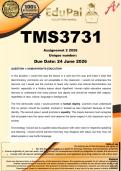
TMS3731
Assignemnt 2 2026
Unique number:
Due Date: 24 June 2026
QUESTION 1: HUMAN RIGHTS EDUCATION
In this situation, I would first stop the lesson in a calm but firm way and make it clear that
discriminatory comments are not acceptable in the classroom. I would not embarrass the
learners, but I would use the moment to teach why racism and cultural discrimination are
harmful, especially in a History lesson about Apartheid. Human rights education requires
learners to understand that every person has dignity and should be treated with respect,
regardless of race, culture, language or background.
The first democratic value I would promote is human dignity. Learners must understand
that no person should be insulted, mocked or treated as less important because of their
identity. The second value I would promote is equality. This means learners must recognise
that all people have the same worth and deserve the same respect in the classroom and in
society.
One strategy I would use is a guided class discussion with clear rules for respectful speaking
and listening. I would remind learners that they may disagree with ideas, but they may not
attack people or use hurtful language. Terms of use
By making use of this document you agree to:
Use this document as a guide for learning, comparison and reference purpose,
Terms of use
Not to duplicate, reproduce and/or misrepresent the contents of this document as your own work,
By making use of this document you agree to:
Use this document
Fully accept the consequences
solely as a guide forshould you plagiarise
learning, reference,or and
misuse this document.
comparison purposes,
Ensure originality of your own work, and fully accept the consequences should you plagiarise or misuse this document.
Comply with all relevant standards, guidelines, regulations, and legislation governing academic and written work.
Disclaimer
Great care has been taken in the preparation of this document; however, the contents are provided "as is" without any express or
implied representations or warranties. The author accepts no responsibility or liability for any actions taken based on the
information contained within this document. This document is intended solely for comparison, research, and reference purposes.
Reproduction, resale, or transmission of any part of this document, in any form or by any means, is strictly prohibited.
, +27 81 278 3372
QUESTION 1: HUMAN RIGHTS EDUCATION
In this situation, I would first stop the lesson in a calm but firm way and make it clear
that discriminatory comments are not acceptable in the classroom. I would not
embarrass the learners, but I would use the moment to teach why racism and
cultural discrimination are harmful, especially in a History lesson about Apartheid.
Human rights education requires learners to understand that every person has
dignity and should be treated with respect, regardless of race, culture, language or
background.
The first democratic value I would promote is human dignity. Learners must
understand that no person should be insulted, mocked or treated as less important
because of their identity. The second value I would promote is equality. This means
learners must recognise that all people have the same worth and deserve the same
respect in the classroom and in society.
One strategy I would use is a guided class discussion with clear rules for respectful
speaking and listening. I would remind learners that they may disagree with ideas,
but they may not attack people or use hurtful language.
For the classroom activity, I would divide learners into small mixed groups and give
each group a short Apartheid case study showing unfair treatment based on race or
culture. As the teacher, I would explain the task, set respectful discussion rules,
move between groups and guide learners who struggle to understand the issue. The
learners would read the case study, identify the human right that was violated,
discuss how the person might have felt, and suggest how people should treat one
another in a democratic South Africa.
This activity would help learners connect the History content to real human rights
values. It would also encourage them to think about their own words and actions, so
that the classroom becomes a safe and inclusive space for everyone.
QUESTION 2: UBUNTU AND INDIGENOUS KNOWLEDGE SYSTEMS
Ubuntu means that a person is connected to other people and should live with care,
respect and responsibility. In Geography, ubuntu can help learners understand that
Disclaimer
Great care has been taken in the preparation of this document; however, the contents are provided "as is"
without any express or implied representations or warranties. The author accepts no responsibility or
liability for any actions taken based on the information contained within this document. This document is
intended solely for comparison, research, and reference purposes. Reproduction, resale, or transmission
of any part of this document, in any form or by any means, is strictly prohibited.
Assignemnt 2 2026
Unique number:
Due Date: 24 June 2026
QUESTION 1: HUMAN RIGHTS EDUCATION
In this situation, I would first stop the lesson in a calm but firm way and make it clear that
discriminatory comments are not acceptable in the classroom. I would not embarrass the
learners, but I would use the moment to teach why racism and cultural discrimination are
harmful, especially in a History lesson about Apartheid. Human rights education requires
learners to understand that every person has dignity and should be treated with respect,
regardless of race, culture, language or background.
The first democratic value I would promote is human dignity. Learners must understand
that no person should be insulted, mocked or treated as less important because of their
identity. The second value I would promote is equality. This means learners must recognise
that all people have the same worth and deserve the same respect in the classroom and in
society.
One strategy I would use is a guided class discussion with clear rules for respectful speaking
and listening. I would remind learners that they may disagree with ideas, but they may not
attack people or use hurtful language. Terms of use
By making use of this document you agree to:
Use this document as a guide for learning, comparison and reference purpose,
Terms of use
Not to duplicate, reproduce and/or misrepresent the contents of this document as your own work,
By making use of this document you agree to:
Use this document
Fully accept the consequences
solely as a guide forshould you plagiarise
learning, reference,or and
misuse this document.
comparison purposes,
Ensure originality of your own work, and fully accept the consequences should you plagiarise or misuse this document.
Comply with all relevant standards, guidelines, regulations, and legislation governing academic and written work.
Disclaimer
Great care has been taken in the preparation of this document; however, the contents are provided "as is" without any express or
implied representations or warranties. The author accepts no responsibility or liability for any actions taken based on the
information contained within this document. This document is intended solely for comparison, research, and reference purposes.
Reproduction, resale, or transmission of any part of this document, in any form or by any means, is strictly prohibited.
, +27 81 278 3372
QUESTION 1: HUMAN RIGHTS EDUCATION
In this situation, I would first stop the lesson in a calm but firm way and make it clear
that discriminatory comments are not acceptable in the classroom. I would not
embarrass the learners, but I would use the moment to teach why racism and
cultural discrimination are harmful, especially in a History lesson about Apartheid.
Human rights education requires learners to understand that every person has
dignity and should be treated with respect, regardless of race, culture, language or
background.
The first democratic value I would promote is human dignity. Learners must
understand that no person should be insulted, mocked or treated as less important
because of their identity. The second value I would promote is equality. This means
learners must recognise that all people have the same worth and deserve the same
respect in the classroom and in society.
One strategy I would use is a guided class discussion with clear rules for respectful
speaking and listening. I would remind learners that they may disagree with ideas,
but they may not attack people or use hurtful language.
For the classroom activity, I would divide learners into small mixed groups and give
each group a short Apartheid case study showing unfair treatment based on race or
culture. As the teacher, I would explain the task, set respectful discussion rules,
move between groups and guide learners who struggle to understand the issue. The
learners would read the case study, identify the human right that was violated,
discuss how the person might have felt, and suggest how people should treat one
another in a democratic South Africa.
This activity would help learners connect the History content to real human rights
values. It would also encourage them to think about their own words and actions, so
that the classroom becomes a safe and inclusive space for everyone.
QUESTION 2: UBUNTU AND INDIGENOUS KNOWLEDGE SYSTEMS
Ubuntu means that a person is connected to other people and should live with care,
respect and responsibility. In Geography, ubuntu can help learners understand that
Disclaimer
Great care has been taken in the preparation of this document; however, the contents are provided "as is"
without any express or implied representations or warranties. The author accepts no responsibility or
liability for any actions taken based on the information contained within this document. This document is
intended solely for comparison, research, and reference purposes. Reproduction, resale, or transmission
of any part of this document, in any form or by any means, is strictly prohibited.