

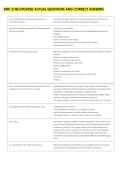
SWK 3140 UPDATED ACTUAL QUESTIONS AND CORRECT ANSWERS
Why is it important for social workers to know how to They help draw people together by creating effecting teamwork in which ideas
Facilitate task groups: are shared, feelings are expressed, and support is developed.
Task the social worker is responsible at the beginning of a ® Introducing new members
task group meeting: ® Distributing handouts not included with the material distributed before the
meeting
® Manageable agenda
® Set tone and pace of the meeting
® A brief opening statement about the purpose of the meeting
® Model expected behavior
Framework for a meeting agenda outline: ® Examine and approve (with any corrections) brief, relevant minutes from the last
meeting
® Make information announcements
® Vote to include special agenda items
® Work on less controversial, easier items
® Work on difficult items
® Break
® Work on "for discussion only" items
® Consider any special agenda items if there is sufficient time
® Summarize
® Adjourn
How to make task groups members feel involved and that -Emphasizing the importance of the group's work purpose, and administrative
their input is important for team's purpose: structure by stating the purpose of the group and explain how the group fits into
the agency's administrative and decisions-making structure.
-Assign members specific roles in the group by clarifying responsibilities, duties,
authority, and power that result from members in the group.
-Encourage members to participate in the decision-making process of the group.
Encouraging creative solutions during group work: -Indicate that input is welcome.
-Provide feedback (sometimes can be negative or positive)
-point out group pressures that inhibit member's free discussion.
-encourage members to continue sharing unique ideas and praising
Group think: The tendency of group members to conform, resulting in a narrow view of some
issues. We can use this phenomenon to examine the coercive power and the
malevolent authority of cults, gangs, terrorists, and fundamentalist groups
because of the way they operate. Norms and a group climate that encourages
free and open discussion of ideas tend to discourage conformity to very
conservative or radical ideas. Group mind and risky shift are very similar to group
think.
Goal achievement in the middle stage of group: Follow the developed set of standards, rules, or guidelines that can be used to
monitor and evaluate the performance of the group or members.
, Model for effective problem solving 1. Identifying a problem
2. Developing goals
3. Collecting data
4. Developing plans
5. Selecting the best plan
6. Implementing the plan
Brainstorming: Generating the highest number of creative ideas to determine a problem or a
solution to the problem and its aspects. Procedures: Freewheeling, no criticism,
quantity is encouraged, combining, rearranging and improving ideas(Hitchhiking)
Reverse brainstorming Reverse brainstorming is useful after a variety of ideas have been generated, and
members narrow the ideas to a few top choices. Members then brainstorm about
the consequences of carrying out each alternative. After the consequences have
been identified, the worker can lead members in a discussion about ways to
overcome the consequences.
Nominal Group Technique (NGT) an idea-generating process in which group members generate their initial ideas
silently and independently and then combine them and consider them as a group.
Takes a long time to arrive to a decision. This is not recommended for building
consensus. It is suspicious because members may feel that is manipulated bc of
the involvement of the worker.
MAU MAU is effective for helping groups make sound, rational decisions, especially
when important policy decisions are being made or when decision-making
processes may be scrutinized. MAU is primarily used as a decision-making
method for choosing among distinct alternatives or for ranking numerous cases
by priority.
Why is it important for social workers to know how to They help draw people together by creating effecting teamwork in which ideas
Facilitate task groups: are shared, feelings are expressed, and support is developed.
Task the social worker is responsible at the beginning of a ® Introducing new members
task group meeting: ® Distributing handouts not included with the material distributed before the
meeting
® Manageable agenda
® Set tone and pace of the meeting
® A brief opening statement about the purpose of the meeting
® Model expected behavior
Framework for a meeting agenda outline: ® Examine and approve (with any corrections) brief, relevant minutes from the last
meeting
® Make information announcements
® Vote to include special agenda items
® Work on less controversial, easier items
® Work on difficult items
® Break
® Work on "for discussion only" items
® Consider any special agenda items if there is sufficient time
® Summarize
® Adjourn
How to make task groups members feel involved and that -Emphasizing the importance of the group's work purpose, and administrative
their input is important for team's purpose: structure by stating the purpose of the group and explain how the group fits into
the agency's administrative and decisions-making structure.
-Assign members specific roles in the group by clarifying responsibilities, duties,
authority, and power that result from members in the group.
-Encourage members to participate in the decision-making process of the group.
Encouraging creative solutions during group work: -Indicate that input is welcome.
-Provide feedback (sometimes can be negative or positive)
-point out group pressures that inhibit member's free discussion.
-encourage members to continue sharing unique ideas and praising
Group think: The tendency of group members to conform, resulting in a narrow view of some
issues. We can use this phenomenon to examine the coercive power and the
malevolent authority of cults, gangs, terrorists, and fundamentalist groups
because of the way they operate. Norms and a group climate that encourages
free and open discussion of ideas tend to discourage conformity to very
conservative or radical ideas. Group mind and risky shift are very similar to group
think.
Goal achievement in the middle stage of group: Follow the developed set of standards, rules, or guidelines that can be used to
monitor and evaluate the performance of the group or members.
, Model for effective problem solving 1. Identifying a problem
2. Developing goals
3. Collecting data
4. Developing plans
5. Selecting the best plan
6. Implementing the plan
Brainstorming: Generating the highest number of creative ideas to determine a problem or a
solution to the problem and its aspects. Procedures: Freewheeling, no criticism,
quantity is encouraged, combining, rearranging and improving ideas(Hitchhiking)
Reverse brainstorming Reverse brainstorming is useful after a variety of ideas have been generated, and
members narrow the ideas to a few top choices. Members then brainstorm about
the consequences of carrying out each alternative. After the consequences have
been identified, the worker can lead members in a discussion about ways to
overcome the consequences.
Nominal Group Technique (NGT) an idea-generating process in which group members generate their initial ideas
silently and independently and then combine them and consider them as a group.
Takes a long time to arrive to a decision. This is not recommended for building
consensus. It is suspicious because members may feel that is manipulated bc of
the involvement of the worker.
MAU MAU is effective for helping groups make sound, rational decisions, especially
when important policy decisions are being made or when decision-making
processes may be scrutinized. MAU is primarily used as a decision-making
method for choosing among distinct alternatives or for ranking numerous cases
by priority.


