

[PAGE 1]
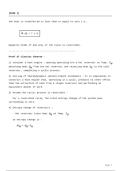
the heat is transferred is less than or equal to zero i.e.,
⛿ dQ / T ≤ 0
Equality holds if and only if the cycle is reversible.
--------------------------------------------------
Proof of clausius theorem →
1) consider a heat engine : opening operating b/w a hot reservoir at Temp. TH,
absorbing heat QH from the hot reservoir and rejecting heat QC to the cold
reservoir, completing a cyclic process.
2) 2nd Law of Thermodynamics (Kelvin-Planck statement) : It is impossible to
construct a heat engine that, operating in a cycle, produces no other effect
than the extraction of heat from a single reservoir and performing an
equivalent amount of work.
3) Assume the cyclic process is reversible :
For a reversible cycle, the total entropy change of the system plus
surrounding is zero.
4) Entropy change of reservoirs :
- Hot reservoir loses heat QH at Temp. TH
so entropy change is :
ΔSH = - QH / TH
Page 1
, [PAGE 2]
i.e. ηR > ηI or ηI ≤ ηR ———— ①
Also, we know that ————
efficiency of heat engine, η = (heat Supplied - heat rejected) / heat Supplied
η = (Q1 - Q2) / Q1
For small amount of heat, η = (dQ1 - dQ2) / dQ1 = 1 - dQ2 / dQ1
From eqn ① —
[ 1 - dQ2 / dQ1 ]I < [ 1 - dQ2 / dQ1 ]R ———— ②
From thermodynamic scale of Temp., for reversible engine,
Q1 / Q2 = T1 / T2 , Q2 / Q1 = T2 / T1
∴ Equation ② becomes,
1 - (dQ2 / dQ1)I < 1 - (T2 / T1)
(dQ2 / dQ1)I > T2 / T1
(dQ1 / T1)I - (dQ2 / T2)I < 0
∴ , ( dQ1 / T1 )I + ( - dQ2 / T2 )I < 0
⛿ dQ / T < 0
Page 2
the heat is transferred is less than or equal to zero i.e.,
⛿ dQ / T ≤ 0
Equality holds if and only if the cycle is reversible.
--------------------------------------------------
Proof of clausius theorem →
1) consider a heat engine : opening operating b/w a hot reservoir at Temp. TH,
absorbing heat QH from the hot reservoir and rejecting heat QC to the cold
reservoir, completing a cyclic process.
2) 2nd Law of Thermodynamics (Kelvin-Planck statement) : It is impossible to
construct a heat engine that, operating in a cycle, produces no other effect
than the extraction of heat from a single reservoir and performing an
equivalent amount of work.
3) Assume the cyclic process is reversible :
For a reversible cycle, the total entropy change of the system plus
surrounding is zero.
4) Entropy change of reservoirs :
- Hot reservoir loses heat QH at Temp. TH
so entropy change is :
ΔSH = - QH / TH
Page 1
, [PAGE 2]
i.e. ηR > ηI or ηI ≤ ηR ———— ①
Also, we know that ————
efficiency of heat engine, η = (heat Supplied - heat rejected) / heat Supplied
η = (Q1 - Q2) / Q1
For small amount of heat, η = (dQ1 - dQ2) / dQ1 = 1 - dQ2 / dQ1
From eqn ① —
[ 1 - dQ2 / dQ1 ]I < [ 1 - dQ2 / dQ1 ]R ———— ②
From thermodynamic scale of Temp., for reversible engine,
Q1 / Q2 = T1 / T2 , Q2 / Q1 = T2 / T1
∴ Equation ② becomes,
1 - (dQ2 / dQ1)I < 1 - (T2 / T1)
(dQ2 / dQ1)I > T2 / T1
(dQ1 / T1)I - (dQ2 / T2)I < 0
∴ , ( dQ1 / T1 )I + ( - dQ2 / T2 )I < 0
⛿ dQ / T < 0
Page 2


