

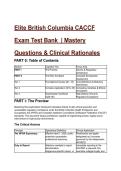
Elite British Columbia CACCF
Exam Test Bank | Mastery
Questions & Clinical Rationales
PART 0: Table of Contents
Section Cognitive Tier Focus Area
PART I The Preview Axioms & Regulatory
Architecture
PART II The Elite Test Bank Complete 60-Question
Assessment
Tier 1 Foundational Syntax (Q1–15) Core Definitions & Statutory
Hard-Decks
Tier 2 Complex Application (Q16–35) Competing Variables & Ethical
Simulations
Tier 3 Grandmaster Synthesis High-Stakes Clinical &
(Q36–60) Regulatory Escalations
PART I: The Preview
Mastering this examination framework translates directly to elite clinical execution and
unassailable regulatory compliance under the British Columbia Health Professions and
Occupations Act (HPOA) and Canadian Addiction Counsellors Certification Federation (CACCF)
standards. This document forges practitioners capable of engineering precise, legally sound
interventions in high-acuity environments.
The Critical Axioms
Principle Operational Definition Clinical Application
The HPOA Supremacy Effective April 1, 2026, publicPractitioners are legally
protection supersedes designated as Licensees
professional autonomy. governed by the independent
HPOROO.
Duty to Report Statutory mandate to report Immediate reporting to the
discrimination, CHCPBC is required; this
Indigenous-specific racism, or overrides collegial loyalty and
,Principle Operational Definition Clinical Application
sexual misconduct. confidentiality.
The Sequence of 12 The Twelve Core Functions
dictate a rigid operational
sequence.
Identity Protection The HPOA mandates Complainants alleging harm by
trauma-informed Support a Licensee are entitled to
Programs for complainants. support workers and IPOs
(Identity Protection Orders).
PART II: THE ELITE TEST BANK
Tier 1: Foundational Syntax & Application
Q1: A new patient presents to an outpatient clinic. The clinician evaluates the psychological and
physiological signs of substance use to determine if the patient meets the specific demographic
and funding parameters of the facility. Based on the Twelve Core Functions, which phase of
care is MOST ACCURATE for this action? A) Client Intake B) Client Assessment C) Client
Screening D) Treatment Planning
● The Answer: C (Client Screening)
● Distractor Analysis:
○ A is incorrect: Client Intake is the administrative process of completing admission
documentation and assigning a primary counselor , not the clinical evaluation of
eligibility.
○ B is incorrect: Client Assessment is a comprehensive diagnostic evaluation
identifying co-occurring conditions, occurring only after eligibility is established. * D
is incorrect: Treatment Planning relies on verified data gathered during assessment
to formulate goals; it is premature here.
The Mentor's Analysis: The immediate priority before initiating care is establishing whether the
client belongs in the specific program based on legal and clinical parameters. By utilizing Client
Screening, you bypass the common trap of investing clinical resources into a patient requiring a
different level of care. Professional/Academic Intuition: Never assess before screening;
eligibility dictates the initiation of care.
Q2: Under the structural changes introduced by the HPOA on April 1, 2026, which entity is
strictly responsible for conducting disciplinary hearings against a Licensee accused of
professional misconduct? A) The CHCPBC Board of Directors B) The Health Professions
Discipline Tribunal C) The CACCF Ethics Committee D) The clinical supervisor of the employing
agency
● The Answer: B (The Health Professions Discipline Tribunal)
● Distractor Analysis:
○ A is incorrect: Under the HPOA, college boards no longer conduct discipline
hearings, ensuring absolute separation of investigation and adjudication.
○ C is incorrect: The CACCF manages professional certification , but statutory
licensure discipline in BC is handled by the provincial regulatory apparatus.
○ D is incorrect: Employers handle internal human resources discipline, but formal
regulatory adjudication is the exclusive domain of the Tribunal.
The Mentor's Analysis: To eliminate bias, the HPOA separates the investigation of a complaint
from the judgment of the complaint. By utilizing the independent Health Professions Discipline
, Tribunal, the regulatory system bypasses the trap of institutional self-protection.
Professional/Academic Intuition: The College investigates; the independent Tribunal
adjudicates.
Q3: A client has been deemed eligible for a residential rehabilitation program. The clinician
provides the client with a detailed overview of the program's goals, rules of conduct, and the
specific infractions that could lead to disciplinary discharge. Which core function is being
satisfied? A) Client Intake B) Client Education C) Client Orientation D) Case Management
● The Answer: C (Client Orientation)
● Distractor Analysis:
○ A is incorrect: Client Intake involves signing forms and establishing the
administrative file , not explaining operational rules.
○ B is incorrect: Client Education involves providing psychoeducation regarding the
physiological effects of substances and available resources.
○ D is incorrect: Case Management involves linking the client to external services and
managing the continuum of care.
The Mentor's Analysis: A client cannot adhere to a therapeutic container they do not
understand. By utilizing Client Orientation, the practitioner bypasses the trap of discharging
clients for violating rules they were never explicitly taught. Professional/Academic Intuition:
Orientation establishes the boundaries of the facility; Education establishes the boundaries of
the disease.
Q4: Following admission, a practitioner works with a client to formulate agreed-upon immediate
and long-term goals utilizing behavioral terms. The practitioner identifies specific
evidence-based interventions tailored to the client's identified problems. Which of the Twelve
Core Functions is FIRST being executed? A) Client Assessment B) Treatment Planning C) Case
Management D) Counselling
● The Answer: B (Treatment Planning)
● Distractor Analysis:
○ A is incorrect: Client Assessment identifies and ranks the problems ; it does not set
the behavioral goals or interventions.
○ C is incorrect: Case Management coordinates services and resources across
different agencies.
○ D is incorrect: Counselling is the actual application of therapeutic techniques to
achieve the goals established during the planning phase.
The Mentor's Analysis: Transitioning from pathology identification to actionable clinical
mapping requires structured objective-setting. By utilizing Treatment Planning, the practitioner
bypasses the trap of aimless, unstructured therapeutic intervention. Professional/Academic
Intuition: Assessment identifies the target; Treatment Planning loads the weapon; Counselling
pulls the trigger.
Q5: Under the 2026 Health Professions and Occupations Act (HPOA), a Licensee observes a
colleague (also a Licensee) repeatedly denying care to patients based on their Indigenous
ancestry. What is the IMMEDIATE statutory obligation of the observing practitioner? A)
Document the behavior and report it to the agency clinical supervisor within 30 days. B) Initiate
a peer-to-peer consultation with the colleague to address cultural competence. C) Submit a
formal regulatory report directly to the College of Health and Care Professionals of BC
(CHCPBC). D) Refer the affected patients to an alternate culturally safe provider while
maintaining collegial confidentiality.
● The Answer: C (Submit a formal regulatory report directly to the College of Health and
Care Professionals of BC (CHCPBC).)
Exam Test Bank | Mastery
Questions & Clinical Rationales
PART 0: Table of Contents
Section Cognitive Tier Focus Area
PART I The Preview Axioms & Regulatory
Architecture
PART II The Elite Test Bank Complete 60-Question
Assessment
Tier 1 Foundational Syntax (Q1–15) Core Definitions & Statutory
Hard-Decks
Tier 2 Complex Application (Q16–35) Competing Variables & Ethical
Simulations
Tier 3 Grandmaster Synthesis High-Stakes Clinical &
(Q36–60) Regulatory Escalations
PART I: The Preview
Mastering this examination framework translates directly to elite clinical execution and
unassailable regulatory compliance under the British Columbia Health Professions and
Occupations Act (HPOA) and Canadian Addiction Counsellors Certification Federation (CACCF)
standards. This document forges practitioners capable of engineering precise, legally sound
interventions in high-acuity environments.
The Critical Axioms
Principle Operational Definition Clinical Application
The HPOA Supremacy Effective April 1, 2026, publicPractitioners are legally
protection supersedes designated as Licensees
professional autonomy. governed by the independent
HPOROO.
Duty to Report Statutory mandate to report Immediate reporting to the
discrimination, CHCPBC is required; this
Indigenous-specific racism, or overrides collegial loyalty and
,Principle Operational Definition Clinical Application
sexual misconduct. confidentiality.
The Sequence of 12 The Twelve Core Functions
dictate a rigid operational
sequence.
Identity Protection The HPOA mandates Complainants alleging harm by
trauma-informed Support a Licensee are entitled to
Programs for complainants. support workers and IPOs
(Identity Protection Orders).
PART II: THE ELITE TEST BANK
Tier 1: Foundational Syntax & Application
Q1: A new patient presents to an outpatient clinic. The clinician evaluates the psychological and
physiological signs of substance use to determine if the patient meets the specific demographic
and funding parameters of the facility. Based on the Twelve Core Functions, which phase of
care is MOST ACCURATE for this action? A) Client Intake B) Client Assessment C) Client
Screening D) Treatment Planning
● The Answer: C (Client Screening)
● Distractor Analysis:
○ A is incorrect: Client Intake is the administrative process of completing admission
documentation and assigning a primary counselor , not the clinical evaluation of
eligibility.
○ B is incorrect: Client Assessment is a comprehensive diagnostic evaluation
identifying co-occurring conditions, occurring only after eligibility is established. * D
is incorrect: Treatment Planning relies on verified data gathered during assessment
to formulate goals; it is premature here.
The Mentor's Analysis: The immediate priority before initiating care is establishing whether the
client belongs in the specific program based on legal and clinical parameters. By utilizing Client
Screening, you bypass the common trap of investing clinical resources into a patient requiring a
different level of care. Professional/Academic Intuition: Never assess before screening;
eligibility dictates the initiation of care.
Q2: Under the structural changes introduced by the HPOA on April 1, 2026, which entity is
strictly responsible for conducting disciplinary hearings against a Licensee accused of
professional misconduct? A) The CHCPBC Board of Directors B) The Health Professions
Discipline Tribunal C) The CACCF Ethics Committee D) The clinical supervisor of the employing
agency
● The Answer: B (The Health Professions Discipline Tribunal)
● Distractor Analysis:
○ A is incorrect: Under the HPOA, college boards no longer conduct discipline
hearings, ensuring absolute separation of investigation and adjudication.
○ C is incorrect: The CACCF manages professional certification , but statutory
licensure discipline in BC is handled by the provincial regulatory apparatus.
○ D is incorrect: Employers handle internal human resources discipline, but formal
regulatory adjudication is the exclusive domain of the Tribunal.
The Mentor's Analysis: To eliminate bias, the HPOA separates the investigation of a complaint
from the judgment of the complaint. By utilizing the independent Health Professions Discipline
, Tribunal, the regulatory system bypasses the trap of institutional self-protection.
Professional/Academic Intuition: The College investigates; the independent Tribunal
adjudicates.
Q3: A client has been deemed eligible for a residential rehabilitation program. The clinician
provides the client with a detailed overview of the program's goals, rules of conduct, and the
specific infractions that could lead to disciplinary discharge. Which core function is being
satisfied? A) Client Intake B) Client Education C) Client Orientation D) Case Management
● The Answer: C (Client Orientation)
● Distractor Analysis:
○ A is incorrect: Client Intake involves signing forms and establishing the
administrative file , not explaining operational rules.
○ B is incorrect: Client Education involves providing psychoeducation regarding the
physiological effects of substances and available resources.
○ D is incorrect: Case Management involves linking the client to external services and
managing the continuum of care.
The Mentor's Analysis: A client cannot adhere to a therapeutic container they do not
understand. By utilizing Client Orientation, the practitioner bypasses the trap of discharging
clients for violating rules they were never explicitly taught. Professional/Academic Intuition:
Orientation establishes the boundaries of the facility; Education establishes the boundaries of
the disease.
Q4: Following admission, a practitioner works with a client to formulate agreed-upon immediate
and long-term goals utilizing behavioral terms. The practitioner identifies specific
evidence-based interventions tailored to the client's identified problems. Which of the Twelve
Core Functions is FIRST being executed? A) Client Assessment B) Treatment Planning C) Case
Management D) Counselling
● The Answer: B (Treatment Planning)
● Distractor Analysis:
○ A is incorrect: Client Assessment identifies and ranks the problems ; it does not set
the behavioral goals or interventions.
○ C is incorrect: Case Management coordinates services and resources across
different agencies.
○ D is incorrect: Counselling is the actual application of therapeutic techniques to
achieve the goals established during the planning phase.
The Mentor's Analysis: Transitioning from pathology identification to actionable clinical
mapping requires structured objective-setting. By utilizing Treatment Planning, the practitioner
bypasses the trap of aimless, unstructured therapeutic intervention. Professional/Academic
Intuition: Assessment identifies the target; Treatment Planning loads the weapon; Counselling
pulls the trigger.
Q5: Under the 2026 Health Professions and Occupations Act (HPOA), a Licensee observes a
colleague (also a Licensee) repeatedly denying care to patients based on their Indigenous
ancestry. What is the IMMEDIATE statutory obligation of the observing practitioner? A)
Document the behavior and report it to the agency clinical supervisor within 30 days. B) Initiate
a peer-to-peer consultation with the colleague to address cultural competence. C) Submit a
formal regulatory report directly to the College of Health and Care Professionals of BC
(CHCPBC). D) Refer the affected patients to an alternate culturally safe provider while
maintaining collegial confidentiality.
● The Answer: C (Submit a formal regulatory report directly to the College of Health and
Care Professionals of BC (CHCPBC).)


