

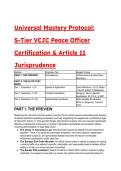
Universal Mastery Protocol:
S-Tier VCJC Peace Officer
Certification & Article 11
Jurisprudence
Section Cognitive Tier Subject Focus
PART I: THE PREVIEW Foundational Critical Axioms & Hard Deck
Directives
PART II: THE ELITE TEST
BANK
Tier 1: Questions 1–10 Syntax & Application Core Definitions, VCJC Rules
13 & 20, Article 11 Baselines
Tier 2: Questions 11–20 Complex Simulation Sprague, Savva, Bauder
Application, 20 V.S.A. § 2401
Tier 3: Questions 21–30 Grandmaster Synthesis Multi-Variable Escalations,
SITA vs. Exigency, Conduct
Tiers
PART I: THE PREVIEW
Mastering the Vermont Criminal Justice Council (VCJC) matrix requires abandoning the leniency
of federal standard-operating procedures and fully integrating the heightened constitutional rigor
of Vermont's Article 11. This gauntlet forges elite decision-makers who can execute mechanistic,
flawless constitutional maneuvers in chaotic, high-stakes operational environments without
incurring administrative or legal fatal errors.
● The Article 11 Supremacy Law: Vermont firmly rejects the federal Fourth Amendment
baseline. There is no absolute automobile exception, exit orders require independent
reasonable suspicion, and generalized federal doctrines will result in immediate
evidentiary suppression under state law.
● The Sprague Exit Order Mandate: An officer cannot order a vehicle occupant out during
a routine traffic stop without a specific, articulable, and reasonable basis to believe officer
safety is at risk or a crime has been committed.
● The Bauder SITA Limitation: Search Incident to Arrest (SITA) within a vehicle is highly
restricted. If a suspect is secured in a cruiser, the vehicle cannot be searched absent a
, warrant or a clear, objective need to protect safety or preserve evidence of the specific
crime of arrest.
● VCJC Rule 20 (The Survival Mandate): Active certification requires 30 hours of annual
in-service training. Failure to complete this results in suspension and constitutes Category
C Unprofessional Conduct.
● 20 V.S.A. § 2401 Architecture: Unprofessional conduct is tri-tiered. Category A covers
crimes, Category B governs gross misconduct and policy violations, and Category C
controls VCJC process violations. First-offense Category B conduct yields no VCJC
sanction except for excessive force, prohibited restraints, or failure to intervene.
PART II: THE ELITE TEST BANK
Tier 1: Foundational Syntax & Application
Q1: A Level III certified municipal officer in Vermont is assembling their annual training portfolio
for the Acadis portal. Under VCJC Rule 20, maintaining active law enforcement authority
mechanistically requires 30 hours of annual in-service training. Which combination of mandated
topics is the MOST ACCURATE baseline for compliance during an even-numbered calendar
year? A) Medical Readiness, Defensive Tactics, Firearms Qualification, 4 hours of Use of Force,
and Fair and Impartial Policing (FIP). B) 40 hours of general in-service training, including a
federally mandated active shooter response module and implicit bias overview. C) First
Aid/CPR, Firearms Qualification, CEW recertification (if carried), 4 hours of Use of Force
administered by a VCJC instructor, and Domestic Violence Response training. D) Firearms
Qualification, 2 hours of Use of Force, First Aid/CPR, and implicit bias training taught by a
nationally recognized civilian contractor.
● The Answer: C (First Aid/CPR, Firearms Qualification, CEW recertification (if carried), 4
hours of Use of Force administered by a VCJC instructor, and Domestic Violence
Response training.)
● Distractor Analysis:
○ A is incorrect: Fair and Impartial Policing (FIP) is the mandated sociological training
for odd-numbered years, whereas the prompt specifically identifies an
even-numbered year requirement.
○ B is incorrect: This applies a generalized federal or out-of-state standard, ignoring
the fact that Vermont strictly requires exactly 30 hours with highly specific,
non-negotiable sub-components.
○ D is incorrect: Use of force training requires a minimum of 4 hours, not 2, and must
be delivered specifically by a VCJC-certified instructor rather than an uncertified
civilian contractor.
The Mentor's Analysis: Administrative survival is the fundamental prerequisite to operational
deployment. Rule 20 operates on a rigid biennial toggle, demanding Fair and Impartial Policing
during odd years and Domestic Violence training during even years. By utilizing mechanistic
compliance validation, you bypass the common trap of assuming generalized tactical training
satisfies state board mandates. Professional/Academic Intuition: What is not documented in
Acadis by March 1st did not legally happen; administrative failure instantly strips operational
authority.
Q2: Under the statutory framework of 20 V.S.A. § 2401 governing Unprofessional Conduct, a
fully certified Vermont officer is charged with a first-offense misdemeanor for Driving Under the
, Influence (DUI) while off duty. Based on the strict statutory definitions enforced by the VCJC,
which classification is the MOST ACCURATE? A) This constitutes Category A conduct, as all
off-duty misdemeanors involving substance abuse are classified under this tier. B) This
constitutes Category B conduct, as it is a substantial deviation from professional conduct but
falls short of a felony conviction. C) This constitutes Category C conduct, as any criminal arrest
immediately impacts the officer's certification status with the Council. D) This does not constitute
Category A conduct, as a first-offense off-duty DUI does not meet the specific statutory
threshold required for state-level decertification.
● The Answer: D (This does not constitute Category A conduct, as a first-offense off-duty
DUI does not meet the specific statutory threshold required for state-level decertification.)
● Distractor Analysis:
○ A is incorrect: The legislature meticulously enumerated only specific off-duty
misdemeanors as Category A conduct. A first-offense DUI is explicitly excluded; the
statute dictates it must be a "driving under the influence, second offense" to trigger
Category A jurisdiction.
○ B is incorrect: Category B conduct fundamentally relates to a willful failure to
comply with a State-required policy (such as Use of Force or Body Worn Camera
guidelines) or gross professional misconduct executed under the authority of the
State.
○ C is incorrect: Category C is strictly reserved for internal Council process violations,
such as falsifying documents or exceeding certification scope, not external criminal
matters.
The Mentor's Analysis: The legislature precision-engineered Category A to capture felonies
and aggravated or chronic off-duty misdemeanors to balance personal failure with professional
decertification. By utilizing statutory threshold analysis, you bypass the common trap of
assuming any criminal charge automatically triggers Category A decertification proceedings.
Professional/Academic Intuition: Category A is reserved exclusively for felonies, on-duty
crimes, and repeat off-duty misdemeanors; a first-offense off-duty DUI is managed as a local
disciplinary issue rather than an immediate Category A trigger.
Q3: A law enforcement agency completes a valid internal investigation, finding that an officer
committed a first offense of Category B conduct by failing to activate their Body Worn Camera
(BWC) during a routine encounter, violating state policy. What action is the VCJC statutorily
mandated to take regarding the officer's state certification? A) The Council must immediately
suspend the officer's certification for 30 days pending retraining. B) The Council shall take no
action against the officer's certification for this specific initial infraction. C) The Council must
revoke the officer's certification, as BWC violations are considered precursors to excessive
force. D) The Council will impose a sanction equal to, but not exceeding, the agency's internal
disciplinary measures.
● The Answer: B (The Council shall take no action against the officer's certification for this
specific initial infraction.)
● Distractor Analysis:
○ A is incorrect: The VCJC explicitly lacks the statutory authority to suspend a
certification for a standard first-offense Category B violation.
○ C is incorrect: A routine BWC violation is not classified as an excessive force
precursor that would trigger the narrow first-offense disciplinary exception.
○ D is incorrect: While the Council is limited by agency discipline parameters for
second or subsequent Category B offenses, a standard first-offense Category B
conduct results in absolute non-action at the state level.
S-Tier VCJC Peace Officer
Certification & Article 11
Jurisprudence
Section Cognitive Tier Subject Focus
PART I: THE PREVIEW Foundational Critical Axioms & Hard Deck
Directives
PART II: THE ELITE TEST
BANK
Tier 1: Questions 1–10 Syntax & Application Core Definitions, VCJC Rules
13 & 20, Article 11 Baselines
Tier 2: Questions 11–20 Complex Simulation Sprague, Savva, Bauder
Application, 20 V.S.A. § 2401
Tier 3: Questions 21–30 Grandmaster Synthesis Multi-Variable Escalations,
SITA vs. Exigency, Conduct
Tiers
PART I: THE PREVIEW
Mastering the Vermont Criminal Justice Council (VCJC) matrix requires abandoning the leniency
of federal standard-operating procedures and fully integrating the heightened constitutional rigor
of Vermont's Article 11. This gauntlet forges elite decision-makers who can execute mechanistic,
flawless constitutional maneuvers in chaotic, high-stakes operational environments without
incurring administrative or legal fatal errors.
● The Article 11 Supremacy Law: Vermont firmly rejects the federal Fourth Amendment
baseline. There is no absolute automobile exception, exit orders require independent
reasonable suspicion, and generalized federal doctrines will result in immediate
evidentiary suppression under state law.
● The Sprague Exit Order Mandate: An officer cannot order a vehicle occupant out during
a routine traffic stop without a specific, articulable, and reasonable basis to believe officer
safety is at risk or a crime has been committed.
● The Bauder SITA Limitation: Search Incident to Arrest (SITA) within a vehicle is highly
restricted. If a suspect is secured in a cruiser, the vehicle cannot be searched absent a
, warrant or a clear, objective need to protect safety or preserve evidence of the specific
crime of arrest.
● VCJC Rule 20 (The Survival Mandate): Active certification requires 30 hours of annual
in-service training. Failure to complete this results in suspension and constitutes Category
C Unprofessional Conduct.
● 20 V.S.A. § 2401 Architecture: Unprofessional conduct is tri-tiered. Category A covers
crimes, Category B governs gross misconduct and policy violations, and Category C
controls VCJC process violations. First-offense Category B conduct yields no VCJC
sanction except for excessive force, prohibited restraints, or failure to intervene.
PART II: THE ELITE TEST BANK
Tier 1: Foundational Syntax & Application
Q1: A Level III certified municipal officer in Vermont is assembling their annual training portfolio
for the Acadis portal. Under VCJC Rule 20, maintaining active law enforcement authority
mechanistically requires 30 hours of annual in-service training. Which combination of mandated
topics is the MOST ACCURATE baseline for compliance during an even-numbered calendar
year? A) Medical Readiness, Defensive Tactics, Firearms Qualification, 4 hours of Use of Force,
and Fair and Impartial Policing (FIP). B) 40 hours of general in-service training, including a
federally mandated active shooter response module and implicit bias overview. C) First
Aid/CPR, Firearms Qualification, CEW recertification (if carried), 4 hours of Use of Force
administered by a VCJC instructor, and Domestic Violence Response training. D) Firearms
Qualification, 2 hours of Use of Force, First Aid/CPR, and implicit bias training taught by a
nationally recognized civilian contractor.
● The Answer: C (First Aid/CPR, Firearms Qualification, CEW recertification (if carried), 4
hours of Use of Force administered by a VCJC instructor, and Domestic Violence
Response training.)
● Distractor Analysis:
○ A is incorrect: Fair and Impartial Policing (FIP) is the mandated sociological training
for odd-numbered years, whereas the prompt specifically identifies an
even-numbered year requirement.
○ B is incorrect: This applies a generalized federal or out-of-state standard, ignoring
the fact that Vermont strictly requires exactly 30 hours with highly specific,
non-negotiable sub-components.
○ D is incorrect: Use of force training requires a minimum of 4 hours, not 2, and must
be delivered specifically by a VCJC-certified instructor rather than an uncertified
civilian contractor.
The Mentor's Analysis: Administrative survival is the fundamental prerequisite to operational
deployment. Rule 20 operates on a rigid biennial toggle, demanding Fair and Impartial Policing
during odd years and Domestic Violence training during even years. By utilizing mechanistic
compliance validation, you bypass the common trap of assuming generalized tactical training
satisfies state board mandates. Professional/Academic Intuition: What is not documented in
Acadis by March 1st did not legally happen; administrative failure instantly strips operational
authority.
Q2: Under the statutory framework of 20 V.S.A. § 2401 governing Unprofessional Conduct, a
fully certified Vermont officer is charged with a first-offense misdemeanor for Driving Under the
, Influence (DUI) while off duty. Based on the strict statutory definitions enforced by the VCJC,
which classification is the MOST ACCURATE? A) This constitutes Category A conduct, as all
off-duty misdemeanors involving substance abuse are classified under this tier. B) This
constitutes Category B conduct, as it is a substantial deviation from professional conduct but
falls short of a felony conviction. C) This constitutes Category C conduct, as any criminal arrest
immediately impacts the officer's certification status with the Council. D) This does not constitute
Category A conduct, as a first-offense off-duty DUI does not meet the specific statutory
threshold required for state-level decertification.
● The Answer: D (This does not constitute Category A conduct, as a first-offense off-duty
DUI does not meet the specific statutory threshold required for state-level decertification.)
● Distractor Analysis:
○ A is incorrect: The legislature meticulously enumerated only specific off-duty
misdemeanors as Category A conduct. A first-offense DUI is explicitly excluded; the
statute dictates it must be a "driving under the influence, second offense" to trigger
Category A jurisdiction.
○ B is incorrect: Category B conduct fundamentally relates to a willful failure to
comply with a State-required policy (such as Use of Force or Body Worn Camera
guidelines) or gross professional misconduct executed under the authority of the
State.
○ C is incorrect: Category C is strictly reserved for internal Council process violations,
such as falsifying documents or exceeding certification scope, not external criminal
matters.
The Mentor's Analysis: The legislature precision-engineered Category A to capture felonies
and aggravated or chronic off-duty misdemeanors to balance personal failure with professional
decertification. By utilizing statutory threshold analysis, you bypass the common trap of
assuming any criminal charge automatically triggers Category A decertification proceedings.
Professional/Academic Intuition: Category A is reserved exclusively for felonies, on-duty
crimes, and repeat off-duty misdemeanors; a first-offense off-duty DUI is managed as a local
disciplinary issue rather than an immediate Category A trigger.
Q3: A law enforcement agency completes a valid internal investigation, finding that an officer
committed a first offense of Category B conduct by failing to activate their Body Worn Camera
(BWC) during a routine encounter, violating state policy. What action is the VCJC statutorily
mandated to take regarding the officer's state certification? A) The Council must immediately
suspend the officer's certification for 30 days pending retraining. B) The Council shall take no
action against the officer's certification for this specific initial infraction. C) The Council must
revoke the officer's certification, as BWC violations are considered precursors to excessive
force. D) The Council will impose a sanction equal to, but not exceeding, the agency's internal
disciplinary measures.
● The Answer: B (The Council shall take no action against the officer's certification for this
specific initial infraction.)
● Distractor Analysis:
○ A is incorrect: The VCJC explicitly lacks the statutory authority to suspend a
certification for a standard first-offense Category B violation.
○ C is incorrect: A routine BWC violation is not classified as an excessive force
precursor that would trigger the narrow first-offense disciplinary exception.
○ D is incorrect: While the Council is limited by agency discipline parameters for
second or subsequent Category B offenses, a standard first-offense Category B
conduct results in absolute non-action at the state level.


