
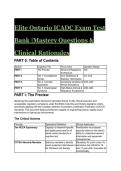
Elite Ontario ICADC Exam Test
Bank |Mastery Questions &
Clinical Rationales
PART 0: Table of Contents
Section Cognitive Tier Focus Area Question Range
PART I The Preview Axioms & Regulatory N/A
Architecture
PART II Tier 1: Foundational Core Definitions & Q1–Q15
Syntax Statutory Hard-Decks
PART II Tier 2: Complex Competing Variables & Q16–Q35
Application Ethical Simulations
PART II Tier 3: Grandmaster High-Stakes Clinical & Q36–Q60
Synthesis Regulatory Escalations
PART I: The Preview
Mastering this examination framework translates directly to elite clinical execution and
unassailable regulatory compliance under the British Columbia and Ontario legislative matrix,
specifically aligning with the Canadian Addiction Counsellors Certification Federation (CACCF)
standards. This document forges practitioners capable of engineering precise, legally sound
interventions in high-acuity environments.
The Critical Axioms
Principle Operational Definition Clinical Application
The HCCA Supremacy Capacity is treatment-specific Practitioners must assess
and legally presumed for all capacity based on the client's
adults unless rebutted by a ability to understand relevant
cognitive test. information and appreciate
consequences.
CYFSA Absolute Mandate Statutory mandate to directly Mandatory for youth under 16;
report suspected child abuse to permissive but critical for 16-
the Children's Aid Society. and 17-year-olds. Overrides all
confidentiality.
,Principle Operational Definition Clinical Application
RHPA Psychotherapy Barrier The "controlled act of ICADC credentialing alone
psychotherapy" is legally does not authorize the
restricted to members of treatment of serious disorders
specific colleges (e.g., CRPO, of thought or cognition via
OCSWSSW). psychotherapy.
PHIPA Circle of Care Implied consent for sharing Non-treating staff, police, and
Personal Health Information family members are excluded
(PHI) is limited to direct from the circle unless express
healthcare providers. consent or a legal exemption
applies.
The Core Sequence The 12 Core Functions of Screening (eligibility) must
addiction counseling dictate a precede Intake (administration),
rigid operational sequence. which precedes Assessment
(clinical deep-dive).
PART II: THE ELITE TEST BANK
Tier 1: Foundational Syntax & Application (Q1–Q15)
Q1: A clinician operating under CACCF standards evaluates an individual seeking admission for
opioid use disorder. The clinician administers a brief tool to determine if the individual meets the
specific age, demographic, and diagnostic criteria for the facility's funding mandate. According
to the 12 Core Functions, which operation is the clinician PRIMARILY executing? A)
Assessment B) Treatment Planning C) Screening D) Intake
● The Answer: C (Screening)
● Distractor Analysis:
○ A is incorrect: Assessment is a deeper investigative process to identify strengths,
weaknesses, and specific problems, occurring only after admission.
○ B is incorrect: Treatment Planning requires collaborative goal setting based on a
completed assessment.
○ D is incorrect: Intake involves the administrative procedures for admission, which
can only occur after the client is deemed eligible via screening.
The Mentor's Analysis: The absolute first point of clinical contact requires determining
appropriateness and eligibility. By utilizing Screening, the practitioner bypasses the common
trap of admitting a client whose acuity or demographic profile falls outside the facility's legal or
clinical scope. Professional/Academic Intuition: Screening determines if they belong in the
building; Intake opens the door; Assessment maps the terrain.
Q2: Under the Ontario Health Care Consent Act (HCCA), an addiction counselor is determining
whether a client can consent to entering a residential withdrawal management program. Which
of the following statements represents the MOST ACCURATE statutory requirement regarding
capacity? A) The client is automatically deemed incapable if their blood alcohol concentration is
above the legal limit. B) The client must be able to understand the relevant information and
appreciate the reasonably foreseeable consequences of a decision. C) Capacity must be
determined exclusively by a physician registered with the College of Physicians and Surgeons
of Ontario. D) The client is presumed incapable until a formal psychiatric evaluation confirms
cognitive stability.
● The Answer: B (The client must be able to understand the relevant information and
, appreciate the reasonably foreseeable consequences of a decision.)
● Distractor Analysis:
○ A is incorrect: Intoxication does not automatically equate to legal incapacity;
capacity is cognitive and functional.
○ C is incorrect: Addiction counselors and other health practitioners can and must
assess capacity for the specific treatments they are proposing.
○ D is incorrect: The HCCA establishes a legal presumption of capacity for all
individuals unless there are reasonable grounds to believe otherwise.
The Mentor's Analysis: Capacity is fluid, treatment-specific, and deeply anchored in cognitive
comprehension, not mere sobriety. By utilizing the two-part cognitive test of the HCCA, the
practitioner bypasses the novice error of conflating acute intoxication with absolute legal
incapacity. Professional/Academic Intuition: Capacity requires understanding the facts and
appreciating the consequences.
Q3: According to the IC&RC ADC Exam blueprint, which clinical domain commands the highest
proportional weight (30%) on the certification examination? A) Scientific Principles of Substance
Use and Co-Occurring Disorders B) Evidence-Based Screening and Assessment C)
Professional, Ethical, and Legal Responsibilities D) Evidence-Based Treatment, Counseling,
and Referral
● The Answer: D (Evidence-Based Treatment, Counseling, and Referral)
● Distractor Analysis:
○ A is incorrect: Scientific Principles accounts for exactly 25% of the examination
blueprint.
○ B is incorrect: Evidence-Based Screening and Assessment accounts for exactly
20% of the examination blueprint.
○ C is incorrect: Professional, Ethical, and Legal Responsibilities accounts for exactly
25% of the examination blueprint.
The Mentor's Analysis: The architecture of the IC&RC examination reflects the operational
reality of the addiction professional. While assessment and ethics are foundational, the vast
majority of clinical hours are spent in active intervention. By prioritizing Evidence-Based
Treatment, Counseling, and Referral, the blueprint emphasizes sustained clinical execution.
Professional/Academic Intuition: Diagnosis is a moment; Treatment is a continuum.
Q4: A client with a severe alcohol use disorder approaches a registered ICADC practitioner in
Ontario for therapy. The counselor utilizes deep psychoanalytic techniques to treat the client's
underlying childhood trauma and severely impaired emotional regulation. The counselor does
not hold registration with the CRPO or OCSWSSW. Based on the Regulated Health Professions
Act (RHPA), what is the MOST ACCURATE conclusion? A) The counselor is operating within
their scope, provided they maintain their CACCF continuing education hours. B) The counselor
is illegally performing the controlled act of psychotherapy. C) The counselor is exempt from the
RHPA because addiction counseling supersedes psychotherapy restrictions. D) The counselor
may perform this act if they obtain informed consent from the client.
● The Answer: B (The counselor is illegally performing the controlled act of
psychotherapy.)
● Distractor Analysis:
○ A is incorrect: CACCF certification does not override provincial statutes restricting
controlled acts.
○ C is incorrect: There is no blanket exemption for addiction counselors regarding the
controlled act of psychotherapy in Ontario.
○ D is incorrect: A client cannot legally consent to a practitioner performing a
Bank |Mastery Questions &
Clinical Rationales
PART 0: Table of Contents
Section Cognitive Tier Focus Area Question Range
PART I The Preview Axioms & Regulatory N/A
Architecture
PART II Tier 1: Foundational Core Definitions & Q1–Q15
Syntax Statutory Hard-Decks
PART II Tier 2: Complex Competing Variables & Q16–Q35
Application Ethical Simulations
PART II Tier 3: Grandmaster High-Stakes Clinical & Q36–Q60
Synthesis Regulatory Escalations
PART I: The Preview
Mastering this examination framework translates directly to elite clinical execution and
unassailable regulatory compliance under the British Columbia and Ontario legislative matrix,
specifically aligning with the Canadian Addiction Counsellors Certification Federation (CACCF)
standards. This document forges practitioners capable of engineering precise, legally sound
interventions in high-acuity environments.
The Critical Axioms
Principle Operational Definition Clinical Application
The HCCA Supremacy Capacity is treatment-specific Practitioners must assess
and legally presumed for all capacity based on the client's
adults unless rebutted by a ability to understand relevant
cognitive test. information and appreciate
consequences.
CYFSA Absolute Mandate Statutory mandate to directly Mandatory for youth under 16;
report suspected child abuse to permissive but critical for 16-
the Children's Aid Society. and 17-year-olds. Overrides all
confidentiality.
,Principle Operational Definition Clinical Application
RHPA Psychotherapy Barrier The "controlled act of ICADC credentialing alone
psychotherapy" is legally does not authorize the
restricted to members of treatment of serious disorders
specific colleges (e.g., CRPO, of thought or cognition via
OCSWSSW). psychotherapy.
PHIPA Circle of Care Implied consent for sharing Non-treating staff, police, and
Personal Health Information family members are excluded
(PHI) is limited to direct from the circle unless express
healthcare providers. consent or a legal exemption
applies.
The Core Sequence The 12 Core Functions of Screening (eligibility) must
addiction counseling dictate a precede Intake (administration),
rigid operational sequence. which precedes Assessment
(clinical deep-dive).
PART II: THE ELITE TEST BANK
Tier 1: Foundational Syntax & Application (Q1–Q15)
Q1: A clinician operating under CACCF standards evaluates an individual seeking admission for
opioid use disorder. The clinician administers a brief tool to determine if the individual meets the
specific age, demographic, and diagnostic criteria for the facility's funding mandate. According
to the 12 Core Functions, which operation is the clinician PRIMARILY executing? A)
Assessment B) Treatment Planning C) Screening D) Intake
● The Answer: C (Screening)
● Distractor Analysis:
○ A is incorrect: Assessment is a deeper investigative process to identify strengths,
weaknesses, and specific problems, occurring only after admission.
○ B is incorrect: Treatment Planning requires collaborative goal setting based on a
completed assessment.
○ D is incorrect: Intake involves the administrative procedures for admission, which
can only occur after the client is deemed eligible via screening.
The Mentor's Analysis: The absolute first point of clinical contact requires determining
appropriateness and eligibility. By utilizing Screening, the practitioner bypasses the common
trap of admitting a client whose acuity or demographic profile falls outside the facility's legal or
clinical scope. Professional/Academic Intuition: Screening determines if they belong in the
building; Intake opens the door; Assessment maps the terrain.
Q2: Under the Ontario Health Care Consent Act (HCCA), an addiction counselor is determining
whether a client can consent to entering a residential withdrawal management program. Which
of the following statements represents the MOST ACCURATE statutory requirement regarding
capacity? A) The client is automatically deemed incapable if their blood alcohol concentration is
above the legal limit. B) The client must be able to understand the relevant information and
appreciate the reasonably foreseeable consequences of a decision. C) Capacity must be
determined exclusively by a physician registered with the College of Physicians and Surgeons
of Ontario. D) The client is presumed incapable until a formal psychiatric evaluation confirms
cognitive stability.
● The Answer: B (The client must be able to understand the relevant information and
, appreciate the reasonably foreseeable consequences of a decision.)
● Distractor Analysis:
○ A is incorrect: Intoxication does not automatically equate to legal incapacity;
capacity is cognitive and functional.
○ C is incorrect: Addiction counselors and other health practitioners can and must
assess capacity for the specific treatments they are proposing.
○ D is incorrect: The HCCA establishes a legal presumption of capacity for all
individuals unless there are reasonable grounds to believe otherwise.
The Mentor's Analysis: Capacity is fluid, treatment-specific, and deeply anchored in cognitive
comprehension, not mere sobriety. By utilizing the two-part cognitive test of the HCCA, the
practitioner bypasses the novice error of conflating acute intoxication with absolute legal
incapacity. Professional/Academic Intuition: Capacity requires understanding the facts and
appreciating the consequences.
Q3: According to the IC&RC ADC Exam blueprint, which clinical domain commands the highest
proportional weight (30%) on the certification examination? A) Scientific Principles of Substance
Use and Co-Occurring Disorders B) Evidence-Based Screening and Assessment C)
Professional, Ethical, and Legal Responsibilities D) Evidence-Based Treatment, Counseling,
and Referral
● The Answer: D (Evidence-Based Treatment, Counseling, and Referral)
● Distractor Analysis:
○ A is incorrect: Scientific Principles accounts for exactly 25% of the examination
blueprint.
○ B is incorrect: Evidence-Based Screening and Assessment accounts for exactly
20% of the examination blueprint.
○ C is incorrect: Professional, Ethical, and Legal Responsibilities accounts for exactly
25% of the examination blueprint.
The Mentor's Analysis: The architecture of the IC&RC examination reflects the operational
reality of the addiction professional. While assessment and ethics are foundational, the vast
majority of clinical hours are spent in active intervention. By prioritizing Evidence-Based
Treatment, Counseling, and Referral, the blueprint emphasizes sustained clinical execution.
Professional/Academic Intuition: Diagnosis is a moment; Treatment is a continuum.
Q4: A client with a severe alcohol use disorder approaches a registered ICADC practitioner in
Ontario for therapy. The counselor utilizes deep psychoanalytic techniques to treat the client's
underlying childhood trauma and severely impaired emotional regulation. The counselor does
not hold registration with the CRPO or OCSWSSW. Based on the Regulated Health Professions
Act (RHPA), what is the MOST ACCURATE conclusion? A) The counselor is operating within
their scope, provided they maintain their CACCF continuing education hours. B) The counselor
is illegally performing the controlled act of psychotherapy. C) The counselor is exempt from the
RHPA because addiction counseling supersedes psychotherapy restrictions. D) The counselor
may perform this act if they obtain informed consent from the client.
● The Answer: B (The counselor is illegally performing the controlled act of
psychotherapy.)
● Distractor Analysis:
○ A is incorrect: CACCF certification does not override provincial statutes restricting
controlled acts.
○ C is incorrect: There is no blanket exemption for addiction counselors regarding the
controlled act of psychotherapy in Ontario.
○ D is incorrect: A client cannot legally consent to a practitioner performing a


