

Written by students who passed Immediately available after payment Read online or as PDF Wrong document? Swap it for free 4.6 TrustPilot
logo-home
Document preview thumbnail
Preview 3 out of 25 pages
Exam (elaborations)

PNB 2265 Exam 4 Study Guide 2026 | 350+ Questions and Answers on Renal Physiology, Reproductive System, Gametogenesis & Hormonal Regulation

Document preview thumbnail
Preview 3 out of 25 pages

This comprehensive PNB 2265 Exam 4 study guide contains more than 350 detailed questions and verified answers covering renal physiology, kidney function, acid-base balance, reproductive anatomy, gametogenesis, hormonal regulation, and human sexual physiology commonly tested in undergraduate anatomy and physiology courses. The document explains essential concepts including nephron structure and function, glomerular filtration, tubular reabsorption and secretion, GFR regulation, RAAS physiology, ADH and aldosterone function, acid-base buffering systems, renal clearance, fluid homeostasis, male and female reproductive anatomy, meiosis, spermatogenesis, oogenesis, follicular development, ovulation, hormonal cycles, fertilization physiology, and sexual response mechanisms. This exam preparation resource is specifically designed for undergraduate students enrolled in anatomy and physiology, nursing, biomedical sciences, pre-medical sciences, exercise science, kinesiology, health sciences, reproductive biology, and healthcare prerequisite programs. The material combines concise exam-focused explanations with advanced physiological and clinical reasoning that simplify complex renal and reproductive system concepts for efficient revision, memorization, active recall learning, and examination readiness. Students preparing for cumulative finals, laboratory practicals, ATI assessments, HESI examinations, and healthcare-related coursework will find this study guide highly beneficial for mastering high-yield anatomy and physiology concepts. The document also provides extensive coverage of nephron anatomy, filtration membranes, hydrostatic and oncotic pressures, juxtaglomerular apparatus regulation, countercurrent multiplication, urine concentration, transport maximum and renal threshold concepts, electrolyte balance, bladder physiology, reproductive endocrinology, chromosomal sex determination, SRY gene function, androgen insensitivity syndrome, ovarian and uterine cycles, seminiferous tubule function, Sertoli and Leydig cell physiology, sperm structure, follicle maturation, corpus luteum physiology, and endocrine regulation of reproduction. Important physiological principles such as osmoregulation, pH homeostasis, gamete development, hormonal feedback systems, and reproductive function are thoroughly reviewed using clinically relevant and scientifically accurate explanations suitable for undergraduate and pre-professional healthcare education. Major anatomy, renal physiology, endocrinology, and reproductive biology concepts discussed in this document align with internationally recognized academic textbooks, laboratory manuals, and peer-reviewed scientific literature, including: Human Anatomy & Physiology Guyton and Hall Textbook of Medical Physiology Principles of Anatomy and Physiology Human Physiology: An Integrated Approach Langman's Medical Embryology The renal, endocrine, and reproductive physiology principles presented in this document are supported by established research in physiology, nephrology, endocrinology, reproductive biology, embryology, and biomedical science, making this study guide highly relevant for both academic coursework and healthcare-related education. Keywords PNB 2265, renal physiology, kidney function, nephron anatomy, glomerular filtration, GFR, renal clearance, RAAS, aldosterone, ADH, renin, angiotensin II, acid base balance, osmoregulation, electrolyte balance, tubular reabsorption, tubular secretion, loop of Henle, collecting duct, juxtaglomerular apparatus, macula densa, filtration membrane, urine formation, renal threshold, transport maximum, fluid homeostasis, reproductive system, gametogenesis, meiosis, mitosis, spermatogenesis, oogenesis, follicular development, ovulation, corpus luteum, ovarian cycle, uterine cycle, reproductive endocrinology, SRY gene, androgen insensitivity syndrome, Sertoli cells, Leydig cells, testosterone, estrogen, progesterone, sperm structure, seminiferous tubules, female reproductive anatomy, male reproductive anatomy, anatomy and physiology exam questions, university physiology study guide, biomedical sciences, nursing prerequisite, healthcare exam prep, endocrine physiology, reproductive biology

Content preview

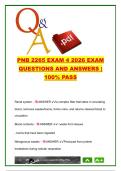
PNB 2265 EXAM 4 2026 EXAM
QUESTIONS AND ANSWERS |
100% PASS


Renal system - ANSWER ✔✔a complex filter that takes in circulating

blood, removes wastes/toxins, forms urine, and returns cleaned blood to

circulation


Blood contents - ANSWER ✔✔- waste from tissues


- toxins that have been ingested


Nitrogenous wastes - ANSWER ✔✔Produced from protein

breakdown during cellular respiration

,effect of waste buildup - ANSWER ✔✔causes alkaline pH imbalance

and can become deadly


Purpose of renal system - ANSWER ✔✔eliminates nitrogenous and

other wastes


Renal system function - ANSWER ✔✔removes wastes and regulates

ion balances


Metabolic wastes removed - ANSWER ✔✔Ketones, prescription

drugs, OTC drugs, xenobiotics


Ion balance importance - ANSWER ✔✔Maintains osmolarity and pH


Substances regulated by kidneys - ANSWER ✔✔- Sodium


- Potassium

- hydrogen ions

-Bicarbonate

- Water


Osmolarity - ANSWER ✔✔- sodium


- water


pH regulation - ANSWER ✔✔- potassium

, - hydrogen ions

- bicarbonate


Renin - ANSWER ✔✔Hormone that regulates long-term blood

pressure


Kidney BP control - ANSWER ✔✔regulates water retention vs

excretion


Kidney location - ANSWER ✔✔- posterior


- superior abdominal cavity near floating ribs


Ureters - ANSWER ✔✔tbes that carry urine via peristalsis


bladder - ANSWER ✔✔stores urine


urethra - ANSWER ✔✔conducts urine out of body


cortex - ANSWER ✔✔outer region of kidney


medulla - ANSWER ✔✔inner region made of renal pyramids


collecting system - ANSWER ✔✔receives urine


nephron - ANSWER ✔✔functional unit of kidney


nephron location - ANSWER ✔✔span cortex and medulla


COPYRIGHT©PROFFKERRYMARTIN 2025/2026. YEAR PUBLISHED 2026. COMPANY REGISTRATION NUMBER: 619652435. TERMS OF USE.
PRIVACY STATEMENT. ALL RIGHTS RESERVED


Document information

Uploaded on
May 28, 2026
Number of pages
25
Written in
2025/2026
Type
Exam (elaborations)
Contains
Questions & answers
$18.99

Wrong document? Swap it for free Within 14 days of purchase and before downloading, you can choose a different document. You can simply spend the amount again.
Written by students who passed
Immediately available after payment
Read online or as PDF

Seller avatar
Reputation scores are based on the amount of documents a seller has sold for a fee and the reviews they have received for those documents. There are three levels: Bronze, Silver and Gold. The better the reputation, the more your can rely on the quality of the sellers work.
PROFFKERRYMARTIN
3.3
(55)
Sold
287
Followers
9
Items
11174
Last sold
9 hours ago


Why students choose Stuvia

Created by fellow students, verified by reviews

Quality you can trust: written by students who passed their tests and reviewed by others who've used these notes.

Didn't get what you expected? Choose another document

No worries! You can instantly pick a different document that better fits what you're looking for.

Pay as you like, start learning right away

No subscription, no commitments. Pay the way you're used to via credit card and download your PDF document instantly.

Student with book image

“Bought, downloaded, and aced it. It really can be that simple.”

Alisha Student

Working on your references?

Create accurate citations in APA, MLA and Harvard with our free citation generator.

Working on your references?

Frequently asked questions
