

Written by students who passed Immediately available after payment Read online or as PDF Wrong document? Swap it for free 4.6 TrustPilot
logo-home
Document preview thumbnail
Preview 2 out of 9 pages
Exam (elaborations)

Pharmacology Chapters 1–7 Study Guide 2026 | 250+ Exam Questions & Already Graded A+ | Pharmacokinetics, Pharmacodynamics, Medication Safety & Nursing Process | ECPI University

Document preview thumbnail
Preview 2 out of 9 pages

This comprehensive Pharmacology Chapters 1–7 Study Guide for 2026 contains more than 250 verified exam questions and already graded A+ answers covering pharmacology fundamentals, pharmacokinetics, pharmacodynamics, medication administration, nursing process concepts, medication safety, toxicology, pediatric pharmacology, dosage calculations, and drug classifications. The material provides extensive review content on absorption, distribution, metabolism, excretion, half-life, peak and trough drug levels, adverse drug reactions, enteral and parenteral drug routes, FDA drug approval processes, medication reconciliation, medication errors, pediatric dosage calculations, polypharmacy, ethnopharmacology, and safe medication administration principles commonly taught in ECPI University nursing and introductory pharmacology courses. This study guide is highly relevant for students enrolled in Pharmacology, Fundamentals of Nursing, Practical Nursing (PN), Licensed Practical Nursing (LPN), Associate Degree Nursing (ADN), Registered Nursing (RN), Medical-Surgical Nursing, Allied Health, Healthcare Science, and pre-NCLEX nursing preparation programs at colleges and universities. It is especially useful for ECPI University nursing students preparing for pharmacology examinations, medication safety assessments, dosage calculation tests, NCLEX-style medication questions, and foundational nursing competency evaluations. The content aligns closely with concepts discussed in Pharmacology and the Nursing Process by Lilley, Rainforth Collins, and Snyder, Lehne’s Pharmacology for Nursing Care, Fundamentals of Nursing by Potter and Perry, and medication safety frameworks established by organizations such as the Food and Drug Administration (FDA), Institute for Safe Medication Practices (ISMP), National Council of State Boards of Nursing (NCSBN), American Nurses Association (ANA), and the Joint Commission. The material also reflects modern evidence-based pharmacology and medication safety practices used in healthcare systems and nursing education environments. The document extensively reviews foundational pharmacology concepts including pharmacokinetics, pharmacodynamics, pharmacotherapeutics, pharmacognosy, pharmaceutics, toxicology, and pharmacoeconomics. Additional concepts include the four pharmacokinetic phases of absorption, distribution, metabolism, and excretion (ADME), as well as therapeutic drug effects, adverse reactions, toxicity, tolerance, dependence, teratogenicity, mutagenicity, and carcinogenic drug effects. The guide also explains therapeutic versus pharmaceutical drug classifications, drug dissolution rates, dosage forms, and the impact of drug formulation on absorption and therapeutic outcomes. The study guide further provides detailed review material on the nursing process and medication administration concepts including assessment, nursing diagnosis, planning, implementation, and evaluation. Additional nursing concepts include subjective and objective data collection, human needs statements, medication administration rights, medication reconciliation, adverse drug events, adverse drug reactions (ADRs), idiosyncratic reactions, and medication error prevention strategies. The guide also reviews near misses, close calls, QSEN initiatives, Just Culture safety frameworks, medication error reporting systems, and high-risk medications such as anticoagulants, central nervous system drugs, and chemotherapeutic agents. The material emphasizes that prescribing is the most common point at which medication errors occur in healthcare systems. The guide also explores medication administration routes and dosage calculation concepts including enteral routes (oral, buccal, sublingual, rectal), parenteral routes (intravenous, intramuscular, subcutaneous, intradermal, intrathecal, intraarterial, intraarticular), and topical administration routes affecting the skin, eyes, ears, lungs, nose, rectum, and vagina. Additional pediatric pharmacology concepts include body surface area dosage calculations, weight-based calculations using kilograms, immature liver and kidney metabolism in pediatric patients, weaker mucus barriers, dehydration risks, and developmental differences affecting pediatric drug responses. The material also reviews ethnopharmacology, polypharmacy, laboratory drug synthesis, and the FDA drug approval process including preclinical testing, clinical studies, investigational drug studies, and expedited drug approval pathways. Additional nursing and pharmacology concepts reviewed include half-life calculations, peak and trough drug monitoring, medication toxicity recognition, physiologic dependence, therapeutic outcomes, medication safety standards, and patient-centered medication education. Students using this resource will strengthen their understanding of pharmacology principles, medication administration safety, dosage calculations, nursing process frameworks, pediatric pharmacology, medication reconciliation, and evidence-based nursing medication practices necessary for success in pharmacology coursework, NCLEX preparation, and modern healthcare environments. Keywords Pharmacology chapters 1 7, pharmacology study guide, pharmacokinetics, pharmacodynamics, pharmacotherapeutics, pharmacognosy, pharmaceutics, toxicology nursing, pharmacoeconomics, absorption distribution metabolism excretion, ADME pharmacology, medication safety, nursing process, nursing diagnosis, assessment planning implementation evaluation, subjective data, objective data, medication administration rights, adverse drug reactions, ADRs, adverse drug events, medication reconciliation, medication errors, QSEN initiatives, Just Culture, medication error prevention, near miss nursing, close call medication error, peak drug level, trough drug level, drug half life, medication toxicity, drug tolerance, physiologic dependence, teratogenic drugs, mutagenic drugs, carcinogenic drug effects, enteral drug routes, parenteral drug routes, intravenous administration, intramuscular injection, subcutaneous injection, intradermal injection, intrathecal route, intraarterial administration, topical medications, oral medications, buccal administration, sublingual medications, rectal administration, pediatric pharmacology, pediatric dosage calculations, body surface area method, polypharmacy, ethnopharmacology, FDA drug approval process, preclinical testing, investigational drug studies, expedited drug approval, medication dosage forms, drug dissolution rate, high risk medications, anticoagulants, chemotherapeutic drugs, CNS medications, NCLEX pharmacology prep, ECPI University, nursing pharmacology exam, dosage calculations nursing, medication administration nursing, patient medication education, healthcare medication safety

Content preview

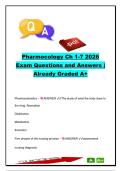
Pharmocology Ch 1-7 2026
Exam Questions and Answers |
Already Graded A+


Pharmacokinetics - ANSWER ✔✔The study of what the body does to

the drug. Absorption

Distribution

Metabolism

Excretion


Five phases of the nursing process - ANSWER ✔✔assessment


nursing diagnosis

, planning

implementation

evaluation


Subjective data - ANSWER ✔✔things a person tells you about that

you cannot observe through your senses; symptoms


Objective data - ANSWER ✔✔information that is seen, heard, felt, or

smelled by an observer; signs


Human needs statement - ANSWER ✔✔same as nursing diagnosis


Pharmacodynamics - ANSWER ✔✔The study of what the drug does

to the body.


Pharmacotherapeutics - ANSWER ✔✔The clinical use of drugs to

prevent and treat diseases


Toxicology - ANSWER ✔✔Science of the adverse effects of

chemicals on living organisms.

Clinical toxicology deals specifically with the care of poisoned patients.


Pharmacognosy - ANSWER ✔✔The study of natural (versus

synthetic) drug sources (i.e., plant, animals, minerals)

Document information

Uploaded on
May 28, 2026
Number of pages
9
Written in
2025/2026
Type
Exam (elaborations)
Contains
Questions & answers
$18.99

Wrong document? Swap it for free Within 14 days of purchase and before downloading, you can choose a different document. You can simply spend the amount again.
Written by students who passed
Immediately available after payment
Read online or as PDF

Seller avatar
Reputation scores are based on the amount of documents a seller has sold for a fee and the reviews they have received for those documents. There are three levels: Bronze, Silver and Gold. The better the reputation, the more your can rely on the quality of the sellers work.
NinjaNerd
3.4
(76)
Sold
401
Followers
6
Items
15349
Last sold
1 day ago


Why students choose Stuvia

Created by fellow students, verified by reviews

Quality you can trust: written by students who passed their tests and reviewed by others who've used these notes.

Didn't get what you expected? Choose another document

No worries! You can instantly pick a different document that better fits what you're looking for.

Pay as you like, start learning right away

No subscription, no commitments. Pay the way you're used to via credit card and download your PDF document instantly.

Student with book image

“Bought, downloaded, and aced it. It really can be that simple.”

Alisha Student

Working on your references?

Create accurate citations in APA, MLA and Harvard with our free citation generator.

Working on your references?

Frequently asked questions

