

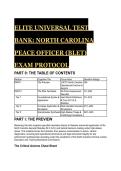
ELITE UNIVERSAL TEST
BANK: NORTH CAROLINA
PEACE OFFICER (BLET)
EXAM PROTOCOL
PART 0: THE TABLE OF CONTENTS
Section Cognitive Tier Focus Area Question Range
PART I The Preview CJETC North Carolina N/A
Operational Doctrine &
Axioms
PART II The Elite Test Bank 30-Point Assessment Q1–Q30
Gauntlet
- Tier 1 Foundational Syntax & Hard Deck Definitions Q1–Q10
Application & Core N.C.G.S.
Statutes
- Tier 2 Complex Application & Multi-Variable Scenario Q11–Q20
Simulation Simulations
- Tier 3 Grandmaster Synthesis High-Stakes Triage & Q21–Q30
Conflicting Precedents
PART I: THE PREVIEW
Mastering this elite cognitive gauntlet translates directly to flawless real-world application of the
North Carolina General Statutes (N.C.G.S.) and tactical decision-making under high-stakes
stress. This material forces the transition from passive memorization to active, clinical
diagnostics, ensuring total operational dominance and legal structural integrity for law
enforcement professionals operating under the jurisdiction of the North Carolina Criminal Justice
Education and Training Standards Commission.
The Critical Axioms Cheat Sheet
,Statutory Domain Core Principle Operational Limitation
Warrantless Misdemeanors An officer may arrest for a Applies ONLY if there is
misdemeanor committed out of probable cause of flight risk,
their presence under specific risk of injury/damage, or
statutory exceptions. specific domestic
violence/protective order
violations.
Premises Search of Persons During a search warrant Items must be concealable on a
execution, officers may detain person. All controlled
anyone present and search substances are statutorily
them if target items are not classified as the same type of
found. property.
Implied Consent (30-Minute) A DWI suspect has the right to Testing cannot be delayed
contact an attorney and a longer than 30 minutes from the
witness to observe chemical time rights are read. At minute
testing. 31, testing must proceed.
Juvenile Interrogation Juveniles under 16 have an For 16- and 17-year-olds, a
absolute inability to waive the "caretaker" may substitute if the
right to a parent, guardian, or parent/guardian is unavailable.
attorney during questioning.
Duty to Intervene Officers observing excessive Strangleholds and vascular
force must physically intervene neck restraints are explicitly
(if safe) and report it within 72 defined as deadly physical
hours. force.
PART II: THE ELITE TEST BANK
Tier 1: Foundational Syntax & Application
Q1: Officer Jenkins responds to a domestic disturbance. Upon arrival, the victim states that her
live-in boyfriend punched her in the face 45 minutes prior and fled the scene on foot. The officer
observes severe swelling on the victim's face. The officer locates the suspect two blocks away.
Based on the principles of N.C.G.S. § 15A-401(b), which action is the MOST ACCURATE? A)
The officer must obtain an arrest warrant from a magistrate before taking the suspect into
custody because the misdemeanor assault occurred outside the officer's presence. B) The
officer may immediately arrest the suspect without a warrant because the suspect committed a
misdemeanor assault involving a personal relationship as defined in Chapter 50B. C) The officer
can only issue a criminal citation because the suspect did not use a deadly weapon during the
commission of the assault. D) The officer must place the suspect under temporary investigative
detention and transport him back to the scene for a show-up identification before an arrest is
legally valid.
● The Answer: B (The officer may immediately arrest the suspect without a warrant
because the suspect committed a misdemeanor assault involving a personal relationship
as defined in Chapter 50B.)
● Distractor Analysis:
○ A is incorrect: While the general rule prohibits warrantless arrests for
misdemeanors occurring outside an officer's presence, N.C.G.S. § 15A-401(b)(2)d
specifically exempts assaults when the offense involves a personal relationship as
, defined in G.S. 50B-1.
○ C is incorrect: A criminal citation is completely inappropriate and legally deficient for
a domestic violence assault involving physical injury, which demands custodial
arrest to prevent further violence.
○ D is incorrect: Transporting a suspect without consent or a warrant constitutes a de
facto arrest. Since probable cause already exists based on the victim's statement
and visible injuries, delaying the formal arrest is procedurally flawed.
The Mentor's Analysis: Misdemeanor domestic violence requires aggressive, immediate
intervention to prevent further escalation. When facing an assault involving a domestic
relationship, the immediate priority is neutralizing the threat and separating the parties. By
utilizing N.C.G.S. § 15A-401(b)(2), you bypass the common trap of leaving a dangerous abuser
free while seeking a magistrate. Professional/Academic Intuition: Misdemeanor domestic
violence is the paramount exception to the "presence" rule for warrantless arrests in
North Carolina.
Q2: A team of officers is executing a search warrant at a private residence. The warrant
explicitly directs officers to search for a stolen 65-inch television. Upon entering, officers
immediately detain a visitor sitting in the living room. Before locating the television, an officer
searches the visitor’s front pants pockets and finds a baggie of cocaine. Based on the principles
of N.C.G.S. § 15A-256, which conclusion is the MOST ACCURATE? A) The search is lawful
because officers have absolute authority to search anyone present during the execution of a
valid search warrant to ensure officer safety. B) The search is lawful because the visitor was in
close proximity to the suspected location of the stolen property. C) The search is unlawful
because the target item of the search warrant could not reasonably be concealed within the
visitor's pants pockets. D) The search is unlawful because officers failed to read the visitor their
Miranda warnings prior to searching their pockets.
● The Answer: C (The search is unlawful because the target item of the search warrant
could not reasonably be concealed within the visitor's pants pockets.)
● Distractor Analysis:
○ A is incorrect: Officers may detain anyone present, and may conduct a limited Terry
frisk for weapons if there is reasonable suspicion they are armed , but they do not
have blanket authority to conduct a full evidentiary search of persons unless
specific physical criteria are met.
○ B is incorrect: Proximity alone does not override the physical constraints of the
search warrant's scope under North Carolina law.
○ D is incorrect: Miranda applies only to custodial interrogations, not to the physical
execution of a search warrant.
The Mentor's Analysis: The scope of a search is strictly limited by the physical size and nature
of the object being sought. When facing the detention of a third party on a search premises, the
immediate priority is verifying if the target evidence could theoretically be hidden on their
person. By utilizing the Scope of the Search limitations, you bypass the common trap of
conducting illegal exploratory searches that result in suppressed evidence.
Professional/Academic Intuition: You cannot search for an elephant in a matchbox; the
physical dimensions of the warranted item strictly dictate where you may legally look.
Q3: An officer arrests a driver for Driving While Impaired (DWI) and transports them to the
station for a chemical breath analysis. The officer reads the subject their implied consent rights
under N.C.G.S. § 20-16.2. The subject invokes their right to have a witness present. After 30
minutes, the witness has not arrived. Based on the principles of implied consent procedures,
which action is the MOST ACCURATE? A) The officer must grant a 15-minute extension if the
BANK: NORTH CAROLINA
PEACE OFFICER (BLET)
EXAM PROTOCOL
PART 0: THE TABLE OF CONTENTS
Section Cognitive Tier Focus Area Question Range
PART I The Preview CJETC North Carolina N/A
Operational Doctrine &
Axioms
PART II The Elite Test Bank 30-Point Assessment Q1–Q30
Gauntlet
- Tier 1 Foundational Syntax & Hard Deck Definitions Q1–Q10
Application & Core N.C.G.S.
Statutes
- Tier 2 Complex Application & Multi-Variable Scenario Q11–Q20
Simulation Simulations
- Tier 3 Grandmaster Synthesis High-Stakes Triage & Q21–Q30
Conflicting Precedents
PART I: THE PREVIEW
Mastering this elite cognitive gauntlet translates directly to flawless real-world application of the
North Carolina General Statutes (N.C.G.S.) and tactical decision-making under high-stakes
stress. This material forces the transition from passive memorization to active, clinical
diagnostics, ensuring total operational dominance and legal structural integrity for law
enforcement professionals operating under the jurisdiction of the North Carolina Criminal Justice
Education and Training Standards Commission.
The Critical Axioms Cheat Sheet
,Statutory Domain Core Principle Operational Limitation
Warrantless Misdemeanors An officer may arrest for a Applies ONLY if there is
misdemeanor committed out of probable cause of flight risk,
their presence under specific risk of injury/damage, or
statutory exceptions. specific domestic
violence/protective order
violations.
Premises Search of Persons During a search warrant Items must be concealable on a
execution, officers may detain person. All controlled
anyone present and search substances are statutorily
them if target items are not classified as the same type of
found. property.
Implied Consent (30-Minute) A DWI suspect has the right to Testing cannot be delayed
contact an attorney and a longer than 30 minutes from the
witness to observe chemical time rights are read. At minute
testing. 31, testing must proceed.
Juvenile Interrogation Juveniles under 16 have an For 16- and 17-year-olds, a
absolute inability to waive the "caretaker" may substitute if the
right to a parent, guardian, or parent/guardian is unavailable.
attorney during questioning.
Duty to Intervene Officers observing excessive Strangleholds and vascular
force must physically intervene neck restraints are explicitly
(if safe) and report it within 72 defined as deadly physical
hours. force.
PART II: THE ELITE TEST BANK
Tier 1: Foundational Syntax & Application
Q1: Officer Jenkins responds to a domestic disturbance. Upon arrival, the victim states that her
live-in boyfriend punched her in the face 45 minutes prior and fled the scene on foot. The officer
observes severe swelling on the victim's face. The officer locates the suspect two blocks away.
Based on the principles of N.C.G.S. § 15A-401(b), which action is the MOST ACCURATE? A)
The officer must obtain an arrest warrant from a magistrate before taking the suspect into
custody because the misdemeanor assault occurred outside the officer's presence. B) The
officer may immediately arrest the suspect without a warrant because the suspect committed a
misdemeanor assault involving a personal relationship as defined in Chapter 50B. C) The officer
can only issue a criminal citation because the suspect did not use a deadly weapon during the
commission of the assault. D) The officer must place the suspect under temporary investigative
detention and transport him back to the scene for a show-up identification before an arrest is
legally valid.
● The Answer: B (The officer may immediately arrest the suspect without a warrant
because the suspect committed a misdemeanor assault involving a personal relationship
as defined in Chapter 50B.)
● Distractor Analysis:
○ A is incorrect: While the general rule prohibits warrantless arrests for
misdemeanors occurring outside an officer's presence, N.C.G.S. § 15A-401(b)(2)d
specifically exempts assaults when the offense involves a personal relationship as
, defined in G.S. 50B-1.
○ C is incorrect: A criminal citation is completely inappropriate and legally deficient for
a domestic violence assault involving physical injury, which demands custodial
arrest to prevent further violence.
○ D is incorrect: Transporting a suspect without consent or a warrant constitutes a de
facto arrest. Since probable cause already exists based on the victim's statement
and visible injuries, delaying the formal arrest is procedurally flawed.
The Mentor's Analysis: Misdemeanor domestic violence requires aggressive, immediate
intervention to prevent further escalation. When facing an assault involving a domestic
relationship, the immediate priority is neutralizing the threat and separating the parties. By
utilizing N.C.G.S. § 15A-401(b)(2), you bypass the common trap of leaving a dangerous abuser
free while seeking a magistrate. Professional/Academic Intuition: Misdemeanor domestic
violence is the paramount exception to the "presence" rule for warrantless arrests in
North Carolina.
Q2: A team of officers is executing a search warrant at a private residence. The warrant
explicitly directs officers to search for a stolen 65-inch television. Upon entering, officers
immediately detain a visitor sitting in the living room. Before locating the television, an officer
searches the visitor’s front pants pockets and finds a baggie of cocaine. Based on the principles
of N.C.G.S. § 15A-256, which conclusion is the MOST ACCURATE? A) The search is lawful
because officers have absolute authority to search anyone present during the execution of a
valid search warrant to ensure officer safety. B) The search is lawful because the visitor was in
close proximity to the suspected location of the stolen property. C) The search is unlawful
because the target item of the search warrant could not reasonably be concealed within the
visitor's pants pockets. D) The search is unlawful because officers failed to read the visitor their
Miranda warnings prior to searching their pockets.
● The Answer: C (The search is unlawful because the target item of the search warrant
could not reasonably be concealed within the visitor's pants pockets.)
● Distractor Analysis:
○ A is incorrect: Officers may detain anyone present, and may conduct a limited Terry
frisk for weapons if there is reasonable suspicion they are armed , but they do not
have blanket authority to conduct a full evidentiary search of persons unless
specific physical criteria are met.
○ B is incorrect: Proximity alone does not override the physical constraints of the
search warrant's scope under North Carolina law.
○ D is incorrect: Miranda applies only to custodial interrogations, not to the physical
execution of a search warrant.
The Mentor's Analysis: The scope of a search is strictly limited by the physical size and nature
of the object being sought. When facing the detention of a third party on a search premises, the
immediate priority is verifying if the target evidence could theoretically be hidden on their
person. By utilizing the Scope of the Search limitations, you bypass the common trap of
conducting illegal exploratory searches that result in suppressed evidence.
Professional/Academic Intuition: You cannot search for an elephant in a matchbox; the
physical dimensions of the warranted item strictly dictate where you may legally look.
Q3: An officer arrests a driver for Driving While Impaired (DWI) and transports them to the
station for a chemical breath analysis. The officer reads the subject their implied consent rights
under N.C.G.S. § 20-16.2. The subject invokes their right to have a witness present. After 30
minutes, the witness has not arrived. Based on the principles of implied consent procedures,
which action is the MOST ACCURATE? A) The officer must grant a 15-minute extension if the


