
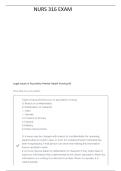
Legal Issues in Psychiatric/Mental Health Nursing (6)
Give this one a try later!
Types of lawsuits that occur in psychiatric nursing:
1.) Breach of confidentiality.
2.) Defamation of character.
→ Libel.
→ Slander.
3.) Invasion of privacy.
4.) Assault.
5.) Battery.
6.) False imprisonment.
1.) A nurse may be charged with breach of confidentiality for revealing
aspects about a client's case, or even for revealing that an individual has
been hospitalized, if that person can show that making this information
known resulted in harm.
2.) A nurse may be liable for defamation of character if they share false or
malicious information that is detrimental to the client's reputation. When this
information is in writing it is referred to as libel. When it is spoken, it is
called slander.
, 3.) Invasion of privacy charges can stem from searching a client without
probable cause.
4.) Assault is an act that result's in genuine fear that he or she will be
touched without consent.
5.) Battery is the unconsented touching of another person. Harm or injury
does not have to occur for these charges to be legitimate.
6.) A nurse can be charged with false imprisonment for holding a client
against his or her wishes outside of an emergency situation.
Legal Considerations
Give this one a try later!
1.) The Nurse Practice Act defines the legal parameters of professional and
practical nursing.
2.) Types of laws:
→ Statutory law: Are those that have been enacted by a legislative body
such as state legislature or the U.S. Congress.
→ Common law: Are derived from decisions that have been made in
previous cases and evolve from court decisions resolving various issues.
This laws may differ from state to state.
1.) The legal parameters of professional and practical nursing are defined
within each state by the state's Nurse Practice Act.
2.) These documents are passed by the state legislature and in general are
concerned with provisions such as:
The definition of important terms, including nursing itself and the various
types of nurses.
3.) A statement of the education and other training or requirements for
licensure and reciprocity
Broad statements that describe the scope of practice for various levels of
nursing (APN, RN, LPN)
4.) Conditions under which a nurse's license may be suspended or revoked,
and instructions for appeal
The general authority and powers of the state board of nursing.
, Core Concepts (1)
Give this one a try later!
1.) Ethics is a branch of philosophy that deals with systematic approaches to
distinguishing right from wrong behavior.
2.) Bioethics is the term applied to these principles when they refer to
concepts within the scope of medicine, nursing, and allied health.
Core Concepts (2)
Give this one a try later!
1.) Moral behavior is defined as conduct that results from serious critical
thinking about how individuals ought to treat others.
2.) Values are personal beliefs about what is important and desirable.
3.) Values clarification is a process of self-exploration through which
individuals identify and rank their own personal values.
Avoiding Liability
Give this one a try later!
Give this one a try later!
Types of lawsuits that occur in psychiatric nursing:
1.) Breach of confidentiality.
2.) Defamation of character.
→ Libel.
→ Slander.
3.) Invasion of privacy.
4.) Assault.
5.) Battery.
6.) False imprisonment.
1.) A nurse may be charged with breach of confidentiality for revealing
aspects about a client's case, or even for revealing that an individual has
been hospitalized, if that person can show that making this information
known resulted in harm.
2.) A nurse may be liable for defamation of character if they share false or
malicious information that is detrimental to the client's reputation. When this
information is in writing it is referred to as libel. When it is spoken, it is
called slander.
, 3.) Invasion of privacy charges can stem from searching a client without
probable cause.
4.) Assault is an act that result's in genuine fear that he or she will be
touched without consent.
5.) Battery is the unconsented touching of another person. Harm or injury
does not have to occur for these charges to be legitimate.
6.) A nurse can be charged with false imprisonment for holding a client
against his or her wishes outside of an emergency situation.
Legal Considerations
Give this one a try later!
1.) The Nurse Practice Act defines the legal parameters of professional and
practical nursing.
2.) Types of laws:
→ Statutory law: Are those that have been enacted by a legislative body
such as state legislature or the U.S. Congress.
→ Common law: Are derived from decisions that have been made in
previous cases and evolve from court decisions resolving various issues.
This laws may differ from state to state.
1.) The legal parameters of professional and practical nursing are defined
within each state by the state's Nurse Practice Act.
2.) These documents are passed by the state legislature and in general are
concerned with provisions such as:
The definition of important terms, including nursing itself and the various
types of nurses.
3.) A statement of the education and other training or requirements for
licensure and reciprocity
Broad statements that describe the scope of practice for various levels of
nursing (APN, RN, LPN)
4.) Conditions under which a nurse's license may be suspended or revoked,
and instructions for appeal
The general authority and powers of the state board of nursing.
, Core Concepts (1)
Give this one a try later!
1.) Ethics is a branch of philosophy that deals with systematic approaches to
distinguishing right from wrong behavior.
2.) Bioethics is the term applied to these principles when they refer to
concepts within the scope of medicine, nursing, and allied health.
Core Concepts (2)
Give this one a try later!
1.) Moral behavior is defined as conduct that results from serious critical
thinking about how individuals ought to treat others.
2.) Values are personal beliefs about what is important and desirable.
3.) Values clarification is a process of self-exploration through which
individuals identify and rank their own personal values.
Avoiding Liability
Give this one a try later!


