https://www.stuvia.com/user/nursecare
Instructor’s Solution Manual
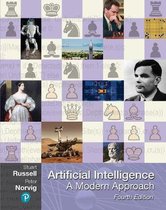
Artificial Intelligence A
Modern Approach
Fourth Edition
Stuart J. Russell and Peter Norvig
with contributions from
Nalin Chhibber, Ernest Davis, Nicholas J. Hay, Jared Moore,
Alex Rudnick, Mehran Sahami, Xiaocheng Mesut Yang, and
Albert Yu
This solution manual is intended for the instructor of a
class. Students should use the online site for exercises
at aimacode.github.io/aima-exercises. That site is
open for anyone to use. It offers solutions for some but
not all of the exercises; an instructor can check there to
see which ones have solutions. The exercises are
online rather than in the textbook itself because (a) the
textbook is long enough as is, and (b) we wanted to be
able to update the exercises frequently.
https://www.stuvia.com/user/nursecare
,https://www.stuvia.com/user/nursecare
Copyright © 2022
© 2023 Pearson Education, Hoboken, NJ. All rights reserved.
,https://www.stuvia.com/user/nursecare
EXERCISES
1
INTRODUCTION
Note that for many of the questions in this chapter, we
give references where answers can be found rather
than writing them out—the full answers would be far
too long.
1.1 What Is AI?
Exercise 1.1.#DEFA
Define in your own words: (a) intelligence, (b) artificial intelligence, (c) agent, (d) ra-
tionality, (e) logical reasoning.
a. Dictionary definitions of intelligence talk about
“the capacity to acquire and apply knowledge” or
“the faculty of thought and reason” or “the ability
to comprehend and profit from experience.” These
are all reasonable answers, but if we want
something quantifiable we would use something
like “the ability to act successfully across a wide
range of objectives in complex environments.”
b. We define artificial intelligence as the study and
construction of agent programs that perform well
in a given class of environments, for a given agent
architecture; they do the right thing. An important
part of that is dealing with the uncertainty of what
the current state is, what the outcome of possible
actions might be, and what is it that we really
https://www.stuvia.com/user/nursecare
,https://www.stuvia.com/user/nursecare
desire.
c. We define an agent as an entity that takes action in
response to percepts from an envi- ronment.
d. We define rationality as the property of a system
which does the “right thing” given what it knows.
See Section 2.2 for a more complete discussion.
The basic concept is perfect rationality; Section ??
describes the impossibility of achieving perfect
rational- ity and proposes an alternative definition.
e. We define logical reasoning as the a process of
deriving new sentences from old, such that the new
sentences are necessarily true if the old ones are
true. (Notice that does not refer to any specific
syntax or formal language, but it does require a
well-defined notion of truth.)
Exercise 1.1.#TURI
Read Turing’s original paper on AI (Turing, 1950). In the paper, he discusses several
objections to his proposed enterprise and his test for intelligence. Which objections still carry
© 2023 Pearson Education, Hoboken, NJ. All rights reserved.
Instructor’s Solution Manual
Artificial Intelligence A
Modern Approach
Fourth Edition
Stuart J. Russell and Peter Norvig
with contributions from
Nalin Chhibber, Ernest Davis, Nicholas J. Hay, Jared Moore,
Alex Rudnick, Mehran Sahami, Xiaocheng Mesut Yang, and
Albert Yu
This solution manual is intended for the instructor of a
class. Students should use the online site for exercises
at aimacode.github.io/aima-exercises. That site is
open for anyone to use. It offers solutions for some but
not all of the exercises; an instructor can check there to
see which ones have solutions. The exercises are
online rather than in the textbook itself because (a) the
textbook is long enough as is, and (b) we wanted to be
able to update the exercises frequently.
https://www.stuvia.com/user/nursecare
,https://www.stuvia.com/user/nursecare
Copyright © 2022
© 2023 Pearson Education, Hoboken, NJ. All rights reserved.
,https://www.stuvia.com/user/nursecare
EXERCISES
1
INTRODUCTION
Note that for many of the questions in this chapter, we
give references where answers can be found rather
than writing them out—the full answers would be far
too long.
1.1 What Is AI?
Exercise 1.1.#DEFA
Define in your own words: (a) intelligence, (b) artificial intelligence, (c) agent, (d) ra-
tionality, (e) logical reasoning.
a. Dictionary definitions of intelligence talk about
“the capacity to acquire and apply knowledge” or
“the faculty of thought and reason” or “the ability
to comprehend and profit from experience.” These
are all reasonable answers, but if we want
something quantifiable we would use something
like “the ability to act successfully across a wide
range of objectives in complex environments.”
b. We define artificial intelligence as the study and
construction of agent programs that perform well
in a given class of environments, for a given agent
architecture; they do the right thing. An important
part of that is dealing with the uncertainty of what
the current state is, what the outcome of possible
actions might be, and what is it that we really
https://www.stuvia.com/user/nursecare
,https://www.stuvia.com/user/nursecare
desire.
c. We define an agent as an entity that takes action in
response to percepts from an envi- ronment.
d. We define rationality as the property of a system
which does the “right thing” given what it knows.
See Section 2.2 for a more complete discussion.
The basic concept is perfect rationality; Section ??
describes the impossibility of achieving perfect
rational- ity and proposes an alternative definition.
e. We define logical reasoning as the a process of
deriving new sentences from old, such that the new
sentences are necessarily true if the old ones are
true. (Notice that does not refer to any specific
syntax or formal language, but it does require a
well-defined notion of truth.)
Exercise 1.1.#TURI
Read Turing’s original paper on AI (Turing, 1950). In the paper, he discusses several
objections to his proposed enterprise and his test for intelligence. Which objections still carry
© 2023 Pearson Education, Hoboken, NJ. All rights reserved.