
Applied Healthcare Statistics FINAL EXAM
Questions and Answers (Verified Answers)
Study Guide (latest version verified for
accuracy) | Latest!!
Save
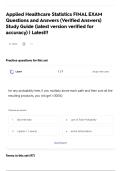
Practice questions for this set
Learn 1 /7 Study with Learn
for any probability tree, if you multiply alone each path and then sum all the
resulting products, you will get 1 (100%)
Choose an answer
1 discrete data 2 Law of Total Probability
3 1 gallon = ? quarts 4 prime factorization
Don't know?
Terms in this set (97)
, discrete data distinct values, can be counted, unconnected
points (ex. number of students)
continuous data values are within a range, measured not counted,
no gaps between data points (ex. time in a race)
less than or greater than marked with (parenthesis), open circle on number
line
less than or equal to marked with {brackets}, closed/shaded circle on
greater than or equal to number line
prime factorization writing the number as a product (multiplication)
of any prime numbers (ex. 12= 2x2x3)
greatest common factor the largest number that divides all the given
numbers evenly (ex. 8 and 10 = 2)
least common multiple the smallest number that can be divided by the
given numbers (ex. 16 and 32 = 16)
1 tablespoon = ? teaspoons 3 teaspoons
1 fluid ounce = ? tablespoons 2 tablespoons
1 cup = ? ounces 8 ounces
1 pint = ? cups 2 cups
1 quart = ? pints 2 pints
1 gallon = ? quarts 4 quarts
1 Liter = ? milliliter (mL) 1000mL
Questions and Answers (Verified Answers)
Study Guide (latest version verified for
accuracy) | Latest!!
Save
Practice questions for this set
Learn 1 /7 Study with Learn
for any probability tree, if you multiply alone each path and then sum all the
resulting products, you will get 1 (100%)
Choose an answer
1 discrete data 2 Law of Total Probability
3 1 gallon = ? quarts 4 prime factorization
Don't know?
Terms in this set (97)
, discrete data distinct values, can be counted, unconnected
points (ex. number of students)
continuous data values are within a range, measured not counted,
no gaps between data points (ex. time in a race)
less than or greater than marked with (parenthesis), open circle on number
line
less than or equal to marked with {brackets}, closed/shaded circle on
greater than or equal to number line
prime factorization writing the number as a product (multiplication)
of any prime numbers (ex. 12= 2x2x3)
greatest common factor the largest number that divides all the given
numbers evenly (ex. 8 and 10 = 2)
least common multiple the smallest number that can be divided by the
given numbers (ex. 16 and 32 = 16)
1 tablespoon = ? teaspoons 3 teaspoons
1 fluid ounce = ? tablespoons 2 tablespoons
1 cup = ? ounces 8 ounces
1 pint = ? cups 2 cups
1 quart = ? pints 2 pints
1 gallon = ? quarts 4 quarts
1 Liter = ? milliliter (mL) 1000mL


