

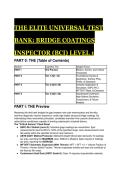
THE ELITE UNIVERSAL TEST
BANK: BRIDGE COATINGS
INSPECTOR (BCI) LEVEL 1
PART 0: THE (Table of Contents)
Section Cognitive Tier Subject Focus
PART I The Preview Mission, Axioms, and Critical
Thresholds
PART II Tier 1 (Q1–15) Foundational Syntax &
Application: Surface Prep,
Profile, & Standards
PART II Tier 2 (Q16–30) Complex Application &
Simulation: SSPC-PA 2,
WFT/DFT Math, & Extraction
PART II Tier 3 (Q31–40) Grandmaster Synthesis:
High-Stakes Simulation,
Containment, & Failure
Analysis
PART I: THE Preview
Mastering this test bank bridges the gap between rote code memorization and the elite,
real-time diagnostic intuition required to certify high-stakes structural bridge coatings. By
internalizing these mechanistic principles, candidates transition from passive observers to
authoritative practitioners capable of averting catastrophic industrial failures.
The "Critical Axioms" Cheat Sheet
● SSPC-PA 2 Default (Level 3): Individual gage readings are unrestricted. Spot
measurements must be 80% to 120% of the specified range. Area measurements must
fall exactly within the specified minimum and maximum.
● ASTM D4417 Method Protocols: Method B (Depth Micrometer) demands 10 readings
per area, reporting the MAXIMUM value. Method C (Replica Tape) requires 2 readings
per area, reporting the AVERAGE.
● WFT/DFT Volumetric Expansion (With Thinner): WFT = DFT × (1 + Volume Fraction of
Thinner) / Volume Solids Fraction. Thinner evaporates entirely and does not contribute to
the final dry film mass.
● Containment Hard Deck (SSPC Guide 6): Class 1A requires impenetrable materials,
, fully sealed joints, airlock entry, and a verified negative pressure of at least 0.03 inches
water column (W.C.).
● Bresle Method Conversion (ISO 8502-9): Soluble salt surface density measured in
mg/m² is converted to µg/cm² by dividing the value by 10.
PART II: THE ELITE TEST BANK
Tier 1: Foundational Syntax & Application
Q1: An inspector evaluates a steel bridge girder prepared using power tools. The specification
requires the complete removal of all visible oil, grease, dirt, rust, coating, and mill scale, but
permits random staining on no more than 33% of each 9-square-inch unit area. Based on the
principles of SSPC Surface Preparation Standards, which standard is MOST ACCURATE for
this requirement? A) SSPC-SP 3 B) SSPC-SP 11 C) SSPC-SP 15 D) SSPC-SP 10
● The Answer: C (SSPC-SP 15)
● Distractor Analysis:
○ A is incorrect: SSPC-SP 3 (Power Tool Cleaning) only removes loose contaminants
and does not require a minimum surface profile or define strict staining limits.
○ B is incorrect: SSPC-SP 11 (Power Tool Cleaning to Bare Metal) requires the
complete removal of all visible contaminants with zero allowable staining on the
surface.
○ D is incorrect: SSPC-SP 10 (Near-White Metal Blast Cleaning) allows 5% staining,
but it is an abrasive blast cleaning standard, not a power tool standard.
The Mentor's Analysis: SSPC-SP 15 bridges the gap between basic power tool cleaning and
bare-metal preparation, allowing for 33% staining while still mandating a 1.0-mil minimum
anchor profile. When abrasive blasting is prohibited due to environmental constraints, SP 15
provides a structurally sound mechanical bond for high-performance coatings.
Professional/Academic Intuition: SP 11 equals bare metal (0% stain); SP 15 equals
commercial power tool (33% stain). Both mandate a 1-mil profile.
Q2: During the preparation of a galvanized steel bridge rail, the specification requires the
removal of loose contaminants and the creation of a minimum 0.75-mil profile on the bare
substrate. Based on the principles of SSPC Surface Preparation, which standard dictates this
specific action? A) SSPC-SP 16 B) SSPC-SP 7 C) SSPC-SP 17 D) SSPC-SP 5
● The Answer: A (SSPC-SP 16)
● Distractor Analysis:
○ B is incorrect: SSPC-SP 7 (Brush-Off Blast Cleaning) applies to carbon steel, not
non-ferrous metals or galvanized surfaces, and does not mandate a specific profile
depth.
○ C is incorrect: SSPC-SP 17 is for Thorough Abrasive Blast Cleaning of non-ferrous
metals, comparable to an SP 10 near-white finish, which critically exceeds the
brush-off requirement.
○ D is incorrect: SSPC-SP 5 is White Metal Blast Cleaning for carbon steel substrates
exclusively.
The Mentor's Analysis: Galvanized and non-ferrous substrates require specialized treatment
to avoid obliterating the protective zinc layer while still achieving mechanical adhesion for the
topcoat. SSPC-SP 16 was specifically engineered to address this delicate balance on
non-ferrous substrates. Professional/Academic Intuition: Whenever non-ferrous or
, galvanized steel requires a brush-off blast with a specific profile (0.75 mil), SP 16 is the
governing law.
Q3: An inspector utilizes ASTM D4417 Method B (Depth Micrometer) to determine the surface
profile of a blast-cleaned structural beam. After taking 10 readings in a given measurement area
and discarding obvious outliers, what is the MOST ACCURATE procedure for reporting the final
profile value? A) Report the arithmetic average of the 10 readings. B) Report the maximum
value of the 10 readings. C) Report the median value of the 10 readings. D) Report the
minimum value to ensure worst-case compliance.
● The Answer: B (Report the maximum value of the 10 readings.)
● Distractor Analysis:
○ A is incorrect: Averaging is strictly reserved for ASTM D4417 Method C (Replica
Tape), not Method B.
○ C is incorrect: The median provides no mathematical significance under ASTM
standard practices for profile depth.
○ D is incorrect: Reporting the minimum value would critically underrepresent the
peak-to-valley height, leading to insufficient coating thickness over the peaks.
The Mentor's Analysis: Method B utilizes a fine conical probe that penetrates the valleys of the
blast profile. Because the probe cannot realistically find the absolute deepest valley every single
time, the statistical maximum of 10 readings is required to accurately represent the true
maximum peak-to-valley profile. Professional/Academic Intuition: Method B (Micrometer)
demands the MAXIMUM of 10 readings; Method C (Replica Tape) demands the AVERAGE
of 2 readings.
Q4: Prior to the application of a high-build epoxy, the inspector performs a blotter test on the
compressed air supply. Based on ASTM D4285, which sequence of parameters is the MOST
ACCURATE for conducting this test? A) Hold a white blotter paper 24 inches from the air supply
for 2 minutes. B) Hold a white blotter paper 18 inches from the air supply for 1 minute. C) Hold a
white blotter paper 12 inches from the air supply for 30 seconds. D) Hold a clear glass plate 18
inches from the air supply for 5 minutes.
● The Answer: B (Hold a white blotter paper 18 inches from the air supply for 1 minute.)
● Distractor Analysis:
○ A is incorrect: 24 inches is too distant to capture atomized oil/water droplets
accurately.
○ C is incorrect: 30 seconds is insufficient time to detect trace contamination.
○ D is incorrect: While occasionally practiced informally, ASTM D4285 specifically
references absorbent blotter paper or cloth, not a glass plate.
The Mentor's Analysis: Compressed air contamination (oil or moisture) introduces catastrophic
non-visible defects that cause immediate adhesion failure. The 18-inch, 1-minute standard
provides the exact physical proximity and duration necessary to visualize microscopic
compressor blow-by. Professional/Academic Intuition: Verify air purity every single shift:
18 inches, 1 minute, white absorbent target.
Q5: An inspector utilizes Testex Press-O-Film to measure surface profile per ASTM D4417
Method C. The first measurement yields 1.8 mils, and the second measurement in the exact
same location yields 2.2 mils. Both readings fall squarely within the 1.5 to 2.5 mil overlap range.
What is the IMMEDIATE required action? A) Discard the 1.8 mil reading and record 2.2 mils as
the final profile. B) Average the two readings and report 2.0 mils as the final profile. C)
Recalibrate the micrometer and take a third reading. D) Switch to X-Coarse Plus tape to verify
the readings.
● The Answer: B (Average the two readings and report 2.0 mils as the final profile.)
BANK: BRIDGE COATINGS
INSPECTOR (BCI) LEVEL 1
PART 0: THE (Table of Contents)
Section Cognitive Tier Subject Focus
PART I The Preview Mission, Axioms, and Critical
Thresholds
PART II Tier 1 (Q1–15) Foundational Syntax &
Application: Surface Prep,
Profile, & Standards
PART II Tier 2 (Q16–30) Complex Application &
Simulation: SSPC-PA 2,
WFT/DFT Math, & Extraction
PART II Tier 3 (Q31–40) Grandmaster Synthesis:
High-Stakes Simulation,
Containment, & Failure
Analysis
PART I: THE Preview
Mastering this test bank bridges the gap between rote code memorization and the elite,
real-time diagnostic intuition required to certify high-stakes structural bridge coatings. By
internalizing these mechanistic principles, candidates transition from passive observers to
authoritative practitioners capable of averting catastrophic industrial failures.
The "Critical Axioms" Cheat Sheet
● SSPC-PA 2 Default (Level 3): Individual gage readings are unrestricted. Spot
measurements must be 80% to 120% of the specified range. Area measurements must
fall exactly within the specified minimum and maximum.
● ASTM D4417 Method Protocols: Method B (Depth Micrometer) demands 10 readings
per area, reporting the MAXIMUM value. Method C (Replica Tape) requires 2 readings
per area, reporting the AVERAGE.
● WFT/DFT Volumetric Expansion (With Thinner): WFT = DFT × (1 + Volume Fraction of
Thinner) / Volume Solids Fraction. Thinner evaporates entirely and does not contribute to
the final dry film mass.
● Containment Hard Deck (SSPC Guide 6): Class 1A requires impenetrable materials,
, fully sealed joints, airlock entry, and a verified negative pressure of at least 0.03 inches
water column (W.C.).
● Bresle Method Conversion (ISO 8502-9): Soluble salt surface density measured in
mg/m² is converted to µg/cm² by dividing the value by 10.
PART II: THE ELITE TEST BANK
Tier 1: Foundational Syntax & Application
Q1: An inspector evaluates a steel bridge girder prepared using power tools. The specification
requires the complete removal of all visible oil, grease, dirt, rust, coating, and mill scale, but
permits random staining on no more than 33% of each 9-square-inch unit area. Based on the
principles of SSPC Surface Preparation Standards, which standard is MOST ACCURATE for
this requirement? A) SSPC-SP 3 B) SSPC-SP 11 C) SSPC-SP 15 D) SSPC-SP 10
● The Answer: C (SSPC-SP 15)
● Distractor Analysis:
○ A is incorrect: SSPC-SP 3 (Power Tool Cleaning) only removes loose contaminants
and does not require a minimum surface profile or define strict staining limits.
○ B is incorrect: SSPC-SP 11 (Power Tool Cleaning to Bare Metal) requires the
complete removal of all visible contaminants with zero allowable staining on the
surface.
○ D is incorrect: SSPC-SP 10 (Near-White Metal Blast Cleaning) allows 5% staining,
but it is an abrasive blast cleaning standard, not a power tool standard.
The Mentor's Analysis: SSPC-SP 15 bridges the gap between basic power tool cleaning and
bare-metal preparation, allowing for 33% staining while still mandating a 1.0-mil minimum
anchor profile. When abrasive blasting is prohibited due to environmental constraints, SP 15
provides a structurally sound mechanical bond for high-performance coatings.
Professional/Academic Intuition: SP 11 equals bare metal (0% stain); SP 15 equals
commercial power tool (33% stain). Both mandate a 1-mil profile.
Q2: During the preparation of a galvanized steel bridge rail, the specification requires the
removal of loose contaminants and the creation of a minimum 0.75-mil profile on the bare
substrate. Based on the principles of SSPC Surface Preparation, which standard dictates this
specific action? A) SSPC-SP 16 B) SSPC-SP 7 C) SSPC-SP 17 D) SSPC-SP 5
● The Answer: A (SSPC-SP 16)
● Distractor Analysis:
○ B is incorrect: SSPC-SP 7 (Brush-Off Blast Cleaning) applies to carbon steel, not
non-ferrous metals or galvanized surfaces, and does not mandate a specific profile
depth.
○ C is incorrect: SSPC-SP 17 is for Thorough Abrasive Blast Cleaning of non-ferrous
metals, comparable to an SP 10 near-white finish, which critically exceeds the
brush-off requirement.
○ D is incorrect: SSPC-SP 5 is White Metal Blast Cleaning for carbon steel substrates
exclusively.
The Mentor's Analysis: Galvanized and non-ferrous substrates require specialized treatment
to avoid obliterating the protective zinc layer while still achieving mechanical adhesion for the
topcoat. SSPC-SP 16 was specifically engineered to address this delicate balance on
non-ferrous substrates. Professional/Academic Intuition: Whenever non-ferrous or
, galvanized steel requires a brush-off blast with a specific profile (0.75 mil), SP 16 is the
governing law.
Q3: An inspector utilizes ASTM D4417 Method B (Depth Micrometer) to determine the surface
profile of a blast-cleaned structural beam. After taking 10 readings in a given measurement area
and discarding obvious outliers, what is the MOST ACCURATE procedure for reporting the final
profile value? A) Report the arithmetic average of the 10 readings. B) Report the maximum
value of the 10 readings. C) Report the median value of the 10 readings. D) Report the
minimum value to ensure worst-case compliance.
● The Answer: B (Report the maximum value of the 10 readings.)
● Distractor Analysis:
○ A is incorrect: Averaging is strictly reserved for ASTM D4417 Method C (Replica
Tape), not Method B.
○ C is incorrect: The median provides no mathematical significance under ASTM
standard practices for profile depth.
○ D is incorrect: Reporting the minimum value would critically underrepresent the
peak-to-valley height, leading to insufficient coating thickness over the peaks.
The Mentor's Analysis: Method B utilizes a fine conical probe that penetrates the valleys of the
blast profile. Because the probe cannot realistically find the absolute deepest valley every single
time, the statistical maximum of 10 readings is required to accurately represent the true
maximum peak-to-valley profile. Professional/Academic Intuition: Method B (Micrometer)
demands the MAXIMUM of 10 readings; Method C (Replica Tape) demands the AVERAGE
of 2 readings.
Q4: Prior to the application of a high-build epoxy, the inspector performs a blotter test on the
compressed air supply. Based on ASTM D4285, which sequence of parameters is the MOST
ACCURATE for conducting this test? A) Hold a white blotter paper 24 inches from the air supply
for 2 minutes. B) Hold a white blotter paper 18 inches from the air supply for 1 minute. C) Hold a
white blotter paper 12 inches from the air supply for 30 seconds. D) Hold a clear glass plate 18
inches from the air supply for 5 minutes.
● The Answer: B (Hold a white blotter paper 18 inches from the air supply for 1 minute.)
● Distractor Analysis:
○ A is incorrect: 24 inches is too distant to capture atomized oil/water droplets
accurately.
○ C is incorrect: 30 seconds is insufficient time to detect trace contamination.
○ D is incorrect: While occasionally practiced informally, ASTM D4285 specifically
references absorbent blotter paper or cloth, not a glass plate.
The Mentor's Analysis: Compressed air contamination (oil or moisture) introduces catastrophic
non-visible defects that cause immediate adhesion failure. The 18-inch, 1-minute standard
provides the exact physical proximity and duration necessary to visualize microscopic
compressor blow-by. Professional/Academic Intuition: Verify air purity every single shift:
18 inches, 1 minute, white absorbent target.
Q5: An inspector utilizes Testex Press-O-Film to measure surface profile per ASTM D4417
Method C. The first measurement yields 1.8 mils, and the second measurement in the exact
same location yields 2.2 mils. Both readings fall squarely within the 1.5 to 2.5 mil overlap range.
What is the IMMEDIATE required action? A) Discard the 1.8 mil reading and record 2.2 mils as
the final profile. B) Average the two readings and report 2.0 mils as the final profile. C)
Recalibrate the micrometer and take a third reading. D) Switch to X-Coarse Plus tape to verify
the readings.
● The Answer: B (Average the two readings and report 2.0 mils as the final profile.)


