

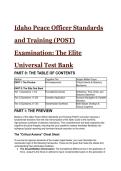
Idaho Peace Officer Standards
and Training (POST)
Examination: The Elite
Universal Test Bank
PART 0: THE TABLE OF CONTENTS
Section Cognitive Tier Subject Matter Focus
PART I: The Preview Pre-Assessment Critical Axioms & Statutory
Mechanics
PART II: The Elite Test Bank
Tier 1 (Questions 1–10) Foundational Syntax Definitions, Time Limits, and
Statutory Baselines
Tier 2 (Questions 11–20) Complex Application Scenario Navigation & Variable
Alteration
Tier 3 (Questions 21–30) Grandmaster Synthesis Multi-Statute Overlays &
Tactical Cognition
PART I: THE PREVIEW
Mastery of the Idaho Peace Officer Standards and Training (POST) curriculum requires a
fundamental transition from the rote memorization of the Idaho Code to the real-time,
high-pressure synthesis of statutory mechanics. This comprehensive test bank engineers elite
cognitive structural integrity, ensuring that your academic mastery translates flawlessly into
bulletproof judicial reporting and dominant tactical execution on the street.
The "Critical Axioms" Cheat Sheet
To survive the rigorous demands of the modern legal theater, you must internalize the
mechanistic logic of the following frameworks. These are the gears that make the statute turn;
understanding them eliminates hesitation.
● The Assault/Battery Demarcation: The foundational difference lies in the application of
force. Assault is the threat or attempt to injure, fundamentally based on the generation of
, fear in the victim. Battery requires the actual, willful, and unlawful touching or striking of
another person against their will.
● The Domestic Violence Threshold (I.C. § 18-918): Felony domestic violence hinges on
the infliction of a Traumatic Injury upon a household member. The state defines traumatic
injury broadly; it includes minor internal or external injuries, such as a simple red mark, a
scrape, or localized soreness resulting from physical force.
● The Strangulation Standard (I.C. § 18-923): Attempted strangulation of a household
member or dating partner is an automatic felony. The statute explicitly mandates that no
injuries are required to prove the crime, and the prosecution is not required to show that
the defendant had any specific intent to kill or severely injure the victim. The mere intent
to choke or attempt to strangle satisfies the legal requirement.
● The Intimidation Dichotomy (I.C. § 18-2604): The categorization of witness intimidation
relies entirely on the jurisdiction of the underlying case. Intimidating a witness in a criminal
proceeding is a felony. Conversely, intimidating a witness in a civil proceeding is classified
strictly as a misdemeanor.
● The OODA Loop Framework: Cognitive processing in high-stress environments follows
the Observe, Orient, Decide, and Act cycle. Whichever party cycles through this loop
faster wins the lethal encounter.
To further bypass common cognitive traps, refer to the statutory matrices below.
Offense Category Statute of Limitations Standard Exceptions & Triggers
Murder & Terrorism No Time Limit Includes Voluntary
Manslaughter.
Child Sexual Abuse No Time Limit Excludes non-sexual reporting
failures.
Standard Felony 5 Years Baseline for most unlisted
felonies.
Failure to Report Child Abuse 4 Years An exception to the standard
misdemeanor rule.
Ritualized Abuse of a Child 3 Years Clock begins exclusively upon
disclosure to law enforcement.
Standard Misdemeanor 1 Year Baseline for most unlisted
misdemeanors.
Substance First Tier Mandatory Second Tier Mandatory Maximum Penalty
Minimum Minimum
Heroin 2 grams = 3 Years 7 grams = 10 Years Life in Prison
Methamphetamine 28 grams = 3 Years 200 grams = 5 Years Life in Prison
Cocaine 28 grams = 3 Years 200 grams = 5 Years Life in Prison
Marijuana 1 pound = 1 Year 5 pounds = 3 Years 15 Years
PART II: THE ELITE TEST BANK
Tier 1: Foundational Syntax & Application
Q1: A patrol officer is dispatched to a dispute where a suspect verbally threatened to assault a
victim, raised a clenched fist, and stepped aggressively toward them, causing the victim to flinch
in genuine fear. No physical contact occurred. Based on the principles of the Idaho Code
, regarding violent crimes against the person, which classification is the MOST ACCURATE? A)
Simple Battery, because the suspect utilized physical movement in conjunction with a verbal
threat. B) Aggravated Battery, because the suspect demonstrated the clear intent to cause great
bodily harm. C) Assault, because the suspect's actions constituted an attempt to injure that
caused fear, without resulting in actual physical contact. D) Aggravated Assault, because the
raised fist is legally considered a deadly weapon under the statutory definitions of personal
combat.
● The Answer: C (Assault, because the suspect's actions constituted an attempt to injure
that caused fear, without resulting in actual physical contact.)
● Distractor Analysis:
○ A is incorrect: This is a highly plausible distractor based on a common novice
misconception that aggressive movement equals battery. Battery requires actual,
unlawful touching or striking.
○ B is incorrect: This option represents an analytical error. Intent to cause harm does
not elevate an offense to battery if the physical threshold of touching is never
crossed.
○ D is incorrect: This relies on an outdated, dramatic legal myth. A standard closed
fist is not classified as a deadly weapon or instrument required to trigger the
aggravated enhancement under the assault statutes.
The Mentor's Analysis: The fundamental physics of Idaho law regarding physical confrontation
rigorously divide the generation of fear from the execution of physical force. When facing a
confrontation scenario, the immediate priority is identifying whether physical contact actually
materialized. By utilizing the Touching Threshold, you bypass the common trap of conflating
menacing behavior with physical harm. Professional/Academic Intuition: Assault is the
promise of violence; Battery is the delivery of violence.
Q2: During a complex narcotics interdiction operation, an investigator uncovers historical
evidence that a suspect committed a standard felony theft exactly six years prior to the current
date. The suspect was never charged. Based on the principles of Idaho's criminal procedure
timelines, which conclusion is the MOST ACCURATE? A) The state may proceed with
prosecution because all felony offenses in Idaho possess no statute of limitations. B) The state
may proceed with prosecution because the clock does not begin until law enforcement actually
discovers the crime. C) The state cannot proceed with prosecution because standard felony
offenses are strictly bound by a five-year statute of limitations. D) The state cannot proceed with
prosecution because the suspect has remained in the state, rendering the tolling mechanism
active.
● The Answer: C (The state cannot proceed with prosecution because standard felony
offenses are strictly bound by a five-year statute of limitations.)
● Distractor Analysis:
○ A is incorrect: This is a massive analytical error. While murder, terrorism, and
specific sex crimes have no limits, standard felonies are constrained by strict
temporal boundaries.
○ B is incorrect: This is technically true for very specific crimes (like ritualized child
abuse), but it is contextually incorrect for a standard property felony, where the
clock begins at the commission of the offense.
○ D is incorrect: Remaining in the state does not activate tolling; leaving the state
typically tolls (pauses) the clock. Regardless, the foundational rule of five years is
the primary barrier.
The Mentor's Analysis: Temporal jurisdiction is the absolute hard deck of criminal prosecution.
and Training (POST)
Examination: The Elite
Universal Test Bank
PART 0: THE TABLE OF CONTENTS
Section Cognitive Tier Subject Matter Focus
PART I: The Preview Pre-Assessment Critical Axioms & Statutory
Mechanics
PART II: The Elite Test Bank
Tier 1 (Questions 1–10) Foundational Syntax Definitions, Time Limits, and
Statutory Baselines
Tier 2 (Questions 11–20) Complex Application Scenario Navigation & Variable
Alteration
Tier 3 (Questions 21–30) Grandmaster Synthesis Multi-Statute Overlays &
Tactical Cognition
PART I: THE PREVIEW
Mastery of the Idaho Peace Officer Standards and Training (POST) curriculum requires a
fundamental transition from the rote memorization of the Idaho Code to the real-time,
high-pressure synthesis of statutory mechanics. This comprehensive test bank engineers elite
cognitive structural integrity, ensuring that your academic mastery translates flawlessly into
bulletproof judicial reporting and dominant tactical execution on the street.
The "Critical Axioms" Cheat Sheet
To survive the rigorous demands of the modern legal theater, you must internalize the
mechanistic logic of the following frameworks. These are the gears that make the statute turn;
understanding them eliminates hesitation.
● The Assault/Battery Demarcation: The foundational difference lies in the application of
force. Assault is the threat or attempt to injure, fundamentally based on the generation of
, fear in the victim. Battery requires the actual, willful, and unlawful touching or striking of
another person against their will.
● The Domestic Violence Threshold (I.C. § 18-918): Felony domestic violence hinges on
the infliction of a Traumatic Injury upon a household member. The state defines traumatic
injury broadly; it includes minor internal or external injuries, such as a simple red mark, a
scrape, or localized soreness resulting from physical force.
● The Strangulation Standard (I.C. § 18-923): Attempted strangulation of a household
member or dating partner is an automatic felony. The statute explicitly mandates that no
injuries are required to prove the crime, and the prosecution is not required to show that
the defendant had any specific intent to kill or severely injure the victim. The mere intent
to choke or attempt to strangle satisfies the legal requirement.
● The Intimidation Dichotomy (I.C. § 18-2604): The categorization of witness intimidation
relies entirely on the jurisdiction of the underlying case. Intimidating a witness in a criminal
proceeding is a felony. Conversely, intimidating a witness in a civil proceeding is classified
strictly as a misdemeanor.
● The OODA Loop Framework: Cognitive processing in high-stress environments follows
the Observe, Orient, Decide, and Act cycle. Whichever party cycles through this loop
faster wins the lethal encounter.
To further bypass common cognitive traps, refer to the statutory matrices below.
Offense Category Statute of Limitations Standard Exceptions & Triggers
Murder & Terrorism No Time Limit Includes Voluntary
Manslaughter.
Child Sexual Abuse No Time Limit Excludes non-sexual reporting
failures.
Standard Felony 5 Years Baseline for most unlisted
felonies.
Failure to Report Child Abuse 4 Years An exception to the standard
misdemeanor rule.
Ritualized Abuse of a Child 3 Years Clock begins exclusively upon
disclosure to law enforcement.
Standard Misdemeanor 1 Year Baseline for most unlisted
misdemeanors.
Substance First Tier Mandatory Second Tier Mandatory Maximum Penalty
Minimum Minimum
Heroin 2 grams = 3 Years 7 grams = 10 Years Life in Prison
Methamphetamine 28 grams = 3 Years 200 grams = 5 Years Life in Prison
Cocaine 28 grams = 3 Years 200 grams = 5 Years Life in Prison
Marijuana 1 pound = 1 Year 5 pounds = 3 Years 15 Years
PART II: THE ELITE TEST BANK
Tier 1: Foundational Syntax & Application
Q1: A patrol officer is dispatched to a dispute where a suspect verbally threatened to assault a
victim, raised a clenched fist, and stepped aggressively toward them, causing the victim to flinch
in genuine fear. No physical contact occurred. Based on the principles of the Idaho Code
, regarding violent crimes against the person, which classification is the MOST ACCURATE? A)
Simple Battery, because the suspect utilized physical movement in conjunction with a verbal
threat. B) Aggravated Battery, because the suspect demonstrated the clear intent to cause great
bodily harm. C) Assault, because the suspect's actions constituted an attempt to injure that
caused fear, without resulting in actual physical contact. D) Aggravated Assault, because the
raised fist is legally considered a deadly weapon under the statutory definitions of personal
combat.
● The Answer: C (Assault, because the suspect's actions constituted an attempt to injure
that caused fear, without resulting in actual physical contact.)
● Distractor Analysis:
○ A is incorrect: This is a highly plausible distractor based on a common novice
misconception that aggressive movement equals battery. Battery requires actual,
unlawful touching or striking.
○ B is incorrect: This option represents an analytical error. Intent to cause harm does
not elevate an offense to battery if the physical threshold of touching is never
crossed.
○ D is incorrect: This relies on an outdated, dramatic legal myth. A standard closed
fist is not classified as a deadly weapon or instrument required to trigger the
aggravated enhancement under the assault statutes.
The Mentor's Analysis: The fundamental physics of Idaho law regarding physical confrontation
rigorously divide the generation of fear from the execution of physical force. When facing a
confrontation scenario, the immediate priority is identifying whether physical contact actually
materialized. By utilizing the Touching Threshold, you bypass the common trap of conflating
menacing behavior with physical harm. Professional/Academic Intuition: Assault is the
promise of violence; Battery is the delivery of violence.
Q2: During a complex narcotics interdiction operation, an investigator uncovers historical
evidence that a suspect committed a standard felony theft exactly six years prior to the current
date. The suspect was never charged. Based on the principles of Idaho's criminal procedure
timelines, which conclusion is the MOST ACCURATE? A) The state may proceed with
prosecution because all felony offenses in Idaho possess no statute of limitations. B) The state
may proceed with prosecution because the clock does not begin until law enforcement actually
discovers the crime. C) The state cannot proceed with prosecution because standard felony
offenses are strictly bound by a five-year statute of limitations. D) The state cannot proceed with
prosecution because the suspect has remained in the state, rendering the tolling mechanism
active.
● The Answer: C (The state cannot proceed with prosecution because standard felony
offenses are strictly bound by a five-year statute of limitations.)
● Distractor Analysis:
○ A is incorrect: This is a massive analytical error. While murder, terrorism, and
specific sex crimes have no limits, standard felonies are constrained by strict
temporal boundaries.
○ B is incorrect: This is technically true for very specific crimes (like ritualized child
abuse), but it is contextually incorrect for a standard property felony, where the
clock begins at the commission of the offense.
○ D is incorrect: Remaining in the state does not activate tolling; leaving the state
typically tolls (pauses) the clock. Regardless, the foundational rule of five years is
the primary barrier.
The Mentor's Analysis: Temporal jurisdiction is the absolute hard deck of criminal prosecution.


