

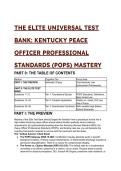
THE ELITE UNIVERSAL TEST
BANK: KENTUCKY PEACE
OFFICER PROFESSIONAL
STANDARDS (POPS) MASTERY
PART 0: THE TABLE OF CONTENTS
Section Cognitive Tier Focus Area
PART I: THE PREVIEW Axiomatic Theory Core Kentucky Law
Enforcement Frameworks
PART II: THE ELITE TEST
BANK
Questions 1–12 Tier 1: Foundational Syntax POPS Standards, Definitions,
Basic Arrest Law
Questions 13–24 Tier 2: Complex Application Citation vs. Arrest, DUI Law,
Use of Force
Questions 25–36 Tier 3: Grandmaster Synthesis Multi-variable High-Stakes
Tactical Scenarios
PART I: THE PREVIEW
Mastery of this Elite Test Bank directly forged the transition from a procedural novice into a
high-caliber Kentucky peace officer whose tactical intuition perfectly mirrors statutory
requirements. By systematically breaking down the Kentucky Revised Statutes (KRS), the
Peace Officer Professional Standards (POPS), and binding case law, you will hardwire the
cognitive frameworks required to survive both the courtroom and the street.
The "Critical Axioms" Cheat Sheet
● The POPS Gateway (KRS 15.382): Certification requires absolute purity in specific
background metrics. A felony, sexual misdemeanor, or dishonorable discharge equates to
permanent disqualification. There is no waiver for compromised integrity.
● The Arrest vs. Citation Mandate (KRS 431.015): The default state for a misdemeanor
committed in an officer's presence is a citation, not an arrest. Physical arrest is strictly
reserved for statutory exceptions: DUI, Assault 4th Degree, protective order violations, or
, imminent danger.
● The Use of Force Continuum (KRS 503.090): Deadly physical force is never justified for
property crimes. It is strictly limited to effecting an arrest for a felony involving deadly
force, or preventing the escape of a felon who poses an imminent threat to human life.
● The McCarthy Doctrine (DUI): Under McCarthy v. Commonwealth, a suspect's refusal to
submit to a warrantless blood test cannot be used as evidence of guilt, nor can it enhance
criminal penalties. This surgically separated blood tests from breath tests under implied
consent.
● The Theft Threshold (KRS 514.030): The felony threshold for Theft by Unlawful Taking
is $1,000. Values between $500 and $999 represent a Class A Misdemeanor, barring
statutory escalators like firearms or anhydrous ammonia.
PART II: THE ELITE TEST BANK
Tier 1: Foundational Syntax & Application
Q1: A candidate applies for a municipal police department in Kentucky. The background
investigation reveals the applicant possesses a high school diploma, was honorably discharged
from the military, and has a prior misdemeanor conviction for sexual abuse (KRS 510.120) from
five years ago that was recently legally expunged. Based on the Peace Officer Professional
Standards (KRS 15.382), which conclusion regarding the candidate's certification eligibility is the
MOST ACCURATE? A) The candidate is eligible because the conviction was a misdemeanor,
not a felony, and occurred over three years ago. B) The candidate is eligible because the charge
was legally expunged, effectively erasing it from their record for employment purposes. C) The
candidate is permanently disqualified from POPS certification due to the specific nature of the
misdemeanor, regardless of the expungement. D) The candidate is eligible pending a waiver
from the Kentucky Law Enforcement Council (KLEC) and a psychological suitability screening.
● The Answer: C (The candidate is permanently disqualified from POPS certification due to
the specific nature of the misdemeanor, regardless of the expungement.)
● Distractor Analysis:
○ A is incorrect: While standard misdemeanors do not automatically disqualify a
candidate, KRS 15.382 explicitly lists KRS 510.120 (sexual abuse) as an absolute
disqualifier.
○ B is incorrect: KRS 15.382 specifically states that having offenses listed under this
subsection expunged does not restore eligibility.
○ D is incorrect: There is no waiver process for mandatory statutory disqualifiers
under POPS. KLEC cannot override KRS 15.382.
The Mentor's Analysis: The state demands uncompromising moral purity for sexual offenses.
Even if a judge seals or expunges a conviction for the general public, the Kentucky Law
Enforcement Council retains the statutory right to view and disqualify based on sexual
misconduct. The ripple effect of this statute ensures that predators cannot use legal loopholes to
achieve positions of supreme public trust. Professional/Academic Intuition: Expungement is a
shield against the public, not against the Peace Officer Professional Standards.
Q2: During the physical agility pre-selection screening for a Kentucky Peace Officer, an
applicant is preparing for the dynamic strength component. According to the standardized KLEC
test battery, what is the minimum required weight the applicant must successfully bench press to
pass this specific event and meet the state standard? A) 50% of their body weight. B) A flat 150
, pounds, regardless of the applicant's body weight. C) 64% of their body weight. D) 73% of their
body weight.
● The Answer: C (64% of their body weight.)
● Distractor Analysis:
○ A is incorrect: 50% is below the validated job-task analysis standard for absolute
strength.
○ B is incorrect: The KLEC standard uses a body weight percentage ratio to measure
proportional absolute strength, rather than a flat weight, ensuring fairness across
diverse body types.
○ D is incorrect: 73% or higher earns an applicant maximum points (11 points) on the
matrix, but the minimum required baseline is 64% (which earns 10 points).
The Mentor's Analysis: Physical standards are not arbitrary; they are derived from a validated
job-task analysis of what it physically requires to survive a kinetic encounter on patrol. The
standard scales with the officer's mass, ensuring that smaller officers possess the proportional
strength to manipulate their own body weight during a physical altercation.
KLEC POPS Event Minimum Standard Maximum Point Threshold
Bench Press 64% body weight >73% body weight
Sit-ups (1 min) 18 repetitions N/A
300 Meter Run 65 seconds N/A
Push-ups 20 repetitions N/A
1.5 Mile Run 17:12 N/A
Professional/Academic Intuition: Minimum baseline competence in dynamic strength is
locked at 64% of body weight.
Q3: Under the Kentucky Penal Code (KRS 500.080), the distinction between a deadly weapon
and a dangerous instrument is critical for determining charge severity. Which of the following
items is statutorily defined exclusively as a DEADLY WEAPON regardless of how it is used? A)
A steel-toed boot. B) A baseball bat. C) A pair of artificial knuckles made from hard plastic. D) A
heavy glass bottle.
● The Answer: C (A pair of artificial knuckles made from hard plastic.)
● Distractor Analysis:
○ A is incorrect: A boot is a dangerous instrument, as it becomes dangerous only in
the manner it is used (e.g., kicking someone in the head).
○ B is incorrect: A baseball bat is designed for sports. It only becomes a dangerous
instrument when swung at a human.
○ D is incorrect: A bottle is a container that transitions into a dangerous instrument
based on circumstantial use.
The Mentor's Analysis: The law classifies items based on intrinsic design versus
circumstantial application. Items manufactured explicitly for violence (firearms, blackjacks,
artificial knuckles) are deadly weapons. Everyday items weaponized in the moment are
dangerous instruments. Misclassifying these in a report will result in an immediate grand jury
dismissal. Professional/Academic Intuition: Deadly weapons are dangerous by design;
dangerous instruments are dangerous by deployment.
Q4: Officer Miller observes a suspect walking out of a retail store with a stolen television. The
store manager provides video evidence confirming the theft. The value of the television is $850.
Under KRS 431.005, which statement regarding Officer Miller's arrest authority is the MOST
ACCURATE? A) Miller must obtain an arrest warrant because the theft is a misdemeanor and
was not fully committed in his presence. B) Miller may physically arrest the suspect immediately
BANK: KENTUCKY PEACE
OFFICER PROFESSIONAL
STANDARDS (POPS) MASTERY
PART 0: THE TABLE OF CONTENTS
Section Cognitive Tier Focus Area
PART I: THE PREVIEW Axiomatic Theory Core Kentucky Law
Enforcement Frameworks
PART II: THE ELITE TEST
BANK
Questions 1–12 Tier 1: Foundational Syntax POPS Standards, Definitions,
Basic Arrest Law
Questions 13–24 Tier 2: Complex Application Citation vs. Arrest, DUI Law,
Use of Force
Questions 25–36 Tier 3: Grandmaster Synthesis Multi-variable High-Stakes
Tactical Scenarios
PART I: THE PREVIEW
Mastery of this Elite Test Bank directly forged the transition from a procedural novice into a
high-caliber Kentucky peace officer whose tactical intuition perfectly mirrors statutory
requirements. By systematically breaking down the Kentucky Revised Statutes (KRS), the
Peace Officer Professional Standards (POPS), and binding case law, you will hardwire the
cognitive frameworks required to survive both the courtroom and the street.
The "Critical Axioms" Cheat Sheet
● The POPS Gateway (KRS 15.382): Certification requires absolute purity in specific
background metrics. A felony, sexual misdemeanor, or dishonorable discharge equates to
permanent disqualification. There is no waiver for compromised integrity.
● The Arrest vs. Citation Mandate (KRS 431.015): The default state for a misdemeanor
committed in an officer's presence is a citation, not an arrest. Physical arrest is strictly
reserved for statutory exceptions: DUI, Assault 4th Degree, protective order violations, or
, imminent danger.
● The Use of Force Continuum (KRS 503.090): Deadly physical force is never justified for
property crimes. It is strictly limited to effecting an arrest for a felony involving deadly
force, or preventing the escape of a felon who poses an imminent threat to human life.
● The McCarthy Doctrine (DUI): Under McCarthy v. Commonwealth, a suspect's refusal to
submit to a warrantless blood test cannot be used as evidence of guilt, nor can it enhance
criminal penalties. This surgically separated blood tests from breath tests under implied
consent.
● The Theft Threshold (KRS 514.030): The felony threshold for Theft by Unlawful Taking
is $1,000. Values between $500 and $999 represent a Class A Misdemeanor, barring
statutory escalators like firearms or anhydrous ammonia.
PART II: THE ELITE TEST BANK
Tier 1: Foundational Syntax & Application
Q1: A candidate applies for a municipal police department in Kentucky. The background
investigation reveals the applicant possesses a high school diploma, was honorably discharged
from the military, and has a prior misdemeanor conviction for sexual abuse (KRS 510.120) from
five years ago that was recently legally expunged. Based on the Peace Officer Professional
Standards (KRS 15.382), which conclusion regarding the candidate's certification eligibility is the
MOST ACCURATE? A) The candidate is eligible because the conviction was a misdemeanor,
not a felony, and occurred over three years ago. B) The candidate is eligible because the charge
was legally expunged, effectively erasing it from their record for employment purposes. C) The
candidate is permanently disqualified from POPS certification due to the specific nature of the
misdemeanor, regardless of the expungement. D) The candidate is eligible pending a waiver
from the Kentucky Law Enforcement Council (KLEC) and a psychological suitability screening.
● The Answer: C (The candidate is permanently disqualified from POPS certification due to
the specific nature of the misdemeanor, regardless of the expungement.)
● Distractor Analysis:
○ A is incorrect: While standard misdemeanors do not automatically disqualify a
candidate, KRS 15.382 explicitly lists KRS 510.120 (sexual abuse) as an absolute
disqualifier.
○ B is incorrect: KRS 15.382 specifically states that having offenses listed under this
subsection expunged does not restore eligibility.
○ D is incorrect: There is no waiver process for mandatory statutory disqualifiers
under POPS. KLEC cannot override KRS 15.382.
The Mentor's Analysis: The state demands uncompromising moral purity for sexual offenses.
Even if a judge seals or expunges a conviction for the general public, the Kentucky Law
Enforcement Council retains the statutory right to view and disqualify based on sexual
misconduct. The ripple effect of this statute ensures that predators cannot use legal loopholes to
achieve positions of supreme public trust. Professional/Academic Intuition: Expungement is a
shield against the public, not against the Peace Officer Professional Standards.
Q2: During the physical agility pre-selection screening for a Kentucky Peace Officer, an
applicant is preparing for the dynamic strength component. According to the standardized KLEC
test battery, what is the minimum required weight the applicant must successfully bench press to
pass this specific event and meet the state standard? A) 50% of their body weight. B) A flat 150
, pounds, regardless of the applicant's body weight. C) 64% of their body weight. D) 73% of their
body weight.
● The Answer: C (64% of their body weight.)
● Distractor Analysis:
○ A is incorrect: 50% is below the validated job-task analysis standard for absolute
strength.
○ B is incorrect: The KLEC standard uses a body weight percentage ratio to measure
proportional absolute strength, rather than a flat weight, ensuring fairness across
diverse body types.
○ D is incorrect: 73% or higher earns an applicant maximum points (11 points) on the
matrix, but the minimum required baseline is 64% (which earns 10 points).
The Mentor's Analysis: Physical standards are not arbitrary; they are derived from a validated
job-task analysis of what it physically requires to survive a kinetic encounter on patrol. The
standard scales with the officer's mass, ensuring that smaller officers possess the proportional
strength to manipulate their own body weight during a physical altercation.
KLEC POPS Event Minimum Standard Maximum Point Threshold
Bench Press 64% body weight >73% body weight
Sit-ups (1 min) 18 repetitions N/A
300 Meter Run 65 seconds N/A
Push-ups 20 repetitions N/A
1.5 Mile Run 17:12 N/A
Professional/Academic Intuition: Minimum baseline competence in dynamic strength is
locked at 64% of body weight.
Q3: Under the Kentucky Penal Code (KRS 500.080), the distinction between a deadly weapon
and a dangerous instrument is critical for determining charge severity. Which of the following
items is statutorily defined exclusively as a DEADLY WEAPON regardless of how it is used? A)
A steel-toed boot. B) A baseball bat. C) A pair of artificial knuckles made from hard plastic. D) A
heavy glass bottle.
● The Answer: C (A pair of artificial knuckles made from hard plastic.)
● Distractor Analysis:
○ A is incorrect: A boot is a dangerous instrument, as it becomes dangerous only in
the manner it is used (e.g., kicking someone in the head).
○ B is incorrect: A baseball bat is designed for sports. It only becomes a dangerous
instrument when swung at a human.
○ D is incorrect: A bottle is a container that transitions into a dangerous instrument
based on circumstantial use.
The Mentor's Analysis: The law classifies items based on intrinsic design versus
circumstantial application. Items manufactured explicitly for violence (firearms, blackjacks,
artificial knuckles) are deadly weapons. Everyday items weaponized in the moment are
dangerous instruments. Misclassifying these in a report will result in an immediate grand jury
dismissal. Professional/Academic Intuition: Deadly weapons are dangerous by design;
dangerous instruments are dangerous by deployment.
Q4: Officer Miller observes a suspect walking out of a retail store with a stolen television. The
store manager provides video evidence confirming the theft. The value of the television is $850.
Under KRS 431.005, which statement regarding Officer Miller's arrest authority is the MOST
ACCURATE? A) Miller must obtain an arrest warrant because the theft is a misdemeanor and
was not fully committed in his presence. B) Miller may physically arrest the suspect immediately


