NUR 216 Exam 4*: Breast & Reproductive
Study online at https://quizlet.com/_evqvu4
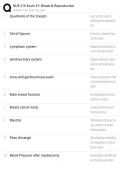
1. Quadrants of the breasts Four sections used to
identify breast abnormali-
ties
2. Tail of Spence Extension of breast tissue
into the axilla
3. Lymphatic system Network of vessels that as-
sist in immune function
4. Genitourinary system Organs involved in repro-
duction and waste excre-
tion
5. Anus and genitourinary exam Physical assessment of the
anal and genitourinary re-
gions
6. Male breast function No physiological function
related to lactation
7. Breast cancer lump Usually painless mass in
the breast tissue
8. Mastitis Inflammation of breast tis-
sue, common in breast-
feeding women
9. Peau d'orange Skin dimpling resembling
an orange peel, a sign of
breast cancer
10. Blood Pressure after mastectomy Avoid taking in the affected
arm during assessment
, NUR 216 Exam 4*: Breast & Reproductive
Study online at https://quizlet.com/_evqvu4
11. Circular Pattern Palpation Using circular motion from
areola to outer breast
perimeter
12. Vertical Strip Pattern Palpation Palpating up and down
from sternum to outer
breast perimeter
13. Radial Spoke Pattern Palpation Dividing breast into
wedges, palpating from
periphery towards nipple
14. Normal Palpation Findings Soft tissue density, no ten-
derness, lumps, or nipple
discharge
15. Abnormal Palpation Findings Firm or nodular tis-
sue, tenderness, lumps, or
masses may indicate is-
sues
16. Areolas & Nipples Palpation Checking for elasticity, dis-
charge, and tenderness
17. Breast Cancer Symptoms Changes in size, lumps,
nipple direction, dis-
charge, skin changes
18. Best Time for BSE 7-9 days after menses for
least swelling or tender-
ness
19. Mammogram Screening Recommendations
Study online at https://quizlet.com/_evqvu4
1. Quadrants of the breasts Four sections used to
identify breast abnormali-
ties
2. Tail of Spence Extension of breast tissue
into the axilla
3. Lymphatic system Network of vessels that as-
sist in immune function
4. Genitourinary system Organs involved in repro-
duction and waste excre-
tion
5. Anus and genitourinary exam Physical assessment of the
anal and genitourinary re-
gions
6. Male breast function No physiological function
related to lactation
7. Breast cancer lump Usually painless mass in
the breast tissue
8. Mastitis Inflammation of breast tis-
sue, common in breast-
feeding women
9. Peau d'orange Skin dimpling resembling
an orange peel, a sign of
breast cancer
10. Blood Pressure after mastectomy Avoid taking in the affected
arm during assessment
, NUR 216 Exam 4*: Breast & Reproductive
Study online at https://quizlet.com/_evqvu4
11. Circular Pattern Palpation Using circular motion from
areola to outer breast
perimeter
12. Vertical Strip Pattern Palpation Palpating up and down
from sternum to outer
breast perimeter
13. Radial Spoke Pattern Palpation Dividing breast into
wedges, palpating from
periphery towards nipple
14. Normal Palpation Findings Soft tissue density, no ten-
derness, lumps, or nipple
discharge
15. Abnormal Palpation Findings Firm or nodular tis-
sue, tenderness, lumps, or
masses may indicate is-
sues
16. Areolas & Nipples Palpation Checking for elasticity, dis-
charge, and tenderness
17. Breast Cancer Symptoms Changes in size, lumps,
nipple direction, dis-
charge, skin changes
18. Best Time for BSE 7-9 days after menses for
least swelling or tender-
ness
19. Mammogram Screening Recommendations