

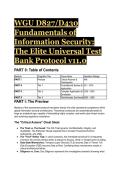
WGU D827/D430
Fundamentals of
Information Security:
The Elite Universal Test
Bank Protocol v11.0
PART 0: Table of Contents
Section Cognitive Tier Focus Area Question Range
PART I Prelude Critical Axioms & N/A
Frameworks
PART II Tier 1 Foundational Syntax & Q1 – Q15
Application
PART II Tier 2 Complex Application & Q16 – Q35
Simulation
PART II Tier 3 Grandmaster Synthesis Q36 – Q60
PART I: The Preview
Mastery of this assessment protocol translates directly into elite operational competence within
global information security architectures. Theoretical constructs are systematically tested to
forge an analytical rigor capable of dismantling highly complex, real-world cyber threat vectors
and achieving regulatory compliance.
The "Critical Axioms" Cheat Sheet
● The Triad vs. The Hexad: The CIA Triad governs Confidentiality, Integrity, and
Availability. The Parkerian Hexad expands this to include Possession/Control,
Authenticity, and Utility.
● The "Fix-It" Reflex Trap: In crisis scenarios, the immediate technical fix is frequently
incorrect; the correct primary action is always to Assess, Verify, or Analyze prior to acting.
● Data State Mismatches: Transport Layer Security (TLS) secures Data in Transit. Full
Disk Encryption (FDE) secures Data at Rest. Conflating these mechanisms results in
critical architectural failure.
● Diligence vs. Care: Due Diligence represents the investigative research (knowing what
, to do). Due Care represents the operational implementation (doing the right thing).
● The Interception Axiom: An interception attack exclusively compromises the
Confidentiality of an asset. A fabrication attack directly compromises Authenticity and
Integrity.
Axiomatic Frameworks for Rapid Synthesis
Regulation Primary Target Data Core Objective Reference
HIPAA ePHI (Medical Data) Privacy and security of
patient health
information.
FERPA Educational Records Privacy of student
academic and financial
data.
SOX Corporate Financials Prevention of corporate
accounting fraud.
GLBA Financial Institution Protection of consumer
Data data at banks/lenders.
FISMA Federal Government Security baselines for
Data U.S. Federal systems.
Access Control Model Decision Mechanism Ideal Use Case Reference
MAC Security Labels & Classified
Clearances Military/Government
DAC Data Owner Discretion Small Business /
Decentralized
RBAC Job Title / Function Enterprise Corporate
Environments
ABAC Environmental Zero-Trust / Remote
Variables (Time/IP) Workforces
PART II: THE ELITE TEST BANK
Tier 1: Foundational Syntax & Application
Q1: A security architect ensures that a proprietary financial database remains entirely unaltered
by unauthorized entities, while guaranteeing authorized users can reverse accidental
modifications. Based on the principles of the CIA Triad, which core attribute is the architect
PRIMARILY preserving? A) Confidentiality B) Authenticity C) Integrity D) Availability
● The Answer: C (Integrity)
● Distractor Analysis:
○ A is incorrect: Confidentiality strictly governs the prevention of unauthorized
disclosure or viewing of data, not its structural alteration.
○ B is incorrect: Authenticity verifies the origin or authorship of the data, rather than
the structural wholeness of the data itself.
○ D is incorrect: Availability ensures the database is accessible when requested; it
does not protect the data from unauthorized modifications.
, The Mentor's Analysis: The preservation of data wholeness, accuracy, and the ability to
reverse unwanted modifications falls exclusively under the domain of Integrity. When facing data
tampering, the immediate priority is verifying cryptographic hashes. By utilizing Hashing
algorithms, the practitioner bypasses the common trap of confusing data privacy with data
accuracy. Professional/Academic Intuition: Integrity ensures the data is correct and
unaltered; Confidentiality ensures it is hidden.
Q2: A corporate network experiences a volumetric Distributed Denial of Service (DDoS) attack,
rendering the customer portal completely inaccessible for 72 hours. Customer databases
remain fully encrypted and untouched. According to the CIA Triad, which principle has been
decisively compromised? A) Integrity B) Confidentiality C) Non-repudiation D) Availability
● The Answer: D (Availability)
● Distractor Analysis:
○ A is incorrect: The scenario explicitly states the data is untouched, meaning
Integrity is completely preserved.
○ B is incorrect: The data remains encrypted and unbreached; therefore,
Confidentiality is fully maintained.
○ C is incorrect: Non-repudiation prevents a subject from denying an action. A
volumetric attack on network bandwidth does not involve transactional denial.
The Mentor's Analysis: Volumetric attacks do not seek to steal or alter data; their sole purpose
is resource exhaustion. When facing an interruption attack, the immediate priority is restoring
system access. By utilizing Redundancy and Load Balancing, the practitioner bypasses the
common trap of misdiagnosing a downtime event as a data breach. Professional/Academic
Intuition: An inaccessible system is a compromised system, even if the cryptography
remains flawless.
Q3: A digital forensics team discovers a physically intact, highly encrypted hard drive stolen
from a rival corporation. The investigators cannot read the data, alter the data, or utilize the data
in any meaningful way. According to the Parkerian Hexad, which specific attribute has been
DIRECTLY violated? A) Confidentiality B) Possession or Control C) Utility D) Availability
● The Answer: B (Possession or Control)
● Distractor Analysis:
○ A is incorrect: Because the drive is highly encrypted and unreadable, Confidentiality
has not been breached.
○ C is incorrect: Utility refers to the usefulness of the data format. The format is
unchanged; the physical location is the issue.
○ D is incorrect: While the original owner lacks Availability, the Hexad categorizes the
physical theft of a locked asset as a specific loss of Possession.
The Mentor's Analysis: The Parkerian Hexad expands upon the CIA triad by recognizing that
an asset can be physically lost without its underlying data being exposed. When facing the
physical theft of encrypted media, the immediate priority is acknowledging the loss of physical
control. By utilizing Possession metrics, the practitioner bypasses the common trap of assuming
encrypted stolen data represents zero security impact. Professional/Academic Intuition: If an
adversary holds the physical media, Possession is lost, even if Confidentiality holds
strong.
Q4: A system administrator provisions access rights for a highly classified military research
environment. The system must enforce access based strictly on security labels (e.g., "Top
Secret") attached to the data, and users must possess a matching clearance. Which access
control model is the MOST APPROPRIATE choice? A) Discretionary Access Control (DAC) B)
Mandatory Access Control (MAC) C) Role-Based Access Control (RBAC) D) Attribute-Based
Fundamentals of
Information Security:
The Elite Universal Test
Bank Protocol v11.0
PART 0: Table of Contents
Section Cognitive Tier Focus Area Question Range
PART I Prelude Critical Axioms & N/A
Frameworks
PART II Tier 1 Foundational Syntax & Q1 – Q15
Application
PART II Tier 2 Complex Application & Q16 – Q35
Simulation
PART II Tier 3 Grandmaster Synthesis Q36 – Q60
PART I: The Preview
Mastery of this assessment protocol translates directly into elite operational competence within
global information security architectures. Theoretical constructs are systematically tested to
forge an analytical rigor capable of dismantling highly complex, real-world cyber threat vectors
and achieving regulatory compliance.
The "Critical Axioms" Cheat Sheet
● The Triad vs. The Hexad: The CIA Triad governs Confidentiality, Integrity, and
Availability. The Parkerian Hexad expands this to include Possession/Control,
Authenticity, and Utility.
● The "Fix-It" Reflex Trap: In crisis scenarios, the immediate technical fix is frequently
incorrect; the correct primary action is always to Assess, Verify, or Analyze prior to acting.
● Data State Mismatches: Transport Layer Security (TLS) secures Data in Transit. Full
Disk Encryption (FDE) secures Data at Rest. Conflating these mechanisms results in
critical architectural failure.
● Diligence vs. Care: Due Diligence represents the investigative research (knowing what
, to do). Due Care represents the operational implementation (doing the right thing).
● The Interception Axiom: An interception attack exclusively compromises the
Confidentiality of an asset. A fabrication attack directly compromises Authenticity and
Integrity.
Axiomatic Frameworks for Rapid Synthesis
Regulation Primary Target Data Core Objective Reference
HIPAA ePHI (Medical Data) Privacy and security of
patient health
information.
FERPA Educational Records Privacy of student
academic and financial
data.
SOX Corporate Financials Prevention of corporate
accounting fraud.
GLBA Financial Institution Protection of consumer
Data data at banks/lenders.
FISMA Federal Government Security baselines for
Data U.S. Federal systems.
Access Control Model Decision Mechanism Ideal Use Case Reference
MAC Security Labels & Classified
Clearances Military/Government
DAC Data Owner Discretion Small Business /
Decentralized
RBAC Job Title / Function Enterprise Corporate
Environments
ABAC Environmental Zero-Trust / Remote
Variables (Time/IP) Workforces
PART II: THE ELITE TEST BANK
Tier 1: Foundational Syntax & Application
Q1: A security architect ensures that a proprietary financial database remains entirely unaltered
by unauthorized entities, while guaranteeing authorized users can reverse accidental
modifications. Based on the principles of the CIA Triad, which core attribute is the architect
PRIMARILY preserving? A) Confidentiality B) Authenticity C) Integrity D) Availability
● The Answer: C (Integrity)
● Distractor Analysis:
○ A is incorrect: Confidentiality strictly governs the prevention of unauthorized
disclosure or viewing of data, not its structural alteration.
○ B is incorrect: Authenticity verifies the origin or authorship of the data, rather than
the structural wholeness of the data itself.
○ D is incorrect: Availability ensures the database is accessible when requested; it
does not protect the data from unauthorized modifications.
, The Mentor's Analysis: The preservation of data wholeness, accuracy, and the ability to
reverse unwanted modifications falls exclusively under the domain of Integrity. When facing data
tampering, the immediate priority is verifying cryptographic hashes. By utilizing Hashing
algorithms, the practitioner bypasses the common trap of confusing data privacy with data
accuracy. Professional/Academic Intuition: Integrity ensures the data is correct and
unaltered; Confidentiality ensures it is hidden.
Q2: A corporate network experiences a volumetric Distributed Denial of Service (DDoS) attack,
rendering the customer portal completely inaccessible for 72 hours. Customer databases
remain fully encrypted and untouched. According to the CIA Triad, which principle has been
decisively compromised? A) Integrity B) Confidentiality C) Non-repudiation D) Availability
● The Answer: D (Availability)
● Distractor Analysis:
○ A is incorrect: The scenario explicitly states the data is untouched, meaning
Integrity is completely preserved.
○ B is incorrect: The data remains encrypted and unbreached; therefore,
Confidentiality is fully maintained.
○ C is incorrect: Non-repudiation prevents a subject from denying an action. A
volumetric attack on network bandwidth does not involve transactional denial.
The Mentor's Analysis: Volumetric attacks do not seek to steal or alter data; their sole purpose
is resource exhaustion. When facing an interruption attack, the immediate priority is restoring
system access. By utilizing Redundancy and Load Balancing, the practitioner bypasses the
common trap of misdiagnosing a downtime event as a data breach. Professional/Academic
Intuition: An inaccessible system is a compromised system, even if the cryptography
remains flawless.
Q3: A digital forensics team discovers a physically intact, highly encrypted hard drive stolen
from a rival corporation. The investigators cannot read the data, alter the data, or utilize the data
in any meaningful way. According to the Parkerian Hexad, which specific attribute has been
DIRECTLY violated? A) Confidentiality B) Possession or Control C) Utility D) Availability
● The Answer: B (Possession or Control)
● Distractor Analysis:
○ A is incorrect: Because the drive is highly encrypted and unreadable, Confidentiality
has not been breached.
○ C is incorrect: Utility refers to the usefulness of the data format. The format is
unchanged; the physical location is the issue.
○ D is incorrect: While the original owner lacks Availability, the Hexad categorizes the
physical theft of a locked asset as a specific loss of Possession.
The Mentor's Analysis: The Parkerian Hexad expands upon the CIA triad by recognizing that
an asset can be physically lost without its underlying data being exposed. When facing the
physical theft of encrypted media, the immediate priority is acknowledging the loss of physical
control. By utilizing Possession metrics, the practitioner bypasses the common trap of assuming
encrypted stolen data represents zero security impact. Professional/Academic Intuition: If an
adversary holds the physical media, Possession is lost, even if Confidentiality holds
strong.
Q4: A system administrator provisions access rights for a highly classified military research
environment. The system must enforce access based strictly on security labels (e.g., "Top
Secret") attached to the data, and users must possess a matching clearance. Which access
control model is the MOST APPROPRIATE choice? A) Discretionary Access Control (DAC) B)
Mandatory Access Control (MAC) C) Role-Based Access Control (RBAC) D) Attribute-Based


