

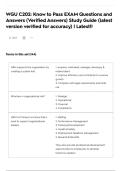
WGU C202: Know to Pass EXAM Questions and
Answers (Verified Answers) Study Guide (latest
version verified for accuracy) | Latest!!
Save
Terms in this set (144)
HRM supports the organization by 1. acquires, motivated, manages, develops, &
creating a system that retains talent.
2. Improve efficiency and contribute to revenue
growth.
3. Complies with legal requirements and limits
risk.
What are 4 organizational risk? 1. Strategic
2. Operational
3. Financial
4. Compliance
HRM's 6 Primary Functions that is 1. Staffing
used to support organizational 2. Performance Management
leaders. 3. Training & Development
4. Health & Safety
5. Employment-Relations Management
6. Rewards & Benefits
They also provide professional development
opportunities to employees to develop
tomorrow leaders.
, HRM (Change in organization) HRM communicates, builds trust, reduces
uncertainty, and reinforces culture.
Biggest Organizational change Mergers & Acquisitons
includes
HRM (Culture) "The way we do things around here" The norms,
values, and assumptions within the organization
that guide employees' attitudes and behaviors.
Standards to resolve ethical Common good, fairness, rights, utilitarian, &
dilemma virtues.
Common Good standard Ask yourself: is this going to benefit all
companies all over.
Example: child labor, over-time.
Fairness Standard "Equality": Should everyone be treated equal?
Rights Standard Should I refuse to do it b/c it violates the law or
company policy?
Example: a Walmart manager asking you to give
his family member an employee discount.
Utilitarian Standard "Scale": How can I balance doing more good
than harm?
Example: a company needing to cut back on
expenses and is contemplating whether to let 5
pt-timers go or reduce other staff's hours.
Diversity (hiring all kinds of people) Enables managers to hire, retain, and motivate
the best talent, which helps maximizing
organization's performance.
Answers (Verified Answers) Study Guide (latest
version verified for accuracy) | Latest!!
Save
Terms in this set (144)
HRM supports the organization by 1. acquires, motivated, manages, develops, &
creating a system that retains talent.
2. Improve efficiency and contribute to revenue
growth.
3. Complies with legal requirements and limits
risk.
What are 4 organizational risk? 1. Strategic
2. Operational
3. Financial
4. Compliance
HRM's 6 Primary Functions that is 1. Staffing
used to support organizational 2. Performance Management
leaders. 3. Training & Development
4. Health & Safety
5. Employment-Relations Management
6. Rewards & Benefits
They also provide professional development
opportunities to employees to develop
tomorrow leaders.
, HRM (Change in organization) HRM communicates, builds trust, reduces
uncertainty, and reinforces culture.
Biggest Organizational change Mergers & Acquisitons
includes
HRM (Culture) "The way we do things around here" The norms,
values, and assumptions within the organization
that guide employees' attitudes and behaviors.
Standards to resolve ethical Common good, fairness, rights, utilitarian, &
dilemma virtues.
Common Good standard Ask yourself: is this going to benefit all
companies all over.
Example: child labor, over-time.
Fairness Standard "Equality": Should everyone be treated equal?
Rights Standard Should I refuse to do it b/c it violates the law or
company policy?
Example: a Walmart manager asking you to give
his family member an employee discount.
Utilitarian Standard "Scale": How can I balance doing more good
than harm?
Example: a company needing to cut back on
expenses and is contemplating whether to let 5
pt-timers go or reduce other staff's hours.
Diversity (hiring all kinds of people) Enables managers to hire, retain, and motivate
the best talent, which helps maximizing
organization's performance.


