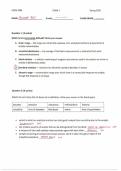
CHEM 2001 EXAM 2 Spring 2026
NAME: Apcwen \[‘57 Email___ EXAM GRADE:
Question 1: (4 points)
Which term is_incorrectly defined? Circle your answer.
A. linear range --- the range over which the response of an analytical method is proportional to
analyte concentration
B. corrected absorbance --- the average of the blank measurements is subtracted from each
measured absorbance
C. blank solution --- a solution containing all reagents and solvents used in the analysis to which no
analyte is deliberately added
@standard solutions --- solutions for which the standard deviation is known
E. dynamic range --- concentration range over which there is a measurable response to analyte,
though the response is not linear
Question 2: (8 points)
Match the term from the list below to its definition. Write your answer in the blank space.
accuracy precision robustness method blank linearity
selectivity limit of detection field blank matrix limit of quantitation
e extent to which an analytical method can distinguish analyte from everything else in the sample:
Serecnivity zet
e the smallest quantity of analyte that can be distinguished from the blank: _LIn(T o¢ o&tectior e
e ameasure of how well replicate measurements agree with each other: __(f€usior 20 ¢
e sample containing all components except analyte, and it is taken through all steps of the
analytical procedure: _ METHOL flare ze¢
, CHEM 2001 EXAM 2 Spring 2026
Question 3: (12 points)
A series of standards containing lead were tested using two different types of chemical analyses for lead
in a paint sample, with one method represented by the dashed curve (Method A) and the other method
by the black solid curve {(Method B).
50.0 2
Method B
400 y=10x+ 10
< R?Z=1
é 30.0 2.
g
x
$200
8 I T 1-4-r1
100¥ =1
o O-IF Method A
000 100 200 300 400 500 y=2.1143x+4.381
Pb Goncentration, ppm R2=0.9861
e Which method (A or B) does have the highest sensitivity? Why?
Methoo B ¢ riore Seesitivé tlee
Wt m QicHen Copé 2P¢S
e 10 mL of a paint sample was placed in a 25 mL volumetric flask and diluted to the mark with the
appropriate solvent. Analysis of this solution using method A gave an instrument response of 12.5
pA. What is the Pb concentration in the original paint sample in ppm? Show your work for full or
portial credit.
X + H.381 = X= .94 epmn
(2. = 2. 11y3
coppect Sewe= )€ coppsct vAcvé = 10€E
M, x lom»[ = B.9Yppm x 25 ml Copneit 36Tve = 20&
H = 9.¢o ¢pm 2¢¢e
NAME: Apcwen \[‘57 Email___ EXAM GRADE:
Question 1: (4 points)
Which term is_incorrectly defined? Circle your answer.
A. linear range --- the range over which the response of an analytical method is proportional to
analyte concentration
B. corrected absorbance --- the average of the blank measurements is subtracted from each
measured absorbance
C. blank solution --- a solution containing all reagents and solvents used in the analysis to which no
analyte is deliberately added
@standard solutions --- solutions for which the standard deviation is known
E. dynamic range --- concentration range over which there is a measurable response to analyte,
though the response is not linear
Question 2: (8 points)
Match the term from the list below to its definition. Write your answer in the blank space.
accuracy precision robustness method blank linearity
selectivity limit of detection field blank matrix limit of quantitation
e extent to which an analytical method can distinguish analyte from everything else in the sample:
Serecnivity zet
e the smallest quantity of analyte that can be distinguished from the blank: _LIn(T o¢ o&tectior e
e ameasure of how well replicate measurements agree with each other: __(f€usior 20 ¢
e sample containing all components except analyte, and it is taken through all steps of the
analytical procedure: _ METHOL flare ze¢
, CHEM 2001 EXAM 2 Spring 2026
Question 3: (12 points)
A series of standards containing lead were tested using two different types of chemical analyses for lead
in a paint sample, with one method represented by the dashed curve (Method A) and the other method
by the black solid curve {(Method B).
50.0 2
Method B
400 y=10x+ 10
< R?Z=1
é 30.0 2.
g
x
$200
8 I T 1-4-r1
100¥ =1
o O-IF Method A
000 100 200 300 400 500 y=2.1143x+4.381
Pb Goncentration, ppm R2=0.9861
e Which method (A or B) does have the highest sensitivity? Why?
Methoo B ¢ riore Seesitivé tlee
Wt m QicHen Copé 2P¢S
e 10 mL of a paint sample was placed in a 25 mL volumetric flask and diluted to the mark with the
appropriate solvent. Analysis of this solution using method A gave an instrument response of 12.5
pA. What is the Pb concentration in the original paint sample in ppm? Show your work for full or
portial credit.
X + H.381 = X= .94 epmn
(2. = 2. 11y3
coppect Sewe= )€ coppsct vAcvé = 10€E
M, x lom»[ = B.9Yppm x 25 ml Copneit 36Tve = 20&
H = 9.¢o ¢pm 2¢¢e