

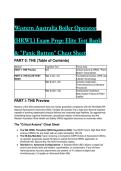
Western Australia Boiler Operator
(HRWL) Exam Prep: Elite Test Bank
& "Panic Button" Cheat Sheet
PART 0: THE (Table of Contents)
Section Cognitive Tier Focus Area
PART I: THE Preview N/A Critical Axioms & HRWL "Panic
Button" Cheat Sheet
PART II: THE ELITE TEST Tier 1 (Q1–10) Foundational Syntax, WHS Law
BANK & Boiler Terminology
Tier 2 (Q11–20) Complex Application,
Thermodynamics & Standard
Procedures
Tier 3 (Q21–30) Grandmaster Synthesis:
Multi-System Failure & PCBU
Liability
PART I: THE Preview
Mastery of this elite assessment does not merely guarantee compliance with the WorkSafe WA
National Assessment Instrument (NAI); it forges the operator into a high-level thermal engineer
capable of averting catastrophic physical failures and corporate legal liabilities. By aggressively
embedding these cognitive frameworks, operational mastery of thermodynamics and the
Western Australian Work Health and Safety (WHS) legislation becomes an automatic reflex.
The "Critical Axioms" Cheat Sheet
● The WA HRWL Threshold (WHS Regulations 2022): You MUST hold a High Risk Work
Licence (HRWL) for any boiler with an output exceeding 150 kW.
● The 60-Day Mandate: Upon receiving a Competent (CMP) Notice of Assessment (NOA),
an operator possesses exactly 60 days to submit the formal HRWL application to
WorkSafe WA. Beyond this, the NOA irreversibly expires.
● Standard vs. Advanced Configurations: A Standard Boiler (BS) utilizes a single fuel
source and strictly lacks pre-heaters, superheaters, or economisers. If any of those
thermodynamic recovery attachments are present, or if it utilizes multiple fuels
simultaneously, it is legally an Advanced Boiler (BA).
, ● The Blowdown Formula: BBR = \frac{SC \times TDSW}{TDSM - TDSW}. To maintain
safe Total Dissolved Solids (TDS), steam consumption (SC) must be mathematically
balanced against incoming feedwater impurities.
● The Hierarchy of Australian Standards: AS 1271 dictates safety valve and gauge
design ; AS 4343 dictates hazard levels (Levels A, B, and C mandate WorkSafe WA plant
registration) ; AS 3873 rules daily operation and maintenance ; and AS 2593:2021
governs safety management, unattended limits, and servicing intervals.
● WHS Act 2020 Penalties: A Category 1 offence (exposing an individual to death or
serious harm via gross negligence) carries a maximum corporate penalty of $3,500,000
and 5 years imprisonment for individuals.
PART II: THE ELITE TEST BANK
Tier 1: Foundational Syntax & Application
Q1: A Person Conducting a Business or Undertaking (PCBU) in Western Australia intends to
commission a steam boiler equipped with a single natural gas burner, a feedwater heater, and
an economiser. According to the Safe Work Australia High Risk Work Licence classes, which
unit of competency is REQUIRED for the primary operator? A) MSMBLIC001 Licence to operate
a standard boiler B) UEPOPL004 Licence to operate a steam turbine C) MSMBLIC002 Licence
to operate an advanced boiler D) CPCCLBM3001 Licence to operate a concrete placing boom
● The Answer: C (MSMBLIC002 Licence to operate an advanced boiler)
● Distractor Analysis:
○ A is incorrect: A standard boiler relies on a single fuel source and strictly excludes
the presence of a pre-heater, superheater, or economiser. Operating this plant with
a Standard Boiler licence constitutes unlicensed high-risk work.
○ B is incorrect: Steam turbines (TO) govern the expansion of steam for rotational
mechanical energy, not the generation of the steam itself.
○ D is incorrect: This is a throwaway distractor for construction equipment, utterly
irrelevant to pressure equipment operation.
The Mentor's Analysis: The legislative definition of an advanced boiler hinges entirely on
thermal efficiency attachments. Even if a boiler uses a single fuel source, the addition of an
economiser or a superheater immediately escalates the thermodynamic complexity,
necessitating an Advanced Boiler (BA) HRWL. Professional/Academic Intuition: Any thermal
recovery device (economiser, superheater, feedwater heater) instantly reclassifies a
boiler from Standard to Advanced.
Q2: Under the updated Western Australian WHS Regulations 2022, what is the EXACT
minimum output threshold that triggers the legal requirement for an operator to hold a Boiler
High Risk Work Licence? A) 500 kilowatts output B) 150 kilowatts output C) 250 kilowatts output
D) 1000 kilowatts output
● The Answer: B (150 kilowatts output)
● Distractor Analysis:
○ A is incorrect: 500 kW was the outdated legacy threshold under the repealed WA
OSH Regulations. Relying on this figure is a fatal compliance trap for veteran
operators failing to adapt to the harmonized WHS Act.
○ C is incorrect: This is a fabricated threshold that occasionally confuses candidates
with the 250 mm piston diameter limit for reciprocating steam engines (ES).
, ○ D is incorrect: 1000 kW represents industrial thresholds for certain legacy
unattended inspections, not the baseline licensing threshold.
The Mentor's Analysis: Regulatory harmonisation across Australia under the model WHS Act
resulted in a dramatic lowering of the HRWL threshold in Western Australia. By memorizing the
150 kW limit, the operator bypasses the common trap of operating mid-sized commercial boilers
illegally, which previously fell under the radar of the old 500 kW OSH exemptions.
Professional/Academic Intuition: The WA WHS Act 2020 legally mandates that boiler
HRWL jurisdiction begins at 150 kW—no exceptions.
Q3: An operator successfully completes their National Assessment Instrument (NAI) practical
exam and receives a Notice of Assessment (NOA) marked "Competent." What is the MAXIMUM
statutory timeframe allowed by WorkSafe WA for the operator to submit their HRWL application
before the NOA irreversibly expires? A) 30 days B) 90 days C) 60 days D) 12 months
● The Answer: C (60 days)
● Distractor Analysis:
○ A is incorrect: 30 days is a common administrative timeframe for standard
government forms, but HRWL regulations specifically afford exactly 60 days to
complete the processing.
○ B is incorrect: 90 days is technically invalid; delaying submission this long requires
a complete reassessment of both the theoretical and practical NAI components.
○ D is incorrect: 12 months refers to the grace period allowed for renewing an
expired, already-issued HRWL, not submitting an initial NOA application.
The Mentor's Analysis: Bureaucratic precision is as vital as mechanical precision. The WHS
Regulations explicitly grant a 60-day window to transition from a trainee holding a Notice of
Assessment to a fully licensed HRWL holder. Operating on day 61 without a submitted
application constitutes unlicensed high-risk work, opening the PCBU to severe penalties.
Professional/Academic Intuition: An NOA is a temporary bureaucratic bridge, not a
permanent shield; it evaporates precisely 60 days post-assessment.
Q4: A PCBU is auditing their plant's pressure equipment portfolio. According to Western
Australian plant registration requirements, boilers must be formally registered with WorkSafe
WA if they fall into which Hazard Levels as defined by AS 4343:2014? A) Hazard Levels C, D,
and E B) Hazard Levels A, B, or C C) Hazard Level A only D) Hazard Levels B, C, or D
● The Answer: B (Hazard Levels A, B, or C)
● Distractor Analysis:
○ A is incorrect: Levels D and E represent low-hazard equipment (e.g., small air
receivers, domestic water heaters) which are explicitly exempt from statutory
WorkSafe WA plant registration.
○ C is incorrect: While Hazard Level A is the most critical and lethal, restricting
registration to Level A ignores the massive explosive potential of B and C class
pressure vessels.
○ D is incorrect: Hazard Level D pressure equipment does not require plant
registration under the WHS Regulations.
The Mentor's Analysis: Australian Standard AS 4343 uses a complex matrix of pressure,
internal volume, fluid phase, and location to calculate a designated Hazard Level. WorkSafe WA
draws the legal line in the sand definitively between Level C and Level D. By forcing the
registration of A, B, and C equipment, the regulator maintains strict oversight on vessels
capable of catastrophic BLEVE (Boiling Liquid Expanding Vapor Explosion) events.
Professional/Academic Intuition: Hazard Levels A, B, and C are statutory liabilities; they
represent lethal kinetic energy and must be registered with the state regulator.
(HRWL) Exam Prep: Elite Test Bank
& "Panic Button" Cheat Sheet
PART 0: THE (Table of Contents)
Section Cognitive Tier Focus Area
PART I: THE Preview N/A Critical Axioms & HRWL "Panic
Button" Cheat Sheet
PART II: THE ELITE TEST Tier 1 (Q1–10) Foundational Syntax, WHS Law
BANK & Boiler Terminology
Tier 2 (Q11–20) Complex Application,
Thermodynamics & Standard
Procedures
Tier 3 (Q21–30) Grandmaster Synthesis:
Multi-System Failure & PCBU
Liability
PART I: THE Preview
Mastery of this elite assessment does not merely guarantee compliance with the WorkSafe WA
National Assessment Instrument (NAI); it forges the operator into a high-level thermal engineer
capable of averting catastrophic physical failures and corporate legal liabilities. By aggressively
embedding these cognitive frameworks, operational mastery of thermodynamics and the
Western Australian Work Health and Safety (WHS) legislation becomes an automatic reflex.
The "Critical Axioms" Cheat Sheet
● The WA HRWL Threshold (WHS Regulations 2022): You MUST hold a High Risk Work
Licence (HRWL) for any boiler with an output exceeding 150 kW.
● The 60-Day Mandate: Upon receiving a Competent (CMP) Notice of Assessment (NOA),
an operator possesses exactly 60 days to submit the formal HRWL application to
WorkSafe WA. Beyond this, the NOA irreversibly expires.
● Standard vs. Advanced Configurations: A Standard Boiler (BS) utilizes a single fuel
source and strictly lacks pre-heaters, superheaters, or economisers. If any of those
thermodynamic recovery attachments are present, or if it utilizes multiple fuels
simultaneously, it is legally an Advanced Boiler (BA).
, ● The Blowdown Formula: BBR = \frac{SC \times TDSW}{TDSM - TDSW}. To maintain
safe Total Dissolved Solids (TDS), steam consumption (SC) must be mathematically
balanced against incoming feedwater impurities.
● The Hierarchy of Australian Standards: AS 1271 dictates safety valve and gauge
design ; AS 4343 dictates hazard levels (Levels A, B, and C mandate WorkSafe WA plant
registration) ; AS 3873 rules daily operation and maintenance ; and AS 2593:2021
governs safety management, unattended limits, and servicing intervals.
● WHS Act 2020 Penalties: A Category 1 offence (exposing an individual to death or
serious harm via gross negligence) carries a maximum corporate penalty of $3,500,000
and 5 years imprisonment for individuals.
PART II: THE ELITE TEST BANK
Tier 1: Foundational Syntax & Application
Q1: A Person Conducting a Business or Undertaking (PCBU) in Western Australia intends to
commission a steam boiler equipped with a single natural gas burner, a feedwater heater, and
an economiser. According to the Safe Work Australia High Risk Work Licence classes, which
unit of competency is REQUIRED for the primary operator? A) MSMBLIC001 Licence to operate
a standard boiler B) UEPOPL004 Licence to operate a steam turbine C) MSMBLIC002 Licence
to operate an advanced boiler D) CPCCLBM3001 Licence to operate a concrete placing boom
● The Answer: C (MSMBLIC002 Licence to operate an advanced boiler)
● Distractor Analysis:
○ A is incorrect: A standard boiler relies on a single fuel source and strictly excludes
the presence of a pre-heater, superheater, or economiser. Operating this plant with
a Standard Boiler licence constitutes unlicensed high-risk work.
○ B is incorrect: Steam turbines (TO) govern the expansion of steam for rotational
mechanical energy, not the generation of the steam itself.
○ D is incorrect: This is a throwaway distractor for construction equipment, utterly
irrelevant to pressure equipment operation.
The Mentor's Analysis: The legislative definition of an advanced boiler hinges entirely on
thermal efficiency attachments. Even if a boiler uses a single fuel source, the addition of an
economiser or a superheater immediately escalates the thermodynamic complexity,
necessitating an Advanced Boiler (BA) HRWL. Professional/Academic Intuition: Any thermal
recovery device (economiser, superheater, feedwater heater) instantly reclassifies a
boiler from Standard to Advanced.
Q2: Under the updated Western Australian WHS Regulations 2022, what is the EXACT
minimum output threshold that triggers the legal requirement for an operator to hold a Boiler
High Risk Work Licence? A) 500 kilowatts output B) 150 kilowatts output C) 250 kilowatts output
D) 1000 kilowatts output
● The Answer: B (150 kilowatts output)
● Distractor Analysis:
○ A is incorrect: 500 kW was the outdated legacy threshold under the repealed WA
OSH Regulations. Relying on this figure is a fatal compliance trap for veteran
operators failing to adapt to the harmonized WHS Act.
○ C is incorrect: This is a fabricated threshold that occasionally confuses candidates
with the 250 mm piston diameter limit for reciprocating steam engines (ES).
, ○ D is incorrect: 1000 kW represents industrial thresholds for certain legacy
unattended inspections, not the baseline licensing threshold.
The Mentor's Analysis: Regulatory harmonisation across Australia under the model WHS Act
resulted in a dramatic lowering of the HRWL threshold in Western Australia. By memorizing the
150 kW limit, the operator bypasses the common trap of operating mid-sized commercial boilers
illegally, which previously fell under the radar of the old 500 kW OSH exemptions.
Professional/Academic Intuition: The WA WHS Act 2020 legally mandates that boiler
HRWL jurisdiction begins at 150 kW—no exceptions.
Q3: An operator successfully completes their National Assessment Instrument (NAI) practical
exam and receives a Notice of Assessment (NOA) marked "Competent." What is the MAXIMUM
statutory timeframe allowed by WorkSafe WA for the operator to submit their HRWL application
before the NOA irreversibly expires? A) 30 days B) 90 days C) 60 days D) 12 months
● The Answer: C (60 days)
● Distractor Analysis:
○ A is incorrect: 30 days is a common administrative timeframe for standard
government forms, but HRWL regulations specifically afford exactly 60 days to
complete the processing.
○ B is incorrect: 90 days is technically invalid; delaying submission this long requires
a complete reassessment of both the theoretical and practical NAI components.
○ D is incorrect: 12 months refers to the grace period allowed for renewing an
expired, already-issued HRWL, not submitting an initial NOA application.
The Mentor's Analysis: Bureaucratic precision is as vital as mechanical precision. The WHS
Regulations explicitly grant a 60-day window to transition from a trainee holding a Notice of
Assessment to a fully licensed HRWL holder. Operating on day 61 without a submitted
application constitutes unlicensed high-risk work, opening the PCBU to severe penalties.
Professional/Academic Intuition: An NOA is a temporary bureaucratic bridge, not a
permanent shield; it evaporates precisely 60 days post-assessment.
Q4: A PCBU is auditing their plant's pressure equipment portfolio. According to Western
Australian plant registration requirements, boilers must be formally registered with WorkSafe
WA if they fall into which Hazard Levels as defined by AS 4343:2014? A) Hazard Levels C, D,
and E B) Hazard Levels A, B, or C C) Hazard Level A only D) Hazard Levels B, C, or D
● The Answer: B (Hazard Levels A, B, or C)
● Distractor Analysis:
○ A is incorrect: Levels D and E represent low-hazard equipment (e.g., small air
receivers, domestic water heaters) which are explicitly exempt from statutory
WorkSafe WA plant registration.
○ C is incorrect: While Hazard Level A is the most critical and lethal, restricting
registration to Level A ignores the massive explosive potential of B and C class
pressure vessels.
○ D is incorrect: Hazard Level D pressure equipment does not require plant
registration under the WHS Regulations.
The Mentor's Analysis: Australian Standard AS 4343 uses a complex matrix of pressure,
internal volume, fluid phase, and location to calculate a designated Hazard Level. WorkSafe WA
draws the legal line in the sand definitively between Level C and Level D. By forcing the
registration of A, B, and C equipment, the regulator maintains strict oversight on vessels
capable of catastrophic BLEVE (Boiling Liquid Expanding Vapor Explosion) events.
Professional/Academic Intuition: Hazard Levels A, B, and C are statutory liabilities; they
represent lethal kinetic energy and must be registered with the state regulator.


