
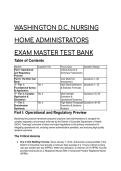
WASHINGTON D.C. NURSING
HOME ADMINISTRATORS
EXAM MASTER TEST BANK
Table of Contents
Section Cognitive Tier Focus Area Question Range
Part I: Operational - Critical Axioms & -
and Regulatory Summary Frameworks
Preview
Part II: The Elite Test - Core Multi-Tier Questions 1–60
Bank Assessment
├─ Tier 1: Tier 1 Hard Deck Definitions Questions 1–15
Foundational Syntax & Statutory Formulas
& Application
├─ Tier 2: Complex Tier 2 Multi-Variable Questions 16–35
Application & Scenarios &
Simulation Operational Dynamics
└─ Tier 3: Tier 3 High-Stakes Paragraph Questions 36–60
Grandmaster Scenarios & Systems
Synthesis Analysis
Part I: Operational and Regulatory Preview
Mastering this practice framework prepares long-term care administrators to navigate the
complex regulatory environment enforced by the District of Columbia Department of Health
(DOH). Thorough command of these municipal regulations is the primary mechanism for
mitigating operational risk, avoiding severe administrative penalties, and ensuring high-quality
resident outcomes.
The Critical Axioms
● The 4.1/0.6 Staffing Formula: Since January 1, 2012, all licensed nursing facilities in the
District of Columbia must provide a minimum daily average of 4.1 hours of direct nursing
care per resident per day (HPRD). Within this allocation, a minimum of 0.6 HPRD must be
provided exclusively by a Registered Nurse (RN) or Advanced Practice Registered Nurse
(APRN).
, ● The Dual-Track Incident Reporting Window: All unusual incidents must be documented
in the resident's medical record. If an incident results in physical harm, the facility must
report it to the DOH licensing agency within eight (8) hours. Incidents that do not result in
resident harm must be reported within forty-eight (48) hours.
● The Six-Week Absence Threshold: If the licensed Nursing Home Administrator (NHA) of
record is absent from the facility for more than six (6) consecutive weeks, the licensee
must formally designate a qualified acting administrator and provide immediate written
notification to the DOH licensing agency.
● The Continuing Education Triad: Biennial license renewal requires 40 contact hours of
approved continuing education. This portfolio must contain at least 10 hours in core
clinical/operational areas defined under 17 DCMR § 6206.4(a), 2 hours of LGBTQ-specific
cultural competency training, and 10% (4 hours) addressing District public health
priorities.
Part II: The Elite Test Bank
Tier 1: Foundational Syntax & Application
Q1: A newly licensed nursing home administrator in Washington D.C. is preparing for their first
license renewal. Under the modernized DC Health birth-month transition renewal system, what
determines the exact expiration date and subsequent renewal cycle of the administrator's
license? A) June 30 of each even-numbered year, regardless of birth date. B) June 30 of each
odd-numbered year, based on the initial licensure year. C) The last day of the administrator's
birth month, with the renewal year matching the parity of the administrator's birth year. D) The
last day of the administrator's birth month, with all renewals standardized to occur exclusively in
even-numbered years.
● The Answer: C (The last day of the administrator's birth month, with the renewal year
matching the parity of the administrator's birth year.)
● Distractor Analysis:
○ A is incorrect: This represents the legacy standard renewal system which expired
midnight June 30 of each even-numbered year.
○ B is incorrect: Licensure renewals have never historically defaulted to
odd-numbered years for all administrators, and this is incorrect under the new
protocol.
○ D is incorrect: Standardizing all renewals to even years is incorrect because
odd-year birthdays renew in odd years under the birth-month protocol.
The Mentor's Analysis: Under the modernized DC Health licensing framework, the District
transitioned from a fixed biennial date to an individualized birth-month cycle. When managing
professional licensure compliance, the administrator must align organizational credentialing
audits with this birth-month schedule rather than relying on legacy fixed-date calendars. By
utilizing the birth-month alignment protocol, the administrator avoids the risk of unlicensed
practice. Professional/Academic Intuition: Professional licenses in the District of Columbia
expire on the last day of the holder's birth month, with the renewal year's parity matching the
birth year's parity.
Q2: An administrator is reviewing the continuing education (CE) credits required for license
renewal in the District of Columbia. To meet the 40 contact hour requirement, which of the
following specific allocations of course content is MOST ACCURATE under Title 17 DCMR
,Chapter 62? A) 10 hours in any management topic, 2 hours in LGBTQ clinical treatment, and
10% (4 hours) in District public health priorities. B) 10 hours in specific practice areas under §
6206.4(a), 2 hours in LGBTQ cultural competency, and at least 10% (4 hours) in District public
health priorities. C) 20 hours in direct resident care, 5 hours in federal regulations, and 2 hours
in safety and infection control. D) 40 hours in any NAB-approved course, with no mandated
specific subject area allocations.
● The Answer: B (10 hours in specific practice areas under § 6206.4(a), 2 hours in LGBTQ
cultural competency, and at least 10% (4 hours) in District public health priorities.)
● Distractor Analysis:
○ A is incorrect: General management topics do not satisfy the specific requirement
for the 10 core practice hours under § 6206.4(a).
○ C is incorrect: This represents a generic state-level requirement and does not align
with the District's specialized statutory CE structure.
○ D is incorrect: While NAB approval is generally recognized, the District strictly
mandates the inclusion of LGBTQ and public health priority hours.
The Mentor's Analysis: Licensing compliance in the District of Columbia requires strict
adherence to content-specific CE quotas. Administrators must verify that their CE portfolios
contain at least 10 hours addressing core clinical/operational areas, 2 hours of LGBTQ training,
and 10% focused on public health priorities. By utilizing the content-specific CE tracking
framework, the administrator ensures successful renewal audits. Professional/Academic
Intuition: The District mandates that a 40-hour biennial CE portfolio include at least 10 hours in
§ 6206.4(a) core areas, 2 hours in LGBTQ cultural competency, and 10% in District public
health priorities.
Q3: A nursing home administrator is applying for their first license renewal in the District of
Columbia. Which of the following statements regarding their continuing education (CE)
requirements is MOST ACCURATE? A) The administrator must complete 20 CE hours instead
of the standard 40. B) The administrator is completely exempt from the 40-hour CE requirement
for this first renewal. C) The administrator must complete only the 2 hours of LGBTQ and 10%
public health priorities CEs. D) The administrator must complete the full 40 hours of CEs,
regardless of first-time status.
● The Answer: B (The administrator is completely exempt from the 40-hour CE
requirement for this first renewal.)
● Distractor Analysis:
○ A is incorrect: There is no pro-rated 20-hour general requirement for first-time
renewals.
○ C is incorrect: The first-time renewal exemption is comprehensive and applies to all
CE categories.
○ D is incorrect: This is a common misconception among novice administrators who
fail to realize that the first renewal cycle is exempt.
The Mentor's Analysis: D.C. regulations relieve newly licensed administrators of CE burdens
during their initial, partial licensing cycle. This transition period allows new practitioners to focus
entirely on operational mastery before mandatory CE cycles begin. By utilizing the first-cycle CE
exemption, the administrator optimizes resources during their transition into practice.
Professional/Academic Intuition: First-time licensure renewal applicants in the District of
Columbia are exempt from all continuing education requirements for that initial renewal.
Q4: A licensed nursing home administrator in D.C. is registered as an approved preceptor. What
is the maximum number of Administrator-in-Training (AIT) candidates this preceptor may
supervise concurrently under Chapter 62 of Title 17 DCMR? A) One candidate. B) Two
, candidates. C) Three candidates. D) Four candidates.
● The Answer: B (Two candidates.)
● Distractor Analysis:
○ A is incorrect: While a preceptor may choose to supervise only one candidate, the
maximum regulatory limit is higher.
○ C is incorrect: Three candidates exceeds the maximum threshold, which is
designed to prevent supervisory dilution.
○ D is incorrect: This is a legacy standard in some other jurisdictions but violates
D.C.'s quality control cap.
The Mentor's Analysis: To maintain the academic and professional integrity of the residency,
the D.C. Board limits a preceptor's active training load. This restriction ensures that each AIT
receives focused mentorship. By utilizing the direct mentorship cap, the preceptor prevents
administrative overextension. Professional/Academic Intuition: A registered and approved
preceptor in the District of Columbia is restricted from supervising more than two AIT candidates
at any given time.
Q5: An applicant seeking licensure as a nursing home administrator in the District of Columbia
must verify the completion of specific academic courses. Which of the following represents the
correct list of required subjects, each of which must consist of at least three (3) credit hours? A)
Finance, Labor Relations, Marketing, Sociology, Healthcare Policy, and Geriatric Nursing. B)
Accounting, Human Resources or Personnel Management, Management, Gerontology, Health
Care Law or Health Care Ethics, and Management of Long-Term Care Institutions. C)
Bookkeeping, Public Relations, Clinical Directives, Anatomy, Medical Terminology, and
Long-Term Care Operations. D) Economics, Organizational Behavior, Strategic Planning, Social
Work, Bioethics, and Assisted Living Administration.
● The Answer: B (Accounting, Human Resources or Personnel Management,
Management, Gerontology, Health Care Law or Health Care Ethics, and Management of
Long-Term Care Institutions.)
● Distractor Analysis:
○ A is incorrect: These courses, while relevant to business, do not match the specific
regulatory list mandated under D.C. law.
○ C is incorrect: This represents a clinical-leaning curriculum that is not required for
the general administrative license.
○ D is incorrect: These subjects are related but do not satisfy the explicit statutory
curriculum requirements.
The Mentor's Analysis: D.C. Municipal Regulations mandate a specific 18-credit core
academic curriculum. This coursework ensures that every licensed administrator possesses a
balanced foundation in business, law, clinical aging, and long-term care operations. By utilizing
the core curriculum alignment matrix, the applicant ensures their academic credentials will pass
Board review. Professional/Academic Intuition: To qualify for licensure, the applicant must
complete six specific three-credit courses covering Accounting, Human Resources,
Management, Gerontology, Health Care Law/Ethics, and Long-Term Care Management.
Q6: To comply with administrative management regulations in Washington D.C., what is the
minimum number of hours per week that the licensed administrator of record must be present in
the facility during regular business hours? A) 30 hours per week. B) 35 hours per week. C) 40
hours per week. D) 45 hours per week.
● The Answer: C (40 hours per week.)
● Distractor Analysis:
○ A is incorrect: 30 hours is insufficient and constitutes a regulatory deficiency under
HOME ADMINISTRATORS
EXAM MASTER TEST BANK
Table of Contents
Section Cognitive Tier Focus Area Question Range
Part I: Operational - Critical Axioms & -
and Regulatory Summary Frameworks
Preview
Part II: The Elite Test - Core Multi-Tier Questions 1–60
Bank Assessment
├─ Tier 1: Tier 1 Hard Deck Definitions Questions 1–15
Foundational Syntax & Statutory Formulas
& Application
├─ Tier 2: Complex Tier 2 Multi-Variable Questions 16–35
Application & Scenarios &
Simulation Operational Dynamics
└─ Tier 3: Tier 3 High-Stakes Paragraph Questions 36–60
Grandmaster Scenarios & Systems
Synthesis Analysis
Part I: Operational and Regulatory Preview
Mastering this practice framework prepares long-term care administrators to navigate the
complex regulatory environment enforced by the District of Columbia Department of Health
(DOH). Thorough command of these municipal regulations is the primary mechanism for
mitigating operational risk, avoiding severe administrative penalties, and ensuring high-quality
resident outcomes.
The Critical Axioms
● The 4.1/0.6 Staffing Formula: Since January 1, 2012, all licensed nursing facilities in the
District of Columbia must provide a minimum daily average of 4.1 hours of direct nursing
care per resident per day (HPRD). Within this allocation, a minimum of 0.6 HPRD must be
provided exclusively by a Registered Nurse (RN) or Advanced Practice Registered Nurse
(APRN).
, ● The Dual-Track Incident Reporting Window: All unusual incidents must be documented
in the resident's medical record. If an incident results in physical harm, the facility must
report it to the DOH licensing agency within eight (8) hours. Incidents that do not result in
resident harm must be reported within forty-eight (48) hours.
● The Six-Week Absence Threshold: If the licensed Nursing Home Administrator (NHA) of
record is absent from the facility for more than six (6) consecutive weeks, the licensee
must formally designate a qualified acting administrator and provide immediate written
notification to the DOH licensing agency.
● The Continuing Education Triad: Biennial license renewal requires 40 contact hours of
approved continuing education. This portfolio must contain at least 10 hours in core
clinical/operational areas defined under 17 DCMR § 6206.4(a), 2 hours of LGBTQ-specific
cultural competency training, and 10% (4 hours) addressing District public health
priorities.
Part II: The Elite Test Bank
Tier 1: Foundational Syntax & Application
Q1: A newly licensed nursing home administrator in Washington D.C. is preparing for their first
license renewal. Under the modernized DC Health birth-month transition renewal system, what
determines the exact expiration date and subsequent renewal cycle of the administrator's
license? A) June 30 of each even-numbered year, regardless of birth date. B) June 30 of each
odd-numbered year, based on the initial licensure year. C) The last day of the administrator's
birth month, with the renewal year matching the parity of the administrator's birth year. D) The
last day of the administrator's birth month, with all renewals standardized to occur exclusively in
even-numbered years.
● The Answer: C (The last day of the administrator's birth month, with the renewal year
matching the parity of the administrator's birth year.)
● Distractor Analysis:
○ A is incorrect: This represents the legacy standard renewal system which expired
midnight June 30 of each even-numbered year.
○ B is incorrect: Licensure renewals have never historically defaulted to
odd-numbered years for all administrators, and this is incorrect under the new
protocol.
○ D is incorrect: Standardizing all renewals to even years is incorrect because
odd-year birthdays renew in odd years under the birth-month protocol.
The Mentor's Analysis: Under the modernized DC Health licensing framework, the District
transitioned from a fixed biennial date to an individualized birth-month cycle. When managing
professional licensure compliance, the administrator must align organizational credentialing
audits with this birth-month schedule rather than relying on legacy fixed-date calendars. By
utilizing the birth-month alignment protocol, the administrator avoids the risk of unlicensed
practice. Professional/Academic Intuition: Professional licenses in the District of Columbia
expire on the last day of the holder's birth month, with the renewal year's parity matching the
birth year's parity.
Q2: An administrator is reviewing the continuing education (CE) credits required for license
renewal in the District of Columbia. To meet the 40 contact hour requirement, which of the
following specific allocations of course content is MOST ACCURATE under Title 17 DCMR
,Chapter 62? A) 10 hours in any management topic, 2 hours in LGBTQ clinical treatment, and
10% (4 hours) in District public health priorities. B) 10 hours in specific practice areas under §
6206.4(a), 2 hours in LGBTQ cultural competency, and at least 10% (4 hours) in District public
health priorities. C) 20 hours in direct resident care, 5 hours in federal regulations, and 2 hours
in safety and infection control. D) 40 hours in any NAB-approved course, with no mandated
specific subject area allocations.
● The Answer: B (10 hours in specific practice areas under § 6206.4(a), 2 hours in LGBTQ
cultural competency, and at least 10% (4 hours) in District public health priorities.)
● Distractor Analysis:
○ A is incorrect: General management topics do not satisfy the specific requirement
for the 10 core practice hours under § 6206.4(a).
○ C is incorrect: This represents a generic state-level requirement and does not align
with the District's specialized statutory CE structure.
○ D is incorrect: While NAB approval is generally recognized, the District strictly
mandates the inclusion of LGBTQ and public health priority hours.
The Mentor's Analysis: Licensing compliance in the District of Columbia requires strict
adherence to content-specific CE quotas. Administrators must verify that their CE portfolios
contain at least 10 hours addressing core clinical/operational areas, 2 hours of LGBTQ training,
and 10% focused on public health priorities. By utilizing the content-specific CE tracking
framework, the administrator ensures successful renewal audits. Professional/Academic
Intuition: The District mandates that a 40-hour biennial CE portfolio include at least 10 hours in
§ 6206.4(a) core areas, 2 hours in LGBTQ cultural competency, and 10% in District public
health priorities.
Q3: A nursing home administrator is applying for their first license renewal in the District of
Columbia. Which of the following statements regarding their continuing education (CE)
requirements is MOST ACCURATE? A) The administrator must complete 20 CE hours instead
of the standard 40. B) The administrator is completely exempt from the 40-hour CE requirement
for this first renewal. C) The administrator must complete only the 2 hours of LGBTQ and 10%
public health priorities CEs. D) The administrator must complete the full 40 hours of CEs,
regardless of first-time status.
● The Answer: B (The administrator is completely exempt from the 40-hour CE
requirement for this first renewal.)
● Distractor Analysis:
○ A is incorrect: There is no pro-rated 20-hour general requirement for first-time
renewals.
○ C is incorrect: The first-time renewal exemption is comprehensive and applies to all
CE categories.
○ D is incorrect: This is a common misconception among novice administrators who
fail to realize that the first renewal cycle is exempt.
The Mentor's Analysis: D.C. regulations relieve newly licensed administrators of CE burdens
during their initial, partial licensing cycle. This transition period allows new practitioners to focus
entirely on operational mastery before mandatory CE cycles begin. By utilizing the first-cycle CE
exemption, the administrator optimizes resources during their transition into practice.
Professional/Academic Intuition: First-time licensure renewal applicants in the District of
Columbia are exempt from all continuing education requirements for that initial renewal.
Q4: A licensed nursing home administrator in D.C. is registered as an approved preceptor. What
is the maximum number of Administrator-in-Training (AIT) candidates this preceptor may
supervise concurrently under Chapter 62 of Title 17 DCMR? A) One candidate. B) Two
, candidates. C) Three candidates. D) Four candidates.
● The Answer: B (Two candidates.)
● Distractor Analysis:
○ A is incorrect: While a preceptor may choose to supervise only one candidate, the
maximum regulatory limit is higher.
○ C is incorrect: Three candidates exceeds the maximum threshold, which is
designed to prevent supervisory dilution.
○ D is incorrect: This is a legacy standard in some other jurisdictions but violates
D.C.'s quality control cap.
The Mentor's Analysis: To maintain the academic and professional integrity of the residency,
the D.C. Board limits a preceptor's active training load. This restriction ensures that each AIT
receives focused mentorship. By utilizing the direct mentorship cap, the preceptor prevents
administrative overextension. Professional/Academic Intuition: A registered and approved
preceptor in the District of Columbia is restricted from supervising more than two AIT candidates
at any given time.
Q5: An applicant seeking licensure as a nursing home administrator in the District of Columbia
must verify the completion of specific academic courses. Which of the following represents the
correct list of required subjects, each of which must consist of at least three (3) credit hours? A)
Finance, Labor Relations, Marketing, Sociology, Healthcare Policy, and Geriatric Nursing. B)
Accounting, Human Resources or Personnel Management, Management, Gerontology, Health
Care Law or Health Care Ethics, and Management of Long-Term Care Institutions. C)
Bookkeeping, Public Relations, Clinical Directives, Anatomy, Medical Terminology, and
Long-Term Care Operations. D) Economics, Organizational Behavior, Strategic Planning, Social
Work, Bioethics, and Assisted Living Administration.
● The Answer: B (Accounting, Human Resources or Personnel Management,
Management, Gerontology, Health Care Law or Health Care Ethics, and Management of
Long-Term Care Institutions.)
● Distractor Analysis:
○ A is incorrect: These courses, while relevant to business, do not match the specific
regulatory list mandated under D.C. law.
○ C is incorrect: This represents a clinical-leaning curriculum that is not required for
the general administrative license.
○ D is incorrect: These subjects are related but do not satisfy the explicit statutory
curriculum requirements.
The Mentor's Analysis: D.C. Municipal Regulations mandate a specific 18-credit core
academic curriculum. This coursework ensures that every licensed administrator possesses a
balanced foundation in business, law, clinical aging, and long-term care operations. By utilizing
the core curriculum alignment matrix, the applicant ensures their academic credentials will pass
Board review. Professional/Academic Intuition: To qualify for licensure, the applicant must
complete six specific three-credit courses covering Accounting, Human Resources,
Management, Gerontology, Health Care Law/Ethics, and Long-Term Care Management.
Q6: To comply with administrative management regulations in Washington D.C., what is the
minimum number of hours per week that the licensed administrator of record must be present in
the facility during regular business hours? A) 30 hours per week. B) 35 hours per week. C) 40
hours per week. D) 45 hours per week.
● The Answer: C (40 hours per week.)
● Distractor Analysis:
○ A is incorrect: 30 hours is insufficient and constitutes a regulatory deficiency under


