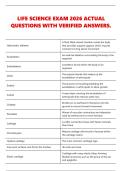
LIFE SCIENCE EXAM 2026 ACTUAL
QUESTIONS WITH VERIFIED ANSWERS.
A fluid-filled closed chamber inside the body
Hydrostatic skeleton that provides support against which muscles
contract to bring about movement
An external skeleton surrounding the body of an
Exoskeleton
organism
A skeleton found within the body of an
Endoskeleton
organism
The polysaccharide that makes up the
Chitin
exoskeleton of arthropods
The process of moulting/shedding the
Ecdysis
exoskeleton in arthropods to allow growth
A waxy layer covering the exoskeleton of
Cuticle
arthropods that reduces water loss
Bristles on an earthworm that press into the
Chaetae
ground to ensure forward movement
Waves of muscular contraction and relaxation
Peristalsis
used by earthworms to move forward
A softer connective tissue with fewer minerals
Cartilage
than bone
Mature cartilage cells found in lacunae within
Chondrocytes
the cartilage matrix
Hyaline cartilage The most common cartilage type
lines joint surfaces and forms the trachea rib ends and nose
Cartilage with many elastic fibres forming
Elastic cartilage flexible structures such as the pinna of the ear
and epiglottis
, The strongest cartilage type found in
Fibrous cartilage
intervertebral discs and the pubic symphysis
acts as a shock absorber
Small cavities within cartilage or bone matrix in
Lacunae
which chondrocytes or osteocytes are found
An inactive mature bone cell found in lacunae
Osteocyte
within the bone matrix
A bone cell that lays down new bone tissue
Osteoblast
when more bone is needed
A bone cell that breaks down bone tissue when
Osteoclast
remodelling is required
Dense hard bone tissue made of Haversian
Compact bone systems found on the surface and shafts of limb
bones
provides strength and support
Lighter bone tissue made of trabeculae arranged
Spongy (cancellous) bone
along stress lines
found in epiphyses
red marrow produces blood cells
The structural unit of compact bone consisting
Haversian system (osteon) of concentric rings of bone matrix around a
central canal
Thin plates of bone forming the irregular
Trabeculae
network of spongy bone
The process by which calcium salts are
Mineralisation incorporated into the bone matrix giving bone
its extreme hardness
Protein fibres in bone matrix arranged in a criss-
Collagen fibres
cross pattern giving bone flexibility and strength
stronger than steel of same size
, The shaft of a long bone made of a cylinder of
Diaphysis
compact bone
The head of a long bone made mainly of spongy
Epiphysis
bone surrounded by compact bone
The tough fibrous membrane surrounding and
Periosteum
protecting the outside of a bone
Hyaline cartilage covering the epiphysis of a
Articular cartilage
bone in a joint
prevents friction and stops bone ends being
crushed
The central cavity of a long bone containing
Marrow cavity
yellow (fatty) marrow in adults
Marrow found in spongy bone that produces
Red marrow red blood cells (erythrocytes) and white blood
cells (leucocytes)
Bones that are longer than they are wide with a
Long bones
shaft (diaphysis) and two heads (epiphyses)
e.g. femur humerus
Cube-shaped bones of nearly equal length and
Short bones
width made mostly of spongy bone
e.g. carpals tarsals
Flat bones Thin
e.g. cranial bones sternum
Bones with complex shapes that do not fit other
Irregular bones
categories
e.g. vertebrae hip bones
A clean break of a bone into two pieces that
Simple fracture
does not penetrate the skin
A fracture where the broken bone ends
Compound (open) fracture
penetrate through the skin
An incomplete fracture where the bone bends
Greenstick fracture
and cracks on one side only
common in children
QUESTIONS WITH VERIFIED ANSWERS.
A fluid-filled closed chamber inside the body
Hydrostatic skeleton that provides support against which muscles
contract to bring about movement
An external skeleton surrounding the body of an
Exoskeleton
organism
A skeleton found within the body of an
Endoskeleton
organism
The polysaccharide that makes up the
Chitin
exoskeleton of arthropods
The process of moulting/shedding the
Ecdysis
exoskeleton in arthropods to allow growth
A waxy layer covering the exoskeleton of
Cuticle
arthropods that reduces water loss
Bristles on an earthworm that press into the
Chaetae
ground to ensure forward movement
Waves of muscular contraction and relaxation
Peristalsis
used by earthworms to move forward
A softer connective tissue with fewer minerals
Cartilage
than bone
Mature cartilage cells found in lacunae within
Chondrocytes
the cartilage matrix
Hyaline cartilage The most common cartilage type
lines joint surfaces and forms the trachea rib ends and nose
Cartilage with many elastic fibres forming
Elastic cartilage flexible structures such as the pinna of the ear
and epiglottis
, The strongest cartilage type found in
Fibrous cartilage
intervertebral discs and the pubic symphysis
acts as a shock absorber
Small cavities within cartilage or bone matrix in
Lacunae
which chondrocytes or osteocytes are found
An inactive mature bone cell found in lacunae
Osteocyte
within the bone matrix
A bone cell that lays down new bone tissue
Osteoblast
when more bone is needed
A bone cell that breaks down bone tissue when
Osteoclast
remodelling is required
Dense hard bone tissue made of Haversian
Compact bone systems found on the surface and shafts of limb
bones
provides strength and support
Lighter bone tissue made of trabeculae arranged
Spongy (cancellous) bone
along stress lines
found in epiphyses
red marrow produces blood cells
The structural unit of compact bone consisting
Haversian system (osteon) of concentric rings of bone matrix around a
central canal
Thin plates of bone forming the irregular
Trabeculae
network of spongy bone
The process by which calcium salts are
Mineralisation incorporated into the bone matrix giving bone
its extreme hardness
Protein fibres in bone matrix arranged in a criss-
Collagen fibres
cross pattern giving bone flexibility and strength
stronger than steel of same size
, The shaft of a long bone made of a cylinder of
Diaphysis
compact bone
The head of a long bone made mainly of spongy
Epiphysis
bone surrounded by compact bone
The tough fibrous membrane surrounding and
Periosteum
protecting the outside of a bone
Hyaline cartilage covering the epiphysis of a
Articular cartilage
bone in a joint
prevents friction and stops bone ends being
crushed
The central cavity of a long bone containing
Marrow cavity
yellow (fatty) marrow in adults
Marrow found in spongy bone that produces
Red marrow red blood cells (erythrocytes) and white blood
cells (leucocytes)
Bones that are longer than they are wide with a
Long bones
shaft (diaphysis) and two heads (epiphyses)
e.g. femur humerus
Cube-shaped bones of nearly equal length and
Short bones
width made mostly of spongy bone
e.g. carpals tarsals
Flat bones Thin
e.g. cranial bones sternum
Bones with complex shapes that do not fit other
Irregular bones
categories
e.g. vertebrae hip bones
A clean break of a bone into two pieces that
Simple fracture
does not penetrate the skin
A fracture where the broken bone ends
Compound (open) fracture
penetrate through the skin
An incomplete fracture where the bone bends
Greenstick fracture
and cracks on one side only
common in children