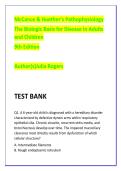
Davis Advantage for Townsend's
Psychiatric Mental Health Nursing
11th Edition
Author(s)Karyn Morgan
TEST BANK
Question 1
,A nursing student states, “Stress only occurs when a person
experiences something negative.” Which response by the
psychiatric nurse is most appropriate?
A. “Stress occurs only when coping skills are ineffective.”
B. “Stress can result from positive or negative life changes.”
C. “Stress is considered abnormal unless it causes physical
illness.”
D. “Stress reactions are identical in all individuals.”
Correct Answer: B
Rationale:
• Stress may arise from both positive and negative events
that require adaptation, such as marriage, graduation,
illness, or loss.
• Option A is incorrect because stress can occur even when
coping skills are effective.
• Option C is incorrect because stress is a normal response
to change.
• Option D is incorrect because stress responses vary among
individuals based on perception and coping ability.
Source:
Davis Advantage for Townsend's Psychiatric Mental Health
Nursing, 11th Edition — Chapter 1: The Concept of Stress
Adaptation
,Question 2
A client states, “I have an exam tomorrow, and my heart is
racing.” Which physiologic response should the nurse associate
with activation of the stress response?
A. Decreased blood pressure
B. Reduced respiratory rate
C. Increased release of catecholamines
D. Decreased muscle tension
Correct Answer: C
Rationale:
• Activation of the stress response stimulates catecholamine
release, preparing the body for “fight-or-flight.”
• Option A is incorrect because blood pressure commonly
increases during stress.
• Option B is incorrect because respiratory rate usually
increases.
• Option D is incorrect because muscle tension generally
increases under stress.
Source:
Davis Advantage for Townsend's Psychiatric Mental Health
Nursing, 11th Edition — Chapter 1: The Concept of Stress
Adaptation
, Question 3
A nurse is assessing a client experiencing prolonged
occupational stress. Which finding is most consistent with the
exhaustion stage of the general adaptation syndrome?
A. Heightened alertness and energy
B. Mobilization of physiologic defenses
C. Depletion of adaptive energy resources
D. Immediate activation of the sympathetic nervous system
Correct Answer: C
Rationale:
• During the exhaustion stage, the body’s adaptive
resources become depleted after prolonged stress
exposure.
• Option A reflects early stress activation.
• Option B describes the resistance stage.
• Option D reflects the alarm reaction stage.
Source:
Davis Advantage for Townsend's Psychiatric Mental Health
Nursing, 11th Edition — Chapter 1: The Concept of Stress
Adaptation
Question 4
Psychiatric Mental Health Nursing
11th Edition
Author(s)Karyn Morgan
TEST BANK
Question 1
,A nursing student states, “Stress only occurs when a person
experiences something negative.” Which response by the
psychiatric nurse is most appropriate?
A. “Stress occurs only when coping skills are ineffective.”
B. “Stress can result from positive or negative life changes.”
C. “Stress is considered abnormal unless it causes physical
illness.”
D. “Stress reactions are identical in all individuals.”
Correct Answer: B
Rationale:
• Stress may arise from both positive and negative events
that require adaptation, such as marriage, graduation,
illness, or loss.
• Option A is incorrect because stress can occur even when
coping skills are effective.
• Option C is incorrect because stress is a normal response
to change.
• Option D is incorrect because stress responses vary among
individuals based on perception and coping ability.
Source:
Davis Advantage for Townsend's Psychiatric Mental Health
Nursing, 11th Edition — Chapter 1: The Concept of Stress
Adaptation
,Question 2
A client states, “I have an exam tomorrow, and my heart is
racing.” Which physiologic response should the nurse associate
with activation of the stress response?
A. Decreased blood pressure
B. Reduced respiratory rate
C. Increased release of catecholamines
D. Decreased muscle tension
Correct Answer: C
Rationale:
• Activation of the stress response stimulates catecholamine
release, preparing the body for “fight-or-flight.”
• Option A is incorrect because blood pressure commonly
increases during stress.
• Option B is incorrect because respiratory rate usually
increases.
• Option D is incorrect because muscle tension generally
increases under stress.
Source:
Davis Advantage for Townsend's Psychiatric Mental Health
Nursing, 11th Edition — Chapter 1: The Concept of Stress
Adaptation
, Question 3
A nurse is assessing a client experiencing prolonged
occupational stress. Which finding is most consistent with the
exhaustion stage of the general adaptation syndrome?
A. Heightened alertness and energy
B. Mobilization of physiologic defenses
C. Depletion of adaptive energy resources
D. Immediate activation of the sympathetic nervous system
Correct Answer: C
Rationale:
• During the exhaustion stage, the body’s adaptive
resources become depleted after prolonged stress
exposure.
• Option A reflects early stress activation.
• Option B describes the resistance stage.
• Option D reflects the alarm reaction stage.
Source:
Davis Advantage for Townsend's Psychiatric Mental Health
Nursing, 11th Edition — Chapter 1: The Concept of Stress
Adaptation
Question 4