
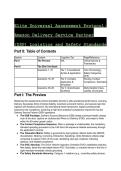
Elite Universal Assessment Protocol:
Amazon Delivery Service Partner
(DSP) Logistics and Safety Standards
Part 0: Table of Contents
Section Content Cognitive Tier Page/Reference
Part I The Preview N/A Critical Axioms &
Frameworks
Part II The Elite Test Bank
Questions 1–15 Tier 1: Foundational Core Terminology,
Syntax & Application Safety Categories,
DVIC
Questions 16–35 Tier 2: Complex Routing, Contact
Application & Compliance, Telematics
Simulation
Questions 36–60 Tier 3: Grandmaster Multi-Variable Crises,
Synthesis Liability, Scorecards
Part I: The Preview
Mastering this assessment protocol translates directly to elite operational performance, ensuring
Delivery Associates (DAs) minimize liability, maximize scorecard metrics, and execute last-mile
logistics with flawless precision. By internalizing these frameworks, logistics professionals
transcend rote compliance, achieving a high-level analytical competence required for top-tier
Delivery Service Partner (DSP) operations.
● The DSB Paradigm: Delivery Success Behaviors (DSB) dictate scorecard health; always
scan at the door, capture an unobstructed Photo on Delivery (POD), and swipe to finish
within the 50-meter geopin radius.
● The Contact Compliance Sequence: When a package is undeliverable, the mandatory
standard operating procedure is the Call-Text-Call sequence initiated exclusively through
the application's prompt.
● The Telematics Matrix: Safety is governed by dual systems: Mentor tracks the ABCDS
(Acceleration, Braking, Cornering, Distraction, Speeding), while Netradyne utilizes edge
computing to capture 100% of the route, identifying stop sign violations, following
distance, and seatbelt compliance.
● The DVIC Absolute: The Driver Vehicle Inspection Checklist (DVIC) establishes statutory
fleet safety; items like tread depth below 4/32", fluid leaks, or cracked mirrors in the line of
sight mandate immediate vehicle grounding.
● The Safety Standards Hierarchy: Category 1 violations (e.g., overriding safety devices,
, unauthorized PIT use) present a risk of serious injury or death and mandate immediate
termination, whereas Category 2 and Category 3 dictate progressive written warnings.
Part II: The Elite Test Bank
Q1: A Delivery Associate (DA) is navigating an Amazon delivery station yard during morning
loadout. Based on the principles of Station Safety Etiquette, which action is the MOST
ACCURATE protocol for movement within the facility? A) Driving up to 10 MPH to maintain
loadout sequence efficiency. B) Pulling loaded carts from the front to maintain visual awareness
of oncoming traffic. C) Pushing the loaded cart with two hands while maintaining the vehicle
speed at a maximum of 5 MPH. D) Completing a U-turn in the yard if a designated staging lane
is temporarily blocked.
● The Answer: C (Pushing the loaded cart with two hands while maintaining the vehicle
speed at a maximum of 5 MPH.)
● Distractor Analysis:
○ A is incorrect: The strict speed limit inside the station and on Amazon property is 5
MPH.
○ B is incorrect: Carts must be pushed, keeping the weight in the DA's power zone,
unless the cart obstructs the view.
○ D is incorrect: DAs are strictly prohibited from backing up or completing U-turns
within the station without Yard Marshal authorization.
The Mentor's Analysis: Station environments represent high-density kinetic zones where
pedestrian and vehicular traffic intersect. When operating Under The Roof (UTR), the immediate
priority is kinetic energy control and ergonomic preservation. By utilizing the Push Protocol and
strict 5 MPH Threshold, you bypass the common trap of yard accidents and lower back
musculoskeletal injuries. Professional/Academic Intuition: Control the environment before
the environment controls the operation; speed in the yard is a liability, not an efficiency.
Q2: During a pre-trip inspection, an associate utilizes the Driver Vehicle Inspection Checklist
(DVIC) and observes the front tire tread. Based on the principles of DOT and Amazon Fleet
Compliance, which measurement dictates an IMMEDIATE grounding of the vehicle? A) Tread
depth measuring exactly 6/32 of an inch. B) Tread depth measuring less than 4/32 of an inch. C)
Superficial scratches on the tire sidewall measuring less than 6 inches. D) Tire pressure that is 2
PSI below the manufacturer's recommendation.
● The Answer: B (Tread depth measuring less than 4/32 of an inch.)
● Distractor Analysis:
○ A is incorrect: 6/32 of an inch is well within safe operating parameters for
commercial delivery tires.
○ C is incorrect: Cosmetic scratches on the body or wheels do not ground a vehicle;
only structural or deep tread/wire exposure grounds a tire.
○ D is incorrect: Minor PSI variations require inflation maintenance but do not
constitute an immediate Out of Service (OOS) grounding defect like compromised
tread.
The Mentor's Analysis: The contact patch of a tire dictates the total kinetic control of a
9,000-pound vehicle. When evaluating fleet readiness, the immediate priority is friction integrity.
By utilizing the 4/32 Tread Mandate, you bypass the common trap of hydroplaning or
experiencing a blowout under full payload. Professional/Academic Intuition: Tread depth is
the primary physical contract between the vehicle's momentum and the road's surface.
, Q3: A DA is captured on the station floor stepping over an active, non-powered conveyor belt to
reach a staged package. Based on the Amazon Safety Standards of Conduct, which
classification is the MOST ACCURATE for this infraction? A) A Category 4 violation, requiring a
documented coaching session. B) A Category 3 violation, resulting in a first written warning. C)
A Category 1 violation, creating a risk of serious injury or death, resulting in immediate
termination. D) A valid operational workaround, provided the conveyor is not powered at that
exact moment.
● The Answer: C (A Category 1 violation, creating a risk of serious injury or death, resulting
in immediate termination.)
● Distractor Analysis:
○ A is incorrect: Category 4 violations involve minor administrative non-compliance,
not direct mechanical exposure.
○ B is incorrect: Category 3 involves lesser at-risk behaviors. Stepping over or
crawling under conveyors is strictly classified at the highest level of risk.
○ D is incorrect: The operational status of the conveyor does not negate the standard;
stepping over any conveyor without a designated walkway is explicitly forbidden.
The Mentor's Analysis: Industrial mechanical systems possess unforgiving shear points. When
navigating the UTR environment, the immediate priority is absolute spatial segregation from
automated hardware. By utilizing Designated Pedestrian Walkways, you bypass the common
trap of catastrophic mechanical entanglement. Professional/Academic Intuition:
Convenience must never supersede mechanical segregation; shortcuts across
conveyors are catastrophic liabilities.
Q4: When utilizing the eDriving Mentor application, the system generates a FICO® Safe Driving
Score. Based on the principles of the ABCDS of Driving, which metric is explicitly tracked but
EXCLUDED from the daily calculation of the FICO score? A) Harsh Cornering B) Delivery
Device Distractions C) Severe Braking D) Reversing Events
● The Answer: D (Reversing Events)
● Distractor Analysis:
○ A is incorrect: Harsh cornering is a primary mathematical component of the FICO
score.
○ B is incorrect: Phone manipulation and distraction carry heavy weights in the daily
FICO calculation.
○ C is incorrect: Severe braking is a core factor used to calculate following-distance
risks.
The Mentor's Analysis: Telematics evaluate predictive risk factors. While reversing is highly
dangerous and tracked as an event, it is structurally excluded from the core daily FICO
numerical algorithm alongside seatbelt events. When reviewing performance, the immediate
priority is understanding which actions deplete the scorecard versus which trigger administrative
alerts. By utilizing Forward Momentum Awareness, you bypass the common trap of
misinterpreting your scorecard penalties. Professional/Academic Intuition: FICO algorithms
punish forward momentum errors; reversing is an isolated tracking metric.
Q5: An associate is preparing to execute a delivery to a residence. The Amazon Flex app
displays a paw print icon next to the customer's address. Based on Amazon Driver Safety
Protocols, which action is the FIRST required step before exiting the vehicle? A) Mark the
package as "Unsafe due to dog" and immediately Return to Station (RTS). B) Honk the horn
three times to alert the animal. C) Utilize the "Notify of arrival" text feature via the question mark
icon to request the customer secure the pet. D) Equip dog repellent spray and proceed to the
front porch cautiously.
Amazon Delivery Service Partner
(DSP) Logistics and Safety Standards
Part 0: Table of Contents
Section Content Cognitive Tier Page/Reference
Part I The Preview N/A Critical Axioms &
Frameworks
Part II The Elite Test Bank
Questions 1–15 Tier 1: Foundational Core Terminology,
Syntax & Application Safety Categories,
DVIC
Questions 16–35 Tier 2: Complex Routing, Contact
Application & Compliance, Telematics
Simulation
Questions 36–60 Tier 3: Grandmaster Multi-Variable Crises,
Synthesis Liability, Scorecards
Part I: The Preview
Mastering this assessment protocol translates directly to elite operational performance, ensuring
Delivery Associates (DAs) minimize liability, maximize scorecard metrics, and execute last-mile
logistics with flawless precision. By internalizing these frameworks, logistics professionals
transcend rote compliance, achieving a high-level analytical competence required for top-tier
Delivery Service Partner (DSP) operations.
● The DSB Paradigm: Delivery Success Behaviors (DSB) dictate scorecard health; always
scan at the door, capture an unobstructed Photo on Delivery (POD), and swipe to finish
within the 50-meter geopin radius.
● The Contact Compliance Sequence: When a package is undeliverable, the mandatory
standard operating procedure is the Call-Text-Call sequence initiated exclusively through
the application's prompt.
● The Telematics Matrix: Safety is governed by dual systems: Mentor tracks the ABCDS
(Acceleration, Braking, Cornering, Distraction, Speeding), while Netradyne utilizes edge
computing to capture 100% of the route, identifying stop sign violations, following
distance, and seatbelt compliance.
● The DVIC Absolute: The Driver Vehicle Inspection Checklist (DVIC) establishes statutory
fleet safety; items like tread depth below 4/32", fluid leaks, or cracked mirrors in the line of
sight mandate immediate vehicle grounding.
● The Safety Standards Hierarchy: Category 1 violations (e.g., overriding safety devices,
, unauthorized PIT use) present a risk of serious injury or death and mandate immediate
termination, whereas Category 2 and Category 3 dictate progressive written warnings.
Part II: The Elite Test Bank
Q1: A Delivery Associate (DA) is navigating an Amazon delivery station yard during morning
loadout. Based on the principles of Station Safety Etiquette, which action is the MOST
ACCURATE protocol for movement within the facility? A) Driving up to 10 MPH to maintain
loadout sequence efficiency. B) Pulling loaded carts from the front to maintain visual awareness
of oncoming traffic. C) Pushing the loaded cart with two hands while maintaining the vehicle
speed at a maximum of 5 MPH. D) Completing a U-turn in the yard if a designated staging lane
is temporarily blocked.
● The Answer: C (Pushing the loaded cart with two hands while maintaining the vehicle
speed at a maximum of 5 MPH.)
● Distractor Analysis:
○ A is incorrect: The strict speed limit inside the station and on Amazon property is 5
MPH.
○ B is incorrect: Carts must be pushed, keeping the weight in the DA's power zone,
unless the cart obstructs the view.
○ D is incorrect: DAs are strictly prohibited from backing up or completing U-turns
within the station without Yard Marshal authorization.
The Mentor's Analysis: Station environments represent high-density kinetic zones where
pedestrian and vehicular traffic intersect. When operating Under The Roof (UTR), the immediate
priority is kinetic energy control and ergonomic preservation. By utilizing the Push Protocol and
strict 5 MPH Threshold, you bypass the common trap of yard accidents and lower back
musculoskeletal injuries. Professional/Academic Intuition: Control the environment before
the environment controls the operation; speed in the yard is a liability, not an efficiency.
Q2: During a pre-trip inspection, an associate utilizes the Driver Vehicle Inspection Checklist
(DVIC) and observes the front tire tread. Based on the principles of DOT and Amazon Fleet
Compliance, which measurement dictates an IMMEDIATE grounding of the vehicle? A) Tread
depth measuring exactly 6/32 of an inch. B) Tread depth measuring less than 4/32 of an inch. C)
Superficial scratches on the tire sidewall measuring less than 6 inches. D) Tire pressure that is 2
PSI below the manufacturer's recommendation.
● The Answer: B (Tread depth measuring less than 4/32 of an inch.)
● Distractor Analysis:
○ A is incorrect: 6/32 of an inch is well within safe operating parameters for
commercial delivery tires.
○ C is incorrect: Cosmetic scratches on the body or wheels do not ground a vehicle;
only structural or deep tread/wire exposure grounds a tire.
○ D is incorrect: Minor PSI variations require inflation maintenance but do not
constitute an immediate Out of Service (OOS) grounding defect like compromised
tread.
The Mentor's Analysis: The contact patch of a tire dictates the total kinetic control of a
9,000-pound vehicle. When evaluating fleet readiness, the immediate priority is friction integrity.
By utilizing the 4/32 Tread Mandate, you bypass the common trap of hydroplaning or
experiencing a blowout under full payload. Professional/Academic Intuition: Tread depth is
the primary physical contract between the vehicle's momentum and the road's surface.
, Q3: A DA is captured on the station floor stepping over an active, non-powered conveyor belt to
reach a staged package. Based on the Amazon Safety Standards of Conduct, which
classification is the MOST ACCURATE for this infraction? A) A Category 4 violation, requiring a
documented coaching session. B) A Category 3 violation, resulting in a first written warning. C)
A Category 1 violation, creating a risk of serious injury or death, resulting in immediate
termination. D) A valid operational workaround, provided the conveyor is not powered at that
exact moment.
● The Answer: C (A Category 1 violation, creating a risk of serious injury or death, resulting
in immediate termination.)
● Distractor Analysis:
○ A is incorrect: Category 4 violations involve minor administrative non-compliance,
not direct mechanical exposure.
○ B is incorrect: Category 3 involves lesser at-risk behaviors. Stepping over or
crawling under conveyors is strictly classified at the highest level of risk.
○ D is incorrect: The operational status of the conveyor does not negate the standard;
stepping over any conveyor without a designated walkway is explicitly forbidden.
The Mentor's Analysis: Industrial mechanical systems possess unforgiving shear points. When
navigating the UTR environment, the immediate priority is absolute spatial segregation from
automated hardware. By utilizing Designated Pedestrian Walkways, you bypass the common
trap of catastrophic mechanical entanglement. Professional/Academic Intuition:
Convenience must never supersede mechanical segregation; shortcuts across
conveyors are catastrophic liabilities.
Q4: When utilizing the eDriving Mentor application, the system generates a FICO® Safe Driving
Score. Based on the principles of the ABCDS of Driving, which metric is explicitly tracked but
EXCLUDED from the daily calculation of the FICO score? A) Harsh Cornering B) Delivery
Device Distractions C) Severe Braking D) Reversing Events
● The Answer: D (Reversing Events)
● Distractor Analysis:
○ A is incorrect: Harsh cornering is a primary mathematical component of the FICO
score.
○ B is incorrect: Phone manipulation and distraction carry heavy weights in the daily
FICO calculation.
○ C is incorrect: Severe braking is a core factor used to calculate following-distance
risks.
The Mentor's Analysis: Telematics evaluate predictive risk factors. While reversing is highly
dangerous and tracked as an event, it is structurally excluded from the core daily FICO
numerical algorithm alongside seatbelt events. When reviewing performance, the immediate
priority is understanding which actions deplete the scorecard versus which trigger administrative
alerts. By utilizing Forward Momentum Awareness, you bypass the common trap of
misinterpreting your scorecard penalties. Professional/Academic Intuition: FICO algorithms
punish forward momentum errors; reversing is an isolated tracking metric.
Q5: An associate is preparing to execute a delivery to a residence. The Amazon Flex app
displays a paw print icon next to the customer's address. Based on Amazon Driver Safety
Protocols, which action is the FIRST required step before exiting the vehicle? A) Mark the
package as "Unsafe due to dog" and immediately Return to Station (RTS). B) Honk the horn
three times to alert the animal. C) Utilize the "Notify of arrival" text feature via the question mark
icon to request the customer secure the pet. D) Equip dog repellent spray and proceed to the
front porch cautiously.


