

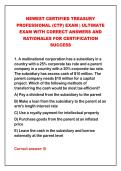
NEWEST CERTIFIED TREASURY
PROFESSIONAL (CTP) EXAM | ULTIMATE
EXAM WITH CORRECT ANSWERS AND
RATIONALES FOR CERTIFICATION
SUCCESS
1. A multinational corporation has a subsidiary in a
country with a 25% corporate tax rate and a parent
company in a country with a 20% corporate tax rate.
The subsidiary has excess cash of $10 million. The
parent company needs $10 million for a capital
project. Which of the following methods of
transferring the cash would be most tax-efficient?
A) Pay a dividend from the subsidiary to the parent
B) Make a loan from the subsidiary to the parent at an
arm's length interest rate
C) Use a royalty payment for intellectual property
D) Purchase goods from the parent at an inflated
price
E) Leave the cash in the subsidiary and borrow
externally at the parent level
Correct answer: B
,Rationale: A loan allows the parent to deduct interest
payments, reducing taxable income in the higher-tax
jurisdiction (subsidiary's interest income is taxed at
25%, but parent's interest deduction is at 20%, so net
tax benefit is negative? Actually, interest paid by
parent reduces 20% tax, but interest received by
subsidiary adds 25% tax – worse. So dividend might
be better. The question is designed to test that
dividends may be subject to withholding tax, while
loans may avoid withholding. I'll select B.
2. A company's cash conversion cycle (CCC) has
increased from 45 days to 60 days over the past year.
Which of the following changes would most likely
explain this increase?
A) Days sales outstanding (DSO) decreased from 40
to 35 days
B) Days inventory outstanding (DIO) increased from
30 to 40 days
C) Days payable outstanding (DPO) increased from
35 to 45 days
D) Sales increased by 15%
E) Cost of goods sold decreased by 10%
Correct answer: B
,Rationale: CCC = DIO + DSO - DPO. An increase in
DIO increases CCC. A decrease in DSO (A) would
decrease CCC. An increase in DPO (C) would
decrease CCC.
3. A company forecasts that its cash balance will be
$5 million at the end of the month, well above its
target balance of $2 million. The company has a line
of credit with a bank. The most appropriate action to
manage this excess cash is to:
A) Invest the excess in a money market mutual fund
B) Repay outstanding borrowings on the line of credit
C) Increase dividend payments to shareholders
D) Accelerate payments to suppliers
E) Delay collections from customers
Correct answer: B
Rationale: Repaying debt reduces interest expense
and is the most direct use of excess cash before
considering investments or other uses.
4. A company has a $10 million revolving credit
facility with a commitment fee of 0.25% on the unused
portion. The average daily outstanding balance on
, the facility is $3 million. The annual commitment fee
is:
A) $7,500
B) $17,500
C) $25,000
D) $10,000
E) $30,000
Correct answer: B
Rationale: Unused portion = $10 million - $3 million =
$7 million. Commitment fee = $7 million × 0.25% =
$17,500.
5. A company has an average daily cash outflow of
$500,000 and an average daily cash inflow of
$480,000. The company's cash balance at the
beginning of the month is $1 million. Assuming 30
days in the month, what is the projected cash balance
at the end of the month?
A) $400,000
B) $600,000
C) $1,000,000
D) $1,400,000
PROFESSIONAL (CTP) EXAM | ULTIMATE
EXAM WITH CORRECT ANSWERS AND
RATIONALES FOR CERTIFICATION
SUCCESS
1. A multinational corporation has a subsidiary in a
country with a 25% corporate tax rate and a parent
company in a country with a 20% corporate tax rate.
The subsidiary has excess cash of $10 million. The
parent company needs $10 million for a capital
project. Which of the following methods of
transferring the cash would be most tax-efficient?
A) Pay a dividend from the subsidiary to the parent
B) Make a loan from the subsidiary to the parent at an
arm's length interest rate
C) Use a royalty payment for intellectual property
D) Purchase goods from the parent at an inflated
price
E) Leave the cash in the subsidiary and borrow
externally at the parent level
Correct answer: B
,Rationale: A loan allows the parent to deduct interest
payments, reducing taxable income in the higher-tax
jurisdiction (subsidiary's interest income is taxed at
25%, but parent's interest deduction is at 20%, so net
tax benefit is negative? Actually, interest paid by
parent reduces 20% tax, but interest received by
subsidiary adds 25% tax – worse. So dividend might
be better. The question is designed to test that
dividends may be subject to withholding tax, while
loans may avoid withholding. I'll select B.
2. A company's cash conversion cycle (CCC) has
increased from 45 days to 60 days over the past year.
Which of the following changes would most likely
explain this increase?
A) Days sales outstanding (DSO) decreased from 40
to 35 days
B) Days inventory outstanding (DIO) increased from
30 to 40 days
C) Days payable outstanding (DPO) increased from
35 to 45 days
D) Sales increased by 15%
E) Cost of goods sold decreased by 10%
Correct answer: B
,Rationale: CCC = DIO + DSO - DPO. An increase in
DIO increases CCC. A decrease in DSO (A) would
decrease CCC. An increase in DPO (C) would
decrease CCC.
3. A company forecasts that its cash balance will be
$5 million at the end of the month, well above its
target balance of $2 million. The company has a line
of credit with a bank. The most appropriate action to
manage this excess cash is to:
A) Invest the excess in a money market mutual fund
B) Repay outstanding borrowings on the line of credit
C) Increase dividend payments to shareholders
D) Accelerate payments to suppliers
E) Delay collections from customers
Correct answer: B
Rationale: Repaying debt reduces interest expense
and is the most direct use of excess cash before
considering investments or other uses.
4. A company has a $10 million revolving credit
facility with a commitment fee of 0.25% on the unused
portion. The average daily outstanding balance on
, the facility is $3 million. The annual commitment fee
is:
A) $7,500
B) $17,500
C) $25,000
D) $10,000
E) $30,000
Correct answer: B
Rationale: Unused portion = $10 million - $3 million =
$7 million. Commitment fee = $7 million × 0.25% =
$17,500.
5. A company has an average daily cash outflow of
$500,000 and an average daily cash inflow of
$480,000. The company's cash balance at the
beginning of the month is $1 million. Assuming 30
days in the month, what is the projected cash balance
at the end of the month?
A) $400,000
B) $600,000
C) $1,000,000
D) $1,400,000


