
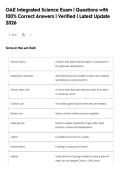
OAE Integrated Science Exam | Questions with
100% Correct Answers | Verified | Latest Update
2026
Save
Terms in this set (348)
Atomic theory a theory that states that all matter is composed of
tiny particles called atoms.
Radioactive Isotopes Atoms that have an unstable nucleus can undergo
spontaneous nuclear reaction
Atomic Mass Unit A unit of mass that describes the mass of an atom
or molecule. (amu)
Charle's Law This states gases expand when they are heated.
Boyles Law Gases contract when pressure is applied
Ideal gas law Used to explain properties of gas under ideal
pressure, volume and temperature.
Lattice Crystalline structure of crystals
Isomerization Forming a compounds Isomer
calorie is the amount of energy needed to raise a gram of
water up one degree Celsius. 4.184 joules
, calorimeter measurement device with a thermometer which
chemical or physical processes take place.
Enthalpy the measure of heat content in a system (closed
system and constant)
Thermodynamics branch of physics that studies the conversion of
energy into work and heat. Temp, volume, pressure
are important.
Open system can interact with surrounding environment
closed system can exchange heat and work but not matter
isolated system cannot exchange heat, work, or matter with
surrounding environment.
zeroth law of thermodynamics A law that if two systems are separately found to
be in thermal equilibrium with a third system, the
first two systems are in thermal equilibrium with
each other; that is, all three systems are at the same
temperature. Also known as thermodynamic
equilibrium.
First law of thermodynamics Energy can be transferred and transformed, but it
cannot be created or destroyed.
Second law of thermodynamics Every energy transfer or transformation increases
the entropy of the universe.
Third law of thermodynamics absolute zero cannot be reached
100% Correct Answers | Verified | Latest Update
2026
Save
Terms in this set (348)
Atomic theory a theory that states that all matter is composed of
tiny particles called atoms.
Radioactive Isotopes Atoms that have an unstable nucleus can undergo
spontaneous nuclear reaction
Atomic Mass Unit A unit of mass that describes the mass of an atom
or molecule. (amu)
Charle's Law This states gases expand when they are heated.
Boyles Law Gases contract when pressure is applied
Ideal gas law Used to explain properties of gas under ideal
pressure, volume and temperature.
Lattice Crystalline structure of crystals
Isomerization Forming a compounds Isomer
calorie is the amount of energy needed to raise a gram of
water up one degree Celsius. 4.184 joules
, calorimeter measurement device with a thermometer which
chemical or physical processes take place.
Enthalpy the measure of heat content in a system (closed
system and constant)
Thermodynamics branch of physics that studies the conversion of
energy into work and heat. Temp, volume, pressure
are important.
Open system can interact with surrounding environment
closed system can exchange heat and work but not matter
isolated system cannot exchange heat, work, or matter with
surrounding environment.
zeroth law of thermodynamics A law that if two systems are separately found to
be in thermal equilibrium with a third system, the
first two systems are in thermal equilibrium with
each other; that is, all three systems are at the same
temperature. Also known as thermodynamic
equilibrium.
First law of thermodynamics Energy can be transferred and transformed, but it
cannot be created or destroyed.
Second law of thermodynamics Every energy transfer or transformation increases
the entropy of the universe.
Third law of thermodynamics absolute zero cannot be reached


