
OAE Music History Exam | Questions with 100%
Correct Answers | Verified | Latest Update 2026
Save
Practice questions for this set
Learn 1 /7 Study using Learn
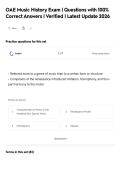
- Referred more to a genre of music than to a certain form or structure.
- Composers of the renaissance introduced imitation, homophony, and four-
part harmony to the motet.
Choose an answer
Characteristics of Music in the
1 2 Renaissance Motet
Medieval Era: Sacred Music
3 Monophony 4 Masses
Don't know?
Terms in this set (83)
, Characteristics of Music in the - Gregorian chant and masses
Medieval Era: Sacred Music
Characteristics of Music in the - Music for dance & entertainment
Medieval Era: Secular Music - sung by Troubadours (Northern France) and
Trouveres (Southern France).
-drone accompaniment with regular meter,
syncopations, polyphony, and harmony.
Gregorian chant - melodies were free flowing with no distinct meter,
melismatic, and largely monophonic.
- Sung by unaccompanied voice or choir.
Organum - An early form of polyphony
- Voices were sung in parallel motion.
Masses - An important religious ritual
- Reenactment of the last days of Christ
- Featured non-imitative polyphony
- Important service of the Roman Catholic Church
First Mass by a known composer Machaut's Mess de Notre Dame.
Ordinary Mass - Kyrie
- Gloria
- Credo
- Sanctus
- Benedictus
- Agnus Dei
Correct Answers | Verified | Latest Update 2026
Save
Practice questions for this set
Learn 1 /7 Study using Learn
- Referred more to a genre of music than to a certain form or structure.
- Composers of the renaissance introduced imitation, homophony, and four-
part harmony to the motet.
Choose an answer
Characteristics of Music in the
1 2 Renaissance Motet
Medieval Era: Sacred Music
3 Monophony 4 Masses
Don't know?
Terms in this set (83)
, Characteristics of Music in the - Gregorian chant and masses
Medieval Era: Sacred Music
Characteristics of Music in the - Music for dance & entertainment
Medieval Era: Secular Music - sung by Troubadours (Northern France) and
Trouveres (Southern France).
-drone accompaniment with regular meter,
syncopations, polyphony, and harmony.
Gregorian chant - melodies were free flowing with no distinct meter,
melismatic, and largely monophonic.
- Sung by unaccompanied voice or choir.
Organum - An early form of polyphony
- Voices were sung in parallel motion.
Masses - An important religious ritual
- Reenactment of the last days of Christ
- Featured non-imitative polyphony
- Important service of the Roman Catholic Church
First Mass by a known composer Machaut's Mess de Notre Dame.
Ordinary Mass - Kyrie
- Gloria
- Credo
- Sanctus
- Benedictus
- Agnus Dei


