

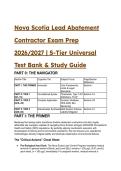
Nova Scotia Lead Abatement
Contractor Exam Prep
2026/2027 | S-Tier Universal
Test Bank & Study Guide
PART 0: THE NAVIGATOR
Section Title Cognitive Tier Subject Focus Page/Section
Reference
PART I: THE PRIMER Axiomatic Core Frameworks, Section I
Limits & Legal
Standards
PART II: TIER 1 Foundational Syntax Thresholds, Type 1/2/3 Section II.A
(Q1–15) Definitions, TCLP
PART II: TIER 2 Complex Application Dynamic Variables, Section II.B
(Q16–35) OHS 2025, BLL
Monitoring
PART II: TIER 3 Grandmaster Synthesis Multi-System Failures, Section II.C
(Q36–60) Liability Mitigation
PART I: THE PRIMER
Mastering this testing matrix transforms frontline abatement contractors into elite, legally
defensible site managers capable of navigating Nova Scotia's stringent 2025/2026 Occupational
Health and Safety (OHS) regulations. By perfectly aligning mechanistic execution with
physiological monitoring and environmental compliance, this tool ensures your operational
methodologies directly mitigate liability and eliminate catastrophic environmental failures.
The "Critical Axioms" Cheat Sheet
● The Biological Hard Deck: The Nova Scotia Lead Control Program mandates medical
removal if a general worker's Blood Lead Level (BLL) remains > 200 µg/L (0.97 µmol/L)
upon retest, or > 300 µg/L immediately. For pregnant workers, medical removal is
, mandatory at > 100 µg/L. Airborne exposures must be maintained below 50 µg/m³
averaged over an 8-hour period.
● The EPA 2026 Clearance Supremacy: Effective 2026, Dust-Lead Action Levels (DLAL)
for post-abatement clearance are lowered to 5 µg/ft² for floors, 40 µg/ft² for window sills,
and 100 µg/ft² for window troughs.
● Abatement Type Classifications: Type 1 encompasses chemical gels and
HEPA-equipped power tools. Type 2 covers manual dry scraping/sanding. Type 3
mandates maximum containment for abrasive blasting, high-temperature welding, and
non-HEPA power tool usage. * The Leachate Liability: Debris, paint chips, and sludge
exceeding the Toxicity Characteristic Leaching Procedure (TCLP) limit of 5.0 mg/L for
lead are classified as hazardous waste and are legally banned from standard municipal
solid waste landfills.
● OHS 2025 Reprisal & Harassment Mandate: Effective September 2025, Nova Scotia
OHS Act amendments expand "health and safety" to explicitly include psychological
safety, requiring mandatory written Workplace Harassment Prevention Policies and
protecting workers against "reprisals" (replacing the legacy term "discriminatory action").
PART II: THE ELITE TEST BANK
TIER 1: Foundational Syntax & Application
Q1: A contractor is managing an interior renovation of a pre-1970 childcare facility.
Post-abatement verification is required. Based on the 2025/2026 Dust-Lead Action Levels, what
is the MAXIMUM allowable lead concentration for window sills to pass clearance? A) 100 µg/ft²
B) 10 µg/ft² C) 40 µg/ft² D) 5 µg/ft²
● The Answer: C (40 µg/ft²)
● Distractor Analysis:
○ A is incorrect: 100 µg/ft² is the updated clearance limit for window troughs, not sills.
○ B is incorrect: This represents outdated legacy thresholds or misapplied floor limits.
○ D is incorrect: 5 µg/ft² is the stringent new standard specifically reserved for floors.
The Mentor's Analysis: Precision in post-abatement clearance is non-negotiable. The 2026
federal alignment strictly delineates clearance by surface geometry. By memorizing the 5/40/100
rule (floors/sills/troughs), you bypass the common trap of applying legacy 100 µg/ft² standards
to contact surfaces. Professional/Academic Intuition: Clearance thresholds scale with
child contact probability: the floor (5) is touched most, the trough (100) least.
Q2: A worker in a Nova Scotia lead recycling facility undergoes mandatory biological
monitoring. The lab results indicate a Blood Lead Level (BLL) of 315 µg/L (1.52 µmol/L). Based
on the Nova Scotia Lead in the Workplace Code of Practice, what is the IMMEDIATE required
action? A) Re-test the worker in 4 weeks to confirm the sustained level before taking action. B)
Conduct air monitoring to determine if ambient levels exceed 50 µg/m³. C) Immediately remove
the worker from all lead exposure environments. D) Provide the worker with a half-mask
cartridge respirator and allow continued work.
● The Answer: C (Immediately remove the worker from all lead exposure environments.)
● Distractor Analysis:
○ A is incorrect: While re-testing in 4 weeks is required for levels > 200 µg/L, a level >
300 µg/L mandates instant removal.
○ B is incorrect: Air monitoring is a systemic requirement, but it does not address the
, acute physiological hazard of the individual worker.
○ D is incorrect: PPE is an engineering/administrative control supplement; it cannot
legally bypass mandatory medical removal thresholds.
The Mentor's Analysis: Biological limits supersede all operational timelines. The > 300 µg/L
threshold is an absolute physiological redline. Waiting to re-test places the worker at imminent
risk of acute neurotoxicity and opens the firm to severe legal liability. Professional/Academic
Intuition: When BLL exceeds 300 µg/L, operational continuity ceases for that worker
immediately. No exceptions.
Q3: A crew is tasked with removing lead-based paint from exterior siding. The contractor plans
to use a chemical gel to strip the paint without generating airborne dust. Under Nova Scotia
abatement standards, how is this work MOST ACCURATELY classified? A) Type 3 Operation
B) Non-regulated maintenance C) Type 1 Operation D) Type 2 Operation
● The Answer: C (Type 1 Operation)
● Distractor Analysis:
○ A is incorrect: Type 3 is reserved for high-dispersion activities like abrasive blasting.
○ B is incorrect: Any disturbance of lead-based paint in a commercial/contractor
setting is strictly regulated.
○ D is incorrect: Type 2 typically involves dry manual scraping or sanding, which
generates moderate dust.
The Mentor's Analysis: Chemical gels and pastes encapsulate the hazard, inherently
suppressing airborne particulate generation below 0.05 mg/m³. By utilizing fluid encapsulation,
you maintain the lowest regulatory burden (Type 1). Professional/Academic Intuition: The
classification scales with particulate generation: wet methods remain Type 1, dry manual
methods escalate to Type 2, and dry mechanical/thermal methods trigger Type 3.
Q4: During a commercial demolition, a contractor generates 500 kg of lead-painted architectural
trim. To determine landfill eligibility, the material undergoes a Toxicity Characteristic Leaching
Procedure (TCLP). What is the EXACT leachate limit above which the waste is classified as
hazardous in Nova Scotia? A) 0.5 mg/L B) 2.0 mg/L C) 5.0 mg/L D) 10.0 mg/L
● The Answer: C (5.0 mg/L)
● Distractor Analysis:
○ A is incorrect: 0.5 mg/L is a common limit for other environmental toxins (like
benzene), not lead.
○ B is incorrect: 2.0 mg/L is a legacy or localized limit often confused with copper or
silver leachate standards.
○ D is incorrect: 10.0 mg/L would allow highly toxic concentrations to permeate
municipal groundwater systems.
The Mentor's Analysis: The TCLP simulates landfill acid rain conditions to measure mobility,
not total mass. A result of 5.0 mg/L or higher means the lead will leach into the water table,
legally barring it from standard Construction & Demolition (C&D) disposal sites.
Professional/Academic Intuition: Leachability dictates liability. If it leaches at 5.0 mg/L, it
is a hazardous waste, period.
Q5: An employer implements a Lead Control Program after air monitoring reveals ambient lead
concentrations of 35 µg/m³. Based on Nova Scotia OHS regulations, how often MUST
subsequent air sampling be conducted? A) At least once every calendar year. B) Monthly until
levels drop below 10 µg/m³. C) At least once every six months. D) Daily at the beginning of each
shift.
● The Answer: C (At least once every six months.)
● Distractor Analysis:
Contractor Exam Prep
2026/2027 | S-Tier Universal
Test Bank & Study Guide
PART 0: THE NAVIGATOR
Section Title Cognitive Tier Subject Focus Page/Section
Reference
PART I: THE PRIMER Axiomatic Core Frameworks, Section I
Limits & Legal
Standards
PART II: TIER 1 Foundational Syntax Thresholds, Type 1/2/3 Section II.A
(Q1–15) Definitions, TCLP
PART II: TIER 2 Complex Application Dynamic Variables, Section II.B
(Q16–35) OHS 2025, BLL
Monitoring
PART II: TIER 3 Grandmaster Synthesis Multi-System Failures, Section II.C
(Q36–60) Liability Mitigation
PART I: THE PRIMER
Mastering this testing matrix transforms frontline abatement contractors into elite, legally
defensible site managers capable of navigating Nova Scotia's stringent 2025/2026 Occupational
Health and Safety (OHS) regulations. By perfectly aligning mechanistic execution with
physiological monitoring and environmental compliance, this tool ensures your operational
methodologies directly mitigate liability and eliminate catastrophic environmental failures.
The "Critical Axioms" Cheat Sheet
● The Biological Hard Deck: The Nova Scotia Lead Control Program mandates medical
removal if a general worker's Blood Lead Level (BLL) remains > 200 µg/L (0.97 µmol/L)
upon retest, or > 300 µg/L immediately. For pregnant workers, medical removal is
, mandatory at > 100 µg/L. Airborne exposures must be maintained below 50 µg/m³
averaged over an 8-hour period.
● The EPA 2026 Clearance Supremacy: Effective 2026, Dust-Lead Action Levels (DLAL)
for post-abatement clearance are lowered to 5 µg/ft² for floors, 40 µg/ft² for window sills,
and 100 µg/ft² for window troughs.
● Abatement Type Classifications: Type 1 encompasses chemical gels and
HEPA-equipped power tools. Type 2 covers manual dry scraping/sanding. Type 3
mandates maximum containment for abrasive blasting, high-temperature welding, and
non-HEPA power tool usage. * The Leachate Liability: Debris, paint chips, and sludge
exceeding the Toxicity Characteristic Leaching Procedure (TCLP) limit of 5.0 mg/L for
lead are classified as hazardous waste and are legally banned from standard municipal
solid waste landfills.
● OHS 2025 Reprisal & Harassment Mandate: Effective September 2025, Nova Scotia
OHS Act amendments expand "health and safety" to explicitly include psychological
safety, requiring mandatory written Workplace Harassment Prevention Policies and
protecting workers against "reprisals" (replacing the legacy term "discriminatory action").
PART II: THE ELITE TEST BANK
TIER 1: Foundational Syntax & Application
Q1: A contractor is managing an interior renovation of a pre-1970 childcare facility.
Post-abatement verification is required. Based on the 2025/2026 Dust-Lead Action Levels, what
is the MAXIMUM allowable lead concentration for window sills to pass clearance? A) 100 µg/ft²
B) 10 µg/ft² C) 40 µg/ft² D) 5 µg/ft²
● The Answer: C (40 µg/ft²)
● Distractor Analysis:
○ A is incorrect: 100 µg/ft² is the updated clearance limit for window troughs, not sills.
○ B is incorrect: This represents outdated legacy thresholds or misapplied floor limits.
○ D is incorrect: 5 µg/ft² is the stringent new standard specifically reserved for floors.
The Mentor's Analysis: Precision in post-abatement clearance is non-negotiable. The 2026
federal alignment strictly delineates clearance by surface geometry. By memorizing the 5/40/100
rule (floors/sills/troughs), you bypass the common trap of applying legacy 100 µg/ft² standards
to contact surfaces. Professional/Academic Intuition: Clearance thresholds scale with
child contact probability: the floor (5) is touched most, the trough (100) least.
Q2: A worker in a Nova Scotia lead recycling facility undergoes mandatory biological
monitoring. The lab results indicate a Blood Lead Level (BLL) of 315 µg/L (1.52 µmol/L). Based
on the Nova Scotia Lead in the Workplace Code of Practice, what is the IMMEDIATE required
action? A) Re-test the worker in 4 weeks to confirm the sustained level before taking action. B)
Conduct air monitoring to determine if ambient levels exceed 50 µg/m³. C) Immediately remove
the worker from all lead exposure environments. D) Provide the worker with a half-mask
cartridge respirator and allow continued work.
● The Answer: C (Immediately remove the worker from all lead exposure environments.)
● Distractor Analysis:
○ A is incorrect: While re-testing in 4 weeks is required for levels > 200 µg/L, a level >
300 µg/L mandates instant removal.
○ B is incorrect: Air monitoring is a systemic requirement, but it does not address the
, acute physiological hazard of the individual worker.
○ D is incorrect: PPE is an engineering/administrative control supplement; it cannot
legally bypass mandatory medical removal thresholds.
The Mentor's Analysis: Biological limits supersede all operational timelines. The > 300 µg/L
threshold is an absolute physiological redline. Waiting to re-test places the worker at imminent
risk of acute neurotoxicity and opens the firm to severe legal liability. Professional/Academic
Intuition: When BLL exceeds 300 µg/L, operational continuity ceases for that worker
immediately. No exceptions.
Q3: A crew is tasked with removing lead-based paint from exterior siding. The contractor plans
to use a chemical gel to strip the paint without generating airborne dust. Under Nova Scotia
abatement standards, how is this work MOST ACCURATELY classified? A) Type 3 Operation
B) Non-regulated maintenance C) Type 1 Operation D) Type 2 Operation
● The Answer: C (Type 1 Operation)
● Distractor Analysis:
○ A is incorrect: Type 3 is reserved for high-dispersion activities like abrasive blasting.
○ B is incorrect: Any disturbance of lead-based paint in a commercial/contractor
setting is strictly regulated.
○ D is incorrect: Type 2 typically involves dry manual scraping or sanding, which
generates moderate dust.
The Mentor's Analysis: Chemical gels and pastes encapsulate the hazard, inherently
suppressing airborne particulate generation below 0.05 mg/m³. By utilizing fluid encapsulation,
you maintain the lowest regulatory burden (Type 1). Professional/Academic Intuition: The
classification scales with particulate generation: wet methods remain Type 1, dry manual
methods escalate to Type 2, and dry mechanical/thermal methods trigger Type 3.
Q4: During a commercial demolition, a contractor generates 500 kg of lead-painted architectural
trim. To determine landfill eligibility, the material undergoes a Toxicity Characteristic Leaching
Procedure (TCLP). What is the EXACT leachate limit above which the waste is classified as
hazardous in Nova Scotia? A) 0.5 mg/L B) 2.0 mg/L C) 5.0 mg/L D) 10.0 mg/L
● The Answer: C (5.0 mg/L)
● Distractor Analysis:
○ A is incorrect: 0.5 mg/L is a common limit for other environmental toxins (like
benzene), not lead.
○ B is incorrect: 2.0 mg/L is a legacy or localized limit often confused with copper or
silver leachate standards.
○ D is incorrect: 10.0 mg/L would allow highly toxic concentrations to permeate
municipal groundwater systems.
The Mentor's Analysis: The TCLP simulates landfill acid rain conditions to measure mobility,
not total mass. A result of 5.0 mg/L or higher means the lead will leach into the water table,
legally barring it from standard Construction & Demolition (C&D) disposal sites.
Professional/Academic Intuition: Leachability dictates liability. If it leaches at 5.0 mg/L, it
is a hazardous waste, period.
Q5: An employer implements a Lead Control Program after air monitoring reveals ambient lead
concentrations of 35 µg/m³. Based on Nova Scotia OHS regulations, how often MUST
subsequent air sampling be conducted? A) At least once every calendar year. B) Monthly until
levels drop below 10 µg/m³. C) At least once every six months. D) Daily at the beginning of each
shift.
● The Answer: C (At least once every six months.)
● Distractor Analysis:


