
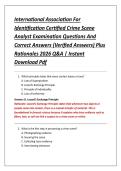
International Association For
Identification Certified Crime Scene
Analyst Examination Questions And
Correct Answers (Verified Answers) Plus
Rationales 2026 Q&A | Instant
Download Pdf
1. Which principle states that every contact leaves a trace?
A. Law of Superposition
B. Locard’s Exchange Principle
C. Principle of Individuality
D. Law of Uniformity
Answer: B. Locard’s Exchange Principle
Rationale: Locard’s Exchange Principle states that whenever two objects or
people come into contact, there is a mutual transfer of material. This is
foundational in forensic science because it explains why trace evidence such as
fibers, hair, or soil can link a suspect to a crime scene or victim.
2. What is the first step in processing a crime scene?
A. Photographing evidence
B. Securing the scene
C. Collecting trace evidence
D. Interviewing witnesses
,Answer: B. Securing the scene
Rationale: Securing the scene is critical to prevent contamination, loss, or
alteration of evidence. Without proper control of access, the integrity of the
entire investigation can be compromised.
3. Which type of evidence directly links a suspect to a crime?
A. Circumstantial evidence
B. Associative evidence
C. Direct evidence
D. Testimonial evidence
Answer: B. Associative evidence
Rationale: Associative evidence such as DNA, fingerprints, or unique trace
materials directly connects a suspect to a crime scene or victim, strengthening
investigative conclusions.
4. What is the primary purpose of crime scene photography?
A. To replace written notes
B. To enhance courtroom drama
C. To create a permanent visual record
D. To identify suspects immediately
Answer: C. To create a permanent visual record
Rationale: Crime scene photography documents the scene as it was found,
preserving spatial relationships and conditions that may later change during
processing.
5. Chain of custody refers to:
A. Storage of evidence in a lab
B. Documentation of evidence handling
, C. Transfer of suspect custody
D. Witness testimony records
Answer: B. Documentation of evidence handling
Rationale: Chain of custody ensures accountability by documenting every person
who handled evidence, preserving its integrity and admissibility in court.
6. Which tool is commonly used to detect latent fingerprints?
A. Magnet brush
B. Alternate light source
C. Thermometer
D. UV scale
Answer: B. Alternate light source
Rationale: Alternate light sources enhance visibility of latent fingerprints and
biological stains by causing them to fluoresce or contrast with the surface.
7. Blood spatter analysis primarily helps determine:
A. Victim identity
B. Time of death
C. Weapon type and direction of force
D. Toxic substances
Answer: C. Weapon type and direction of force
Rationale: Bloodstain pattern analysis provides insight into the events of a
violent crime, including direction, force, and type of impact used.
8. The term "class evidence" refers to:
A. Evidence unique to a single source
B. Evidence shared by a group
C. Evidence inadmissible in court
D. Digital-only evidence
, Answer: B. Evidence shared by a group
Rationale: Class evidence narrows down possibilities but does not uniquely
identify a source, such as blood type or carpet fibers.
9. What is the purpose of sketching a crime scene?
A. Replace photographs
B. Provide scaled spatial representation
C. Identify suspects
D. Analyze DNA
Answer: B. Provide scaled spatial representation
Rationale: Crime scene sketches help document the layout, distances, and
relationships between evidence items in a simplified but accurate format.
10.Which of the following is biological evidence?
A. Glass fragments
B. Blood
C. Paint chips
D. Soil
Answer: B. Blood
Rationale: Biological evidence originates from living organisms and includes
blood, saliva, and tissue, often used for DNA analysis.
11.What is the main goal of evidence preservation?
A. Increase lab workload
B. Prevent contamination or degradation
C. Identify suspects quickly
D. Reduce documentation
Identification Certified Crime Scene
Analyst Examination Questions And
Correct Answers (Verified Answers) Plus
Rationales 2026 Q&A | Instant
Download Pdf
1. Which principle states that every contact leaves a trace?
A. Law of Superposition
B. Locard’s Exchange Principle
C. Principle of Individuality
D. Law of Uniformity
Answer: B. Locard’s Exchange Principle
Rationale: Locard’s Exchange Principle states that whenever two objects or
people come into contact, there is a mutual transfer of material. This is
foundational in forensic science because it explains why trace evidence such as
fibers, hair, or soil can link a suspect to a crime scene or victim.
2. What is the first step in processing a crime scene?
A. Photographing evidence
B. Securing the scene
C. Collecting trace evidence
D. Interviewing witnesses
,Answer: B. Securing the scene
Rationale: Securing the scene is critical to prevent contamination, loss, or
alteration of evidence. Without proper control of access, the integrity of the
entire investigation can be compromised.
3. Which type of evidence directly links a suspect to a crime?
A. Circumstantial evidence
B. Associative evidence
C. Direct evidence
D. Testimonial evidence
Answer: B. Associative evidence
Rationale: Associative evidence such as DNA, fingerprints, or unique trace
materials directly connects a suspect to a crime scene or victim, strengthening
investigative conclusions.
4. What is the primary purpose of crime scene photography?
A. To replace written notes
B. To enhance courtroom drama
C. To create a permanent visual record
D. To identify suspects immediately
Answer: C. To create a permanent visual record
Rationale: Crime scene photography documents the scene as it was found,
preserving spatial relationships and conditions that may later change during
processing.
5. Chain of custody refers to:
A. Storage of evidence in a lab
B. Documentation of evidence handling
, C. Transfer of suspect custody
D. Witness testimony records
Answer: B. Documentation of evidence handling
Rationale: Chain of custody ensures accountability by documenting every person
who handled evidence, preserving its integrity and admissibility in court.
6. Which tool is commonly used to detect latent fingerprints?
A. Magnet brush
B. Alternate light source
C. Thermometer
D. UV scale
Answer: B. Alternate light source
Rationale: Alternate light sources enhance visibility of latent fingerprints and
biological stains by causing them to fluoresce or contrast with the surface.
7. Blood spatter analysis primarily helps determine:
A. Victim identity
B. Time of death
C. Weapon type and direction of force
D. Toxic substances
Answer: C. Weapon type and direction of force
Rationale: Bloodstain pattern analysis provides insight into the events of a
violent crime, including direction, force, and type of impact used.
8. The term "class evidence" refers to:
A. Evidence unique to a single source
B. Evidence shared by a group
C. Evidence inadmissible in court
D. Digital-only evidence
, Answer: B. Evidence shared by a group
Rationale: Class evidence narrows down possibilities but does not uniquely
identify a source, such as blood type or carpet fibers.
9. What is the purpose of sketching a crime scene?
A. Replace photographs
B. Provide scaled spatial representation
C. Identify suspects
D. Analyze DNA
Answer: B. Provide scaled spatial representation
Rationale: Crime scene sketches help document the layout, distances, and
relationships between evidence items in a simplified but accurate format.
10.Which of the following is biological evidence?
A. Glass fragments
B. Blood
C. Paint chips
D. Soil
Answer: B. Blood
Rationale: Biological evidence originates from living organisms and includes
blood, saliva, and tissue, often used for DNA analysis.
11.What is the main goal of evidence preservation?
A. Increase lab workload
B. Prevent contamination or degradation
C. Identify suspects quickly
D. Reduce documentation


