
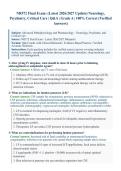
NR572 Final Exam: (Latest 2026/2027 Update) Neurology,
Psychiatry, Critical Care | Q&A | Grade A | 100% Correct (Verified
Answers)
Subject: Advanced Pathophysiology and Pharmacology - Neurology, Psychiatry, and
Critical Care
Source: NR572 Final Exam - Latest 2026/2027 Blueprint
Format: Q&A Guide with Clinical Rationale | Evidence-Based Practice | Verified
Accurate Solutions
Instructions: Each question includes the verified correct answer covering ischemic
stroke, meningitis, encephalitis, brain abscess, psychiatric disorders, sleep medicine, and
critical care management.
1: After giving IV alteplase, what should be done 24 hours prior to initiating
anticoagulants or antiplatelet agents?
Correct Answer: A follow-up CT scan of the head.
1. Alteplase (tPA) carries a 6-7% risk of symptomatic intracranial hemorrhage (sICH).
2. Follow-up CT must rule out hemorrhage before starting antithrombotic therapy.
3. If CT shows no hemorrhage, antiplatelet or anticoagulant therapy can be safely
started at 24 hours.
2: What are indications for lumbar puncture (LP)?
Correct Answer: CSF sample for examination; pressure measurements (NPH); reduction in
CSF pressure; infections; subarachnoid hemorrhage; inflammatory conditions; multiple
sclerosis; carcinomatosis; spinal anesthetics; antitumor agents; antibiotics; myelography;
radionuclide cisternography; cryptococcal meningitis; hydrocephalus; pseudotumor cerebri.
1. LP is essential for diagnosing meningitis, SAH (if CT negative), and inflammatory
CNS disorders.
2. Opening pressure measurement is critical for idiopathic intracranial hypertension
(pseudotumor cerebri).
3. Therapeutic LP can reduce CSF pressure in normal pressure hydrocephalus.
3: What are contraindications for performing lumbar puncture?
Correct Answer: Increased risk of fatal cerebellar or transtentorial herniation;
coagulopathy; infection over puncture site; spinal block requiring sample above lesion.
1. LP is contraindicated if signs of increased ICP (papilledema, focal neuro deficits,
altered mental status).
2. Coagulopathy (INR >1.5, platelets <50,000) increases risk of spinal epidural
hematoma.
3. Skin infection at puncture site can introduce organisms into CSF.
, 4: What are common complications of lumbar puncture?
Correct Answer: Sciatic pain during needle insertion; post-LP headache (worse upright,
improved supine); slowing of fluid removal (elevate patient head).
1. Post-LP headache occurs in 10-30% due to CSF leakage; treat with caffeine,
hydration, epidural blood patch if severe.
2. Root irritation (sciatica) is transient; reposition needle if paresthesia occurs.
3. Keep patient supine for 1-2 hours to reduce headache risk.
5: How is chronic meningitis diagnosed?
Correct Answer: On LP/CSF analysis or contrast MRI/CT showing leakage into meninges.
Meningeal biopsy if CSF not diagnostic.
1. Chronic meningitis defined as symptoms >4 weeks with CSF abnormalities.
2. CSF studies: cell count, protein, glucose, cultures, PCR, cytology, fungal stain, TB
culture.
3. Contrast MRI shows meningeal enhancement; biopsy reserved for refractory cases.
6: What are differentials for chronic meningitis?
Correct Answer: Partially treated suppurative meningitis; parameningeal infection;
Mycobacterium TB; Lyme; syphilis; HIV; HSV; malignancy; SLE; Behcet's disease.
1. TB meningitis: subacute course, basal exudates, hydrocephalus; CSF shows
lymphocytosis, low glucose, high protein.
2. Lyme meningitis: tick exposure, erythema migrans, cranial neuritis (VII).
3. Malignant meningitis: leptomeningeal carcinomatosis from breast, lung, melanoma,
lymphoma.
7: What are Medicare coverage requirements for hospice?
Correct Answer: Prognosis of six months or less if illness runs normal course; falls under
Medicare Part A.
1. Two physicians must certify terminal prognosis (life expectancy ≤6 months).
2. Patient elects comfort care instead of curative treatment.
3. Covers medications, supplies, nursing, social work, chaplain, bereavement support.
8: What are the three common causes of acute ischemic stroke?
Correct Answer: Anoxic injury; thrombosis in situ; thrombotic embolism.
1. Thrombosis in situ: atherosclerosis of large arteries (carotid, vertebrobasilar, MCA).
2. Embolic: cardioembolic (AFib, valve disease) or artery-to-artery embolism.
3. Anoxic/hypoperfusion: global hypoperfusion from cardiac arrest or shock.
Psychiatry, Critical Care | Q&A | Grade A | 100% Correct (Verified
Answers)
Subject: Advanced Pathophysiology and Pharmacology - Neurology, Psychiatry, and
Critical Care
Source: NR572 Final Exam - Latest 2026/2027 Blueprint
Format: Q&A Guide with Clinical Rationale | Evidence-Based Practice | Verified
Accurate Solutions
Instructions: Each question includes the verified correct answer covering ischemic
stroke, meningitis, encephalitis, brain abscess, psychiatric disorders, sleep medicine, and
critical care management.
1: After giving IV alteplase, what should be done 24 hours prior to initiating
anticoagulants or antiplatelet agents?
Correct Answer: A follow-up CT scan of the head.
1. Alteplase (tPA) carries a 6-7% risk of symptomatic intracranial hemorrhage (sICH).
2. Follow-up CT must rule out hemorrhage before starting antithrombotic therapy.
3. If CT shows no hemorrhage, antiplatelet or anticoagulant therapy can be safely
started at 24 hours.
2: What are indications for lumbar puncture (LP)?
Correct Answer: CSF sample for examination; pressure measurements (NPH); reduction in
CSF pressure; infections; subarachnoid hemorrhage; inflammatory conditions; multiple
sclerosis; carcinomatosis; spinal anesthetics; antitumor agents; antibiotics; myelography;
radionuclide cisternography; cryptococcal meningitis; hydrocephalus; pseudotumor cerebri.
1. LP is essential for diagnosing meningitis, SAH (if CT negative), and inflammatory
CNS disorders.
2. Opening pressure measurement is critical for idiopathic intracranial hypertension
(pseudotumor cerebri).
3. Therapeutic LP can reduce CSF pressure in normal pressure hydrocephalus.
3: What are contraindications for performing lumbar puncture?
Correct Answer: Increased risk of fatal cerebellar or transtentorial herniation;
coagulopathy; infection over puncture site; spinal block requiring sample above lesion.
1. LP is contraindicated if signs of increased ICP (papilledema, focal neuro deficits,
altered mental status).
2. Coagulopathy (INR >1.5, platelets <50,000) increases risk of spinal epidural
hematoma.
3. Skin infection at puncture site can introduce organisms into CSF.
, 4: What are common complications of lumbar puncture?
Correct Answer: Sciatic pain during needle insertion; post-LP headache (worse upright,
improved supine); slowing of fluid removal (elevate patient head).
1. Post-LP headache occurs in 10-30% due to CSF leakage; treat with caffeine,
hydration, epidural blood patch if severe.
2. Root irritation (sciatica) is transient; reposition needle if paresthesia occurs.
3. Keep patient supine for 1-2 hours to reduce headache risk.
5: How is chronic meningitis diagnosed?
Correct Answer: On LP/CSF analysis or contrast MRI/CT showing leakage into meninges.
Meningeal biopsy if CSF not diagnostic.
1. Chronic meningitis defined as symptoms >4 weeks with CSF abnormalities.
2. CSF studies: cell count, protein, glucose, cultures, PCR, cytology, fungal stain, TB
culture.
3. Contrast MRI shows meningeal enhancement; biopsy reserved for refractory cases.
6: What are differentials for chronic meningitis?
Correct Answer: Partially treated suppurative meningitis; parameningeal infection;
Mycobacterium TB; Lyme; syphilis; HIV; HSV; malignancy; SLE; Behcet's disease.
1. TB meningitis: subacute course, basal exudates, hydrocephalus; CSF shows
lymphocytosis, low glucose, high protein.
2. Lyme meningitis: tick exposure, erythema migrans, cranial neuritis (VII).
3. Malignant meningitis: leptomeningeal carcinomatosis from breast, lung, melanoma,
lymphoma.
7: What are Medicare coverage requirements for hospice?
Correct Answer: Prognosis of six months or less if illness runs normal course; falls under
Medicare Part A.
1. Two physicians must certify terminal prognosis (life expectancy ≤6 months).
2. Patient elects comfort care instead of curative treatment.
3. Covers medications, supplies, nursing, social work, chaplain, bereavement support.
8: What are the three common causes of acute ischemic stroke?
Correct Answer: Anoxic injury; thrombosis in situ; thrombotic embolism.
1. Thrombosis in situ: atherosclerosis of large arteries (carotid, vertebrobasilar, MCA).
2. Embolic: cardioembolic (AFib, valve disease) or artery-to-artery embolism.
3. Anoxic/hypoperfusion: global hypoperfusion from cardiac arrest or shock.


