

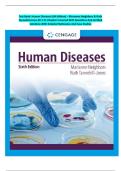
Test Bank: Human Diseases (6th Edition) – Marianne Neighbors & Ruth
Tannehill-Jones All 1-21 Chapters Covered With Questions And Verified
Solutions With Detailed Rationales And Case Studies
, TABLE OF CONTENT
Unit I: Concepts of Human Disease
• Chapter 1: Introduction to Human Diseases
• Chapter 2: Mechanisms of Disease
• Chapter 3: Neoplasms
• Chapter 4: Inflammation and Infection
Unit II: Common Diseases and Disorders of Body Systems
• Chapter 5: Immune System Diseases and Disorders
• Chapter 6: Musculoskeletal System Diseases and Disorders
• Chapter 7: Blood and Blood-Forming Organ Diseases and Disorders
• Chapter 8: Cardiovascular System Diseases and Disorders
• Chapter 9: Respiratory System Diseases and Disorders
• Chapter 10: Lymphatic System Diseases and Disorders
• Chapter 11: Digestive System Diseases and Disorders
• Chapter 12: Liver, Gallbladder, and Pancreatic Diseases and Disorders
• Chapter 13: Urinary System Diseases and Disorders
• Chapter 14: Endocrine System Diseases and Disorders
• Chapter 15: Nervous System Diseases and Disorders
• Chapter 16: Eye and Ear Diseases and Disorders
• Chapter 17: Reproductive System Diseases and Disorders
• Chapter 18: Integumentary System Diseases and Disorders
Unit III: Genetic/Developmental, Childhood, and Mental Health Diseases and Disorders
• Chapter 19: Genetic and Developmental Diseases and Disorders
• Chapter 20: Childhood Diseases and Disorders
• Chapter 21: Mental Health Diseases and Disorders
,Chapter 1 Practice Questions (21 MCQs)
1. Which term refers to the study of diseases?
A. Anatomy
B. Physiology
C. Pathology
D. Histology
Correct Answer: C. Pathology
Rationale:
Pathology is the scientific study of disease processes, including causes, mechanisms, and effects on
the body.
• Anatomy = body structures
• Physiology = body functions
• Histology = tissues
2. The term etiology refers to:
A. Signs of disease
B. Cause of disease
C. Treatment of disease
D. Prognosis
Correct Answer: B. Cause of disease
Rationale:
Etiology identifies the origin or cause of a disease such as infection, trauma, genetics, or
environmental exposure.
3. A disease present at birth is called:
A. Acquired
B. Idiopathic
C. Congenital
D. Chronic
Correct Answer: C. Congenital
Rationale:
Congenital diseases exist at birth and may result from genetic abnormalities or prenatal influences.
4. Which is an example of a communicable disease?
, A. Diabetes mellitus
B. Asthma
C. Tuberculosis
D. Arthritis
Correct Answer: C. Tuberculosis
Rationale:
Communicable diseases can spread from one person to another. Tuberculosis is caused by
Mycobacterium tuberculosis.
5. Signs of disease are:
A. Subjective symptoms
B. Objective findings
C. Treatment goals
D. Prognosis factors
Correct Answer: B. Objective findings
Rationale:
Signs are measurable or observable findings such as fever, rash, or elevated blood pressure.
6. Which is a symptom?
A. Temperature of 39°C
B. Blood pressure 160/100
C. Pain
D. Cyanosis
Correct Answer: C. Pain
Rationale:
Symptoms are subjective experiences reported by patients.
7. Disease that develops slowly and lasts a long time is:
A. Acute
B. Chronic
C. Subclinical
D. Remission
Correct Answer: B. Chronic
Rationale:
Chronic diseases persist over long periods, often months or years.
8. Sudden onset and short duration disease is:
Tannehill-Jones All 1-21 Chapters Covered With Questions And Verified
Solutions With Detailed Rationales And Case Studies
, TABLE OF CONTENT
Unit I: Concepts of Human Disease
• Chapter 1: Introduction to Human Diseases
• Chapter 2: Mechanisms of Disease
• Chapter 3: Neoplasms
• Chapter 4: Inflammation and Infection
Unit II: Common Diseases and Disorders of Body Systems
• Chapter 5: Immune System Diseases and Disorders
• Chapter 6: Musculoskeletal System Diseases and Disorders
• Chapter 7: Blood and Blood-Forming Organ Diseases and Disorders
• Chapter 8: Cardiovascular System Diseases and Disorders
• Chapter 9: Respiratory System Diseases and Disorders
• Chapter 10: Lymphatic System Diseases and Disorders
• Chapter 11: Digestive System Diseases and Disorders
• Chapter 12: Liver, Gallbladder, and Pancreatic Diseases and Disorders
• Chapter 13: Urinary System Diseases and Disorders
• Chapter 14: Endocrine System Diseases and Disorders
• Chapter 15: Nervous System Diseases and Disorders
• Chapter 16: Eye and Ear Diseases and Disorders
• Chapter 17: Reproductive System Diseases and Disorders
• Chapter 18: Integumentary System Diseases and Disorders
Unit III: Genetic/Developmental, Childhood, and Mental Health Diseases and Disorders
• Chapter 19: Genetic and Developmental Diseases and Disorders
• Chapter 20: Childhood Diseases and Disorders
• Chapter 21: Mental Health Diseases and Disorders
,Chapter 1 Practice Questions (21 MCQs)
1. Which term refers to the study of diseases?
A. Anatomy
B. Physiology
C. Pathology
D. Histology
Correct Answer: C. Pathology
Rationale:
Pathology is the scientific study of disease processes, including causes, mechanisms, and effects on
the body.
• Anatomy = body structures
• Physiology = body functions
• Histology = tissues
2. The term etiology refers to:
A. Signs of disease
B. Cause of disease
C. Treatment of disease
D. Prognosis
Correct Answer: B. Cause of disease
Rationale:
Etiology identifies the origin or cause of a disease such as infection, trauma, genetics, or
environmental exposure.
3. A disease present at birth is called:
A. Acquired
B. Idiopathic
C. Congenital
D. Chronic
Correct Answer: C. Congenital
Rationale:
Congenital diseases exist at birth and may result from genetic abnormalities or prenatal influences.
4. Which is an example of a communicable disease?
, A. Diabetes mellitus
B. Asthma
C. Tuberculosis
D. Arthritis
Correct Answer: C. Tuberculosis
Rationale:
Communicable diseases can spread from one person to another. Tuberculosis is caused by
Mycobacterium tuberculosis.
5. Signs of disease are:
A. Subjective symptoms
B. Objective findings
C. Treatment goals
D. Prognosis factors
Correct Answer: B. Objective findings
Rationale:
Signs are measurable or observable findings such as fever, rash, or elevated blood pressure.
6. Which is a symptom?
A. Temperature of 39°C
B. Blood pressure 160/100
C. Pain
D. Cyanosis
Correct Answer: C. Pain
Rationale:
Symptoms are subjective experiences reported by patients.
7. Disease that develops slowly and lasts a long time is:
A. Acute
B. Chronic
C. Subclinical
D. Remission
Correct Answer: B. Chronic
Rationale:
Chronic diseases persist over long periods, often months or years.
8. Sudden onset and short duration disease is:


