
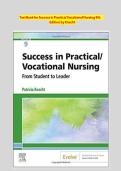
Test Bank for Success in Practical Vocational Nursing 9th
Edition by Knecht
Test /Bank /for /Success /in /Practical /Vocational /Nursing /9th /Edition /by /Knecht /| /Complete /Chapters /1-42 /BY/HAVENS/
, Chapter 01: Personal Resources of an Adult Learner Knecht:
/ / / / / / / /
Success in Practical/Vocational Nursing, 9th Edition
/ / / / / /
MULTIPLE CHOICE /
1. Which individual in a practical/vocational nursing class would be identified as a traditional adult learner?
/ / / / / / / / / / / / / /
a. One who has been out of school for many years / / / / / / / / /
b. One who has children and grandchildren / / / / /
c. One who knows the routine of education / / / / / /
d. One who is in his or her early 20s / / / / / / / /
ANS: D /
Traditional adult learners are individuals who come to the educational program directly from high school or
/ / / / / / / / / / / / / / /
another program of study. They are usually in their late teens or early 20s. The learner who has been out of
/ / / / / / / / / / / / / / / / / / / / /
school for many years and the learner who has children and grandchildren would be identified as a
/ / / / / / / / / / / / / / / / /
returning adult learner. The learner who knows the routine of education does not provide sufficient
/ / / / / / / / / / / / / / /
information for classification.
/ / /
DIF: Cognitive Level: Application / / REF: p. 3 OBJ: 1 / / / / /
TOP: Adult Learner
/ / / KEY: Nursing Process Step: N/A / / / /
MSC: NCLEX: N/A
/ / /
2. A student enrolled in an LPN/LVN program states, “I’m fresh out of high school and living alone for the first
/ / / / / / / / / / / / / / / / / / /
time in my life. I’m learning how to take care of myself as well as learning to care for my patients.” This
/ / / / / / / / / / / / / / / / / / / / / /
statement identifies the student as
/ / / / /
a. a traditional adult learner.
/ / /
b. a returning adult learner.
/ / /
c. someone in need of counseling. / / / /
d. someone who is not accustomed to formal education. / / / / / / /
ANS: A /
Traditional adult learners are individuals who are in their late teens or early 20s who have come to the
/ / / / / / / / / / / / / / / / / /
practical/vocational program directly from high school or another program of study. A returning adult
/ / / / / / / / / / / / / /
learner is someone who has been out of school for several years. A person in needed of counseling is
/ / / / / / / / / / / / / / / / / / /
commonly a student who has been evaluated by the instructor as having areas that need improvement.
/ / / / / / / / / / / / / / / /
This student is a traditional adult learner, and traditional adult learners are accustomed to formal
/ / / / / / / / / / / / / / /
education.
/
DIF: Cognitive Level: Analysis / / REF: p. 3 OBJ: 1 / / / / /
TOP: Adult Learner
/ / / KEY: Nursing Process Step: N/A / / / /
MSC: NCLEX: N/A
/ / /
3. A nursing student states, “I have taken advantage of informal learning experiences.” Another student asks,
/ / / / / / / / / / / / / /
“Could you give me an example?” The best example of an informal learning experience is
/ / / / / / / / / / / / / / /
a. caring for a disabled family member. / / / / /
b. taking a continuing education course. / / / /
c. enrolling in an academic program. / / / /
d. attending credit classes at the mall. / / / / /
Test /Bank /for /Success /in /Practical /Vocational /Nursing /9th /Edition /by /Knecht /| /Complete /Chapters /1-42 /BY/HAVENS/
, ANS: A /
Informal learning experiences are those that take place outside a formal educational setting. A person who
/ / / / / / / / / / / / / / /
cares for a disabled family member would gain knowledge and skill in providing personal care. An education
/ / / / / / / / / / / / / / / / /
course, academic program, and credited classes all take place in a formal educational setting.
/ / / / / / / / / / / / / /
DIF: Cognitive Level: Comprehension / / REF: p. 3 OBJ: 2
/ / / / /
TOP: Informal educational experience
/ / / / KEY: Nursing Process Step: N/A
/ / / /
MSC: NCLEX: N/A
/ / /
4. What strategy can be used by a nursing student to effectively combat a fear of failure?
/ / / / / / / / / / / / / / /
a. Picture in your mind the rewards of succeeding / / / / / / /
b. Positive self-talk /
c. Create a mental script of positive thoughts / / / / / /
d. All of the above / / /
ANS: D /
Picturing the rewards of succeeding, positive self-talk, and a mental script of positive thoughts all contribute a
/ / / / / / / / / / / / / / / /
positive mental attitude and are all ways to combat the fear of failure.
/ / / / / / / / / / / / /
DIF: Cognitive Level: Comprehension REF: p. 4 / / / / / / OBJ: 2 /
TOP: Promoting success in the program of study
/ / / / / / / KEY: Nursing Process Step: N/A / / / /
MSC: NCLEX: N/A
/ / /
5. An example of a self-talk “script” that promotes success in a practical/vocational nursing program is
/ / / / / / / / / / / / / /
a. “I get sick from smelling bad odors.”
/ / / / / /
b. “What if I’m ‘all thumbs’ in practice lab?” / / / / / / /
c. “I don’t think the instructor likes me.”
/ / / / / /
d. “I work well with my hands.”
/ / / / /
ANS: D /
The statement “I work well with my hands” is a positive thought. It focuses on a strength and promotes the
/ / / / / / / / / / / / / / / / / / /
expectation that the individual will succeed. All other options are examples of negative
/ / thinking that / / / / / / / / / / / / /
create expectations for problems and failure.
/ / / / / /
DIF: Cognitive Level: Analysis / / REF: p. 3 OBJ: 2
/ / / / /
TOP: Hidden dangers
/ / / KEY: Nursing Process Step: N/A
/ / / /
MSC: NCLEX: N/A
/ / /
6. Select the factor common to ALL types of adult learners that predisposes them to success in a nursing
/ / / / / / / / / / / / / / / / /
program.
/
a. They have few responsibilities at home. / / / / /
b. They have the motivation to succeed. / / / / /
c. They automatically qualify for financial aid. / / / / /
d. They have few daily distractions. / / / /
ANS: B /
The only statement applicable to all types of adult learners is that the majority is motivated to succeed. The
/ / / / / / / / / / / / / / / / / /
other factors may be applicable to one or two classifications of learners but not to all three.
/ / / / / / / / / / / / / / / / /
Test /Bank /for /Success /in /Practical /Vocational /Nursing /9th /Edition /by /Knecht /| /Complete /Chapters /1-42 /BY/HAVENS/
, DIF: Cognitive Level: Comprehension / / REF: p. 4 OBJ: 2/ / / / /
TOP: Factors predisposing to success
/ / / / / KEY: Nursing Process Step: N/A
/ / / /
MSC: NCLEX: N/A
/ / /
7. When a class of nursing students discusses their concerns about their program, the concern shared by
/ / / / / / / / / / / / / / /
most learners is generally the fear of
/ / / / / / /
a. succeeding.
b. economic problems. /
c. failure.
d. ridicule.
ANS: C /
Some degree of fear of failure is nearly universal and often relates to earlier failures or setbacks the learner
/ / / / / / / / / / / / / / / / / /
has experienced in other educational settings. Few individuals are afraid of succeeding. Uncertainty about
/ / / / / / / / / / / / / /
economic issues is common among students but is not as universal as fear of failure. Fear of ridicule is
/ / / / / / / / / / / / / / / / / / /
rarely a concern; if present, it is usually superseded by fear of failure.
/ / / / / / / / / / / / /
DIF: Cognitive Level: Analysis / / REF: p. 4 OBJ: 2/ / / / /
TOP: Hidden dangers
/ / / KEY: Nursing Process Step: N/A
/ / / /
MSC: NCLEX: N/A
/ / /
8. The First Amendment of the U.S. Constitution guarantees students the right to
/ / / / / / / / / / /
a. graduate from a program. / / /
b. fail an academic program. / / /
c. express oneself in class. / / /
d. have unlimited absences. / /
ANS: C /
The First Amendment provides for freedom of expression as long as what is expressed does not disrupt
/ / / / / / / / / / / / / / / /
class or infringe on the rights of peers. The remaining options are topics that are not addressed by this
/ / / / / / / / / / / / / / / / / / /
amendment.
/
DIF: Cognitive Level: Knowledge / / REF: p. 6 OBJ: 6/ / / / /
TOP: Learner rights
/ / / KEY: Nursing Process Step: N/A
/ / / /
MSC: NCLEX: N/A
/ / /
9. Which amendment to the U.S. Constitution protects the learner from being asked to leave an educational
/ / / / / / / / / / / / / / /
program without due process?
/ / / /
a. Eleventh
b. Twelfth
c. Thirteenth
d. Fourteenth
ANS: D /
The Fourteenth Amendment guarantees due process. The learner has the right to defend him- or herself if
/ / / / / / / / / / / / / / / /
charged with a violation of policy or rules. The Eleventh, Twelfth, and Thirteenth amendments do not
/ / / / / / / / / / / / / / / /
address due process.
/ / /
DIF: Cognitive Level: Knowledge / / REF: p. 6 OBJ: 6
/ / / / /
TOP: Learner rights
/ / / KEY: Nursing Process Step: N/A / / / /
Test /Bank /for /Success /in /Practical /Vocational /Nursing /9th /Edition /by /Knecht /| /Complete /Chapters /1-42 /BY/HAVENS/


