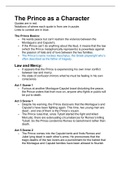
The Prince as a Character
Quotes are in red.
Notations of where each quote is from are in purple.
Links to context are in blue.
The Prince Basics:
He wants peace but can’t restrain the violence between the
Montague’s and Capulet’s.
If the Prince can’t do anything about the feud, it means that the law
(which the Prince metaphorically represents) is powerless against
the passion of hate and of love between the two families.
The Prince’s name invokes Aeschylus, the Greek playwright who’s
often described as the father of tragedy.
Law and Mercy:
It appears that the Prince is experiencing his own inner conflict
between law and mercy
His state of confusion mirrors what he must be feeling in his own
conscience.
Act 1 Scene 1
Furious at another Montague-Capulet brawl disturbing the peace,
the Prince orders that from now on, anyone who fights in public will
be put to death.
Act 3 Scene 1
Despite his warning, the Prince discovers that the Montague’s and
Capulet’s have been fighting again. This time, two young men are
dead - and one of them is the Prince’s cousin.
The Prince rules that, since Tybalt started the fight and killed
Mercutio, there are extenuating circumstances for Romeo’s killing
Tybalt. So the Prince condemns Romeo to banishment rather than
death.
Act 5 Scene 2
The Prince comes into the Capulet tomb and finds Romeo and
Juliet lying dead in each other’s arms. He pronounces that the
tragic deaths of the two lovers are a punishment for the hatred that
the Montague and Capulet families have been allowed to flourish.
Quotes are in red.
Notations of where each quote is from are in purple.
Links to context are in blue.
The Prince Basics:
He wants peace but can’t restrain the violence between the
Montague’s and Capulet’s.
If the Prince can’t do anything about the feud, it means that the law
(which the Prince metaphorically represents) is powerless against
the passion of hate and of love between the two families.
The Prince’s name invokes Aeschylus, the Greek playwright who’s
often described as the father of tragedy.
Law and Mercy:
It appears that the Prince is experiencing his own inner conflict
between law and mercy
His state of confusion mirrors what he must be feeling in his own
conscience.
Act 1 Scene 1
Furious at another Montague-Capulet brawl disturbing the peace,
the Prince orders that from now on, anyone who fights in public will
be put to death.
Act 3 Scene 1
Despite his warning, the Prince discovers that the Montague’s and
Capulet’s have been fighting again. This time, two young men are
dead - and one of them is the Prince’s cousin.
The Prince rules that, since Tybalt started the fight and killed
Mercutio, there are extenuating circumstances for Romeo’s killing
Tybalt. So the Prince condemns Romeo to banishment rather than
death.
Act 5 Scene 2
The Prince comes into the Capulet tomb and finds Romeo and
Juliet lying dead in each other’s arms. He pronounces that the
tragic deaths of the two lovers are a punishment for the hatred that
the Montague and Capulet families have been allowed to flourish.