

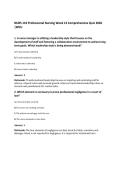
NURS 110 Professional Nursing Week 13 Comprehensive Quiz 2026
|WCU
1. A nurse manager is utilizing a leadership style that focuses on the
development of staff and fostering a collaborative environment to achieve long-
term goals. Which leadership style is being demonstrated?
A. Transactional Leadership
B. Transformational Leadership
C. Autocratic Leadership
D. Laissez-faire Leadership
Answer: B
Rationale: Transformational leadership focuses on inspiring and motivating staff to
achieve a shared vision and personal growth, whereas transactional leadership relies on
rewards and punishments for routine tasks.
2. Which element is necessary to prove professional negligence in a court of
law?
A. A breach of duty occurred.
B. The nurse was working overtime.
C. The patient was unhappy with the care.
D. The nurse intended to cause harm.
Answer: A
Rationale: The four elements of negligence are duty, breach of duty, causation, and
damages. Intent is not required for negligence; it is required for intentional torts.
,3. A nurse is caring for a patient who decides to refuse a life-saving blood
transfusion due to religious beliefs. The nurse supports this decision. Which
ethical principle is the nurse practicing?
A. Autonomy
B. Non-maleficence
C. Beneficence
D. Justice
Answer: A
Rationale: Autonomy refers to the patient’s right to make their own healthcare decisions,
even if those decisions conflict with the healthcare provider’s recommendations.
4. An RN is delegating tasks to a Licensed Practical Nurse (LPN). Which task is
most appropriate for the LPN?
A. Performing the initial admission assessment on a new patient.
B. Developing a plan of care for a patient with complex needs.
C. Administering an oral antibiotic to a stable patient.
D. Providing discharge teaching to a patient after a stroke.
Answer: C
Rationale: LPNs can administer medications and care for stable patients. Initial
assessments, care planning, and complex discharge teaching are the responsibility of the
RN.
5. What is the primary purpose of a Root Cause Analysis (RCA) after a sentinel
event?
A. To prevent the recurrence of the event by identifying system failures.
B. To assign blame to the individual responsible.
C. To provide documentation for legal defense.
D. To satisfy requirements for the hospital’s marketing department.
Answer: A
, Rationale: RCA is a process used to identify the underlying system issues that contributed
to an error, focusing on prevention rather than individual blame.
6. In Lewin’s Change Theory, what occurs during the ‘unfreezing’ stage?
A. The change is integrated into the daily routine.
B. A period of stability after the change is complete.
C. The actual implementation of the new policy.
D. Staff are motivated to let go of old patterns and prepare for change.
Answer: D
Rationale: Unfreezing involves creating the motivation to change by identifying a need for
improvement and reducing barriers to change.
7. A nurse shares a patient’s laboratory results with a colleague who is not
involved in that patient’s care. This is a violation of which federal law?
A. Patient Self-Determination Act
B. Emergency Medical Treatment and Labor Act (EMTALA)
C. Health Insurance Portability and Accountability Act (HIPAA)
D. Americans with Disabilities Act
Answer: C
Rationale: HIPAA protects the privacy and security of health information and prohibits
sharing patient data with unauthorized individuals.
8. The nurse’s obligation to ‘do no harm’ is known as:
A. Fidelity
B. Non-maleficence
C. Veracity
D. Beneficence
Answer: B
Rationale: Non-maleficence is the ethical duty to avoid causing harm to the patient.
|WCU
1. A nurse manager is utilizing a leadership style that focuses on the
development of staff and fostering a collaborative environment to achieve long-
term goals. Which leadership style is being demonstrated?
A. Transactional Leadership
B. Transformational Leadership
C. Autocratic Leadership
D. Laissez-faire Leadership
Answer: B
Rationale: Transformational leadership focuses on inspiring and motivating staff to
achieve a shared vision and personal growth, whereas transactional leadership relies on
rewards and punishments for routine tasks.
2. Which element is necessary to prove professional negligence in a court of
law?
A. A breach of duty occurred.
B. The nurse was working overtime.
C. The patient was unhappy with the care.
D. The nurse intended to cause harm.
Answer: A
Rationale: The four elements of negligence are duty, breach of duty, causation, and
damages. Intent is not required for negligence; it is required for intentional torts.
,3. A nurse is caring for a patient who decides to refuse a life-saving blood
transfusion due to religious beliefs. The nurse supports this decision. Which
ethical principle is the nurse practicing?
A. Autonomy
B. Non-maleficence
C. Beneficence
D. Justice
Answer: A
Rationale: Autonomy refers to the patient’s right to make their own healthcare decisions,
even if those decisions conflict with the healthcare provider’s recommendations.
4. An RN is delegating tasks to a Licensed Practical Nurse (LPN). Which task is
most appropriate for the LPN?
A. Performing the initial admission assessment on a new patient.
B. Developing a plan of care for a patient with complex needs.
C. Administering an oral antibiotic to a stable patient.
D. Providing discharge teaching to a patient after a stroke.
Answer: C
Rationale: LPNs can administer medications and care for stable patients. Initial
assessments, care planning, and complex discharge teaching are the responsibility of the
RN.
5. What is the primary purpose of a Root Cause Analysis (RCA) after a sentinel
event?
A. To prevent the recurrence of the event by identifying system failures.
B. To assign blame to the individual responsible.
C. To provide documentation for legal defense.
D. To satisfy requirements for the hospital’s marketing department.
Answer: A
, Rationale: RCA is a process used to identify the underlying system issues that contributed
to an error, focusing on prevention rather than individual blame.
6. In Lewin’s Change Theory, what occurs during the ‘unfreezing’ stage?
A. The change is integrated into the daily routine.
B. A period of stability after the change is complete.
C. The actual implementation of the new policy.
D. Staff are motivated to let go of old patterns and prepare for change.
Answer: D
Rationale: Unfreezing involves creating the motivation to change by identifying a need for
improvement and reducing barriers to change.
7. A nurse shares a patient’s laboratory results with a colleague who is not
involved in that patient’s care. This is a violation of which federal law?
A. Patient Self-Determination Act
B. Emergency Medical Treatment and Labor Act (EMTALA)
C. Health Insurance Portability and Accountability Act (HIPAA)
D. Americans with Disabilities Act
Answer: C
Rationale: HIPAA protects the privacy and security of health information and prohibits
sharing patient data with unauthorized individuals.
8. The nurse’s obligation to ‘do no harm’ is known as:
A. Fidelity
B. Non-maleficence
C. Veracity
D. Beneficence
Answer: B
Rationale: Non-maleficence is the ethical duty to avoid causing harm to the patient.


