

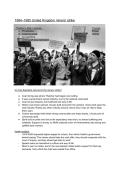
1984–1985 United Kingdom miners' strike
Thatcher’s Main Features: Themes:
1. Privatization Protest
2. Lowering taxes Unions
3. Cut spending
4. Limiting left wing radicalism
Q: How Spending cuts led to the miners’ strike?
● Coal mining was where Thatcher had began cost cutting
● It was a government owned industry, run by the national coal board
● Coal not just industry, but livelihood and way of life
● Where coal mines opened, houses built around for the workers. Towns built upon the
coal industry. Rarely any other industry around, hence why it was so vital to keep
them open.
● Culture associated with these mining communities are brass bands, a focal point of
community spirit.
● Spirit built on pride and risk as life expectancy was short, so shared suffering and
solidarity. Support is strong, so NUM (national union of mineworkers) was strong and
uplifted each worker)
Heath incident:
- 1974 NUM requested higher wages for miners, from which Heath’s government
denied saying “The miners should take the cash offer, they should cooperate with the
court of inquiry, and they should get back to work”
- Speech seen as insensitive to culture and way of life
- Miner’s went on strike, and in the next election rallied public support for their pay
demands, from which the chief was ousted from office.
, Demanding cost and imports:
- Thatcher recognised the costly domestic coal extraction, and does not want to
continue subsidising it, claiming it would be much cheaper to import from abroad.
- Feb 1981, Thatcher proposes shutting down 23 of Britain’s 200 mines. She backed
down after threats of protest from NUM.
- The NUM elects in 1982, Arthur Scargill, who stated “are you going to accept it down
on your knees, or are you going to stand and fight?”
- Scargill divisive and blunt man, not diplomatic, complete opposite to Thatcher: a
class on cultures, politics and values.
- Thatcher saw the NUM as an organization that needed to be tamed, reframed,
reorganized, and their power reduced for the economy to flourish free of trade unions
- Thatcher outside bought-in McGregor, oversaw massive cuts to the British steel
industry and was seen as a provocation to the NUM.
- Inflammatory brewing conflict, with McGregor and Thatcher seen as the villains,
responsible for the loss of stability, jobs
Early 1984:
- Miners go on strike, but the NUM forgets to ask its members to formally vote for a
strike in a national ballot (sep 1984 high court deems strike unlawful as a result)
- 165,000 miners by the end of march walking out, 25,000 more decide to stay on
- Nearly all of nottinghamshire (a very rich coal field) were working because they
objected to the absence of a ballot, for security, so the union was divided.
- Arthur scargill deployed the flying pickets, groups of union activities that harassed the
miners that went back to work, which might have divided people further
- Government’s response was to send in the police, who’s salaries were increased.
- Government created friction, labelling them as trouble makers, and using force.
- Support came from the women in the miners community, who raised funds and joined
the picked lines, and from the LGBTQ community, on the basis of a shared
commitment to socialism.
- Increasing violence from any industry that needed coal, the miners and the police
- Thatcher “what we’ve got is an attempt to substitute the rule of the mob for the rule of
law”
Battle of Orgreave 1984
- Orgreave coking plants in south yorkshire, miners prevented coal from reaching it by
standing in the truck’s way, led by Scargill.
- 5k pickets faced 6000 police
- Violent clashes saw over 100 miners injured and 95 arrested charged with riot or
violent disorder
- 1991, 39 of the convicted miners were compensated £425k by south yorkshire police,
for assault by the police, wrongful arrest and wrongful prosecution
- Kettling, police sorrowing protestors in a circle and not letting them leave
- At the time it seemed that the protestors/miners were getting what they deserved.
- Now the police are seen then to have acted outside of the rule of law
- The term battle of orgreave is a newer term,reflecting the constant mythologisation of
the battle
Thatcher’s Main Features: Themes:
1. Privatization Protest
2. Lowering taxes Unions
3. Cut spending
4. Limiting left wing radicalism
Q: How Spending cuts led to the miners’ strike?
● Coal mining was where Thatcher had began cost cutting
● It was a government owned industry, run by the national coal board
● Coal not just industry, but livelihood and way of life
● Where coal mines opened, houses built around for the workers. Towns built upon the
coal industry. Rarely any other industry around, hence why it was so vital to keep
them open.
● Culture associated with these mining communities are brass bands, a focal point of
community spirit.
● Spirit built on pride and risk as life expectancy was short, so shared suffering and
solidarity. Support is strong, so NUM (national union of mineworkers) was strong and
uplifted each worker)
Heath incident:
- 1974 NUM requested higher wages for miners, from which Heath’s government
denied saying “The miners should take the cash offer, they should cooperate with the
court of inquiry, and they should get back to work”
- Speech seen as insensitive to culture and way of life
- Miner’s went on strike, and in the next election rallied public support for their pay
demands, from which the chief was ousted from office.
, Demanding cost and imports:
- Thatcher recognised the costly domestic coal extraction, and does not want to
continue subsidising it, claiming it would be much cheaper to import from abroad.
- Feb 1981, Thatcher proposes shutting down 23 of Britain’s 200 mines. She backed
down after threats of protest from NUM.
- The NUM elects in 1982, Arthur Scargill, who stated “are you going to accept it down
on your knees, or are you going to stand and fight?”
- Scargill divisive and blunt man, not diplomatic, complete opposite to Thatcher: a
class on cultures, politics and values.
- Thatcher saw the NUM as an organization that needed to be tamed, reframed,
reorganized, and their power reduced for the economy to flourish free of trade unions
- Thatcher outside bought-in McGregor, oversaw massive cuts to the British steel
industry and was seen as a provocation to the NUM.
- Inflammatory brewing conflict, with McGregor and Thatcher seen as the villains,
responsible for the loss of stability, jobs
Early 1984:
- Miners go on strike, but the NUM forgets to ask its members to formally vote for a
strike in a national ballot (sep 1984 high court deems strike unlawful as a result)
- 165,000 miners by the end of march walking out, 25,000 more decide to stay on
- Nearly all of nottinghamshire (a very rich coal field) were working because they
objected to the absence of a ballot, for security, so the union was divided.
- Arthur scargill deployed the flying pickets, groups of union activities that harassed the
miners that went back to work, which might have divided people further
- Government’s response was to send in the police, who’s salaries were increased.
- Government created friction, labelling them as trouble makers, and using force.
- Support came from the women in the miners community, who raised funds and joined
the picked lines, and from the LGBTQ community, on the basis of a shared
commitment to socialism.
- Increasing violence from any industry that needed coal, the miners and the police
- Thatcher “what we’ve got is an attempt to substitute the rule of the mob for the rule of
law”
Battle of Orgreave 1984
- Orgreave coking plants in south yorkshire, miners prevented coal from reaching it by
standing in the truck’s way, led by Scargill.
- 5k pickets faced 6000 police
- Violent clashes saw over 100 miners injured and 95 arrested charged with riot or
violent disorder
- 1991, 39 of the convicted miners were compensated £425k by south yorkshire police,
for assault by the police, wrongful arrest and wrongful prosecution
- Kettling, police sorrowing protestors in a circle and not letting them leave
- At the time it seemed that the protestors/miners were getting what they deserved.
- Now the police are seen then to have acted outside of the rule of law
- The term battle of orgreave is a newer term,reflecting the constant mythologisation of
the battle


