

Lab 03 - Electric Fields
Introduction
To conduct the experiments utilized in this week’s lab, you must begin by ensuring the webpage
Phet lab - Charges and Fields is able to function in your web browser. First go to the Phet Lab
webpage. Likely Chrome will be the best browser for this, but most any should work.
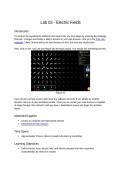
Next, click on the +1nC dot and drag it into the black space. You should see something like this:
Figure #1
If you do see a similar screen, then likely the software will work. If not, please try another
browser until you do see something similar. Once you are certain your web-browser is capable
of using this app, then refresh it until you have a blank/black screen and begin the activities
below.
Materials/Supplies
Access to computer and high-speed internet
Electronics kit from Amazon
Time Spent
Approximately 2 hours, does not need to be done at one sitting
Learning Objectives
Define electric force, electric field, and electric potential and their respective
characteristics as vectors or scalars
, Apply these definitions to characterize static charges in various configurations
Virtual Lab
1. What can you change about the simulation?
Answer:
You can change the number of charges used, their positions relative to one another, and
whether they are positive or negative charges. You can also add electric field sensors, turn on
field lines, grid, and values.
2. Click on the “sensor” dot on the bottom and put it somewhat far from a +1nC charge.
Then click “show values” on the upper right box. What is the physical significance of this
value?
Answer:
The value represents the electric field at that point, which is a vector quantity that shows both
magnitude and direction. The magnitude tells how strong the force would be on a positive test
charge, and the direction shows which way the force would act. As the sensor moves farther
from the charge, the magnitude of the electric field decreases.
3. How can you make a charge of +2nC? -3nC? Describe your attempts to do this below.
Answer:
To make a +2 nC charge, I placed two +1 nC charges on top of each other in the same
location. To make a -3 nC charge, I placed three -1 nC charges on top of each other. By
stacking charges at the same point, their values add together, following the principle of
superposition.
4. Draw the field lines for a +4nC charge. Make sure you are sketching continuous field
lines. You can use Google Drawing to complete this or simply attach a screenshot of
your image from the simulator.
Answer:
Introduction
To conduct the experiments utilized in this week’s lab, you must begin by ensuring the webpage
Phet lab - Charges and Fields is able to function in your web browser. First go to the Phet Lab
webpage. Likely Chrome will be the best browser for this, but most any should work.
Next, click on the +1nC dot and drag it into the black space. You should see something like this:
Figure #1
If you do see a similar screen, then likely the software will work. If not, please try another
browser until you do see something similar. Once you are certain your web-browser is capable
of using this app, then refresh it until you have a blank/black screen and begin the activities
below.
Materials/Supplies
Access to computer and high-speed internet
Electronics kit from Amazon
Time Spent
Approximately 2 hours, does not need to be done at one sitting
Learning Objectives
Define electric force, electric field, and electric potential and their respective
characteristics as vectors or scalars
, Apply these definitions to characterize static charges in various configurations
Virtual Lab
1. What can you change about the simulation?
Answer:
You can change the number of charges used, their positions relative to one another, and
whether they are positive or negative charges. You can also add electric field sensors, turn on
field lines, grid, and values.
2. Click on the “sensor” dot on the bottom and put it somewhat far from a +1nC charge.
Then click “show values” on the upper right box. What is the physical significance of this
value?
Answer:
The value represents the electric field at that point, which is a vector quantity that shows both
magnitude and direction. The magnitude tells how strong the force would be on a positive test
charge, and the direction shows which way the force would act. As the sensor moves farther
from the charge, the magnitude of the electric field decreases.
3. How can you make a charge of +2nC? -3nC? Describe your attempts to do this below.
Answer:
To make a +2 nC charge, I placed two +1 nC charges on top of each other in the same
location. To make a -3 nC charge, I placed three -1 nC charges on top of each other. By
stacking charges at the same point, their values add together, following the principle of
superposition.
4. Draw the field lines for a +4nC charge. Make sure you are sketching continuous field
lines. You can use Google Drawing to complete this or simply attach a screenshot of
your image from the simulator.
Answer:


