

1|Page
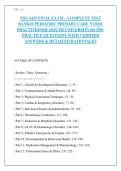
NSG 6435 FINAL EXAM – COMPLETE TEST
BANK## PEDIATRIC PRIMARY CARE NURSE
PRACTITIONER (SOUTH UNIVERSITY)## 250+
PRACTICE QUESTIONS WITH VERIFIED
ANSWERS & DETAILED RATIONALES
## TABLE OF CONTENTS
| Section | Topic | Questions |
|---------|-------|-----------|
| Part 1 | Growth & Development Milestones | 1–35 |
| Part 2 | Communication & Health History | 36–50 |
| Part 3 | Physical Assessment Techniques | 51–70 |
| Part 4 | Cardiac & Respiratory Disorders | 71–90 |
| Part 5 | Infectious Diseases & Immunizations | 91–110 |
| Part 6 | Dermatologic Conditions | 111–130 |
| Part 7 | Endocrine & Metabolic Disorders | 131–145 |
| Part 8 | GI, GU & Hematologic Disorders | 146–160 |
| Part 9 | Pediatric Emergencies & Trauma | 161–175 |
| Part 10 | Developmental & Behavioral Health | 176–190 |
| Part 11 | Medication Management & Pharmacology | 191–210 |
| Part 12 | Professional Issues & Ethics | 211–225 |
,2|Page
# PART 1: GROWTH & DEVELOPMENT MILESTONES (Questions 1–
35)
**Q1. By what age do the head and chest circumferences generally
become equal?**
A) 6 months
B) 1 to 2 years
C) 3 to 4 years
D) 6 months to 1 year
**Answer: B**
*Rationale:* At birth, the head circumference is approximately 2 cm
larger than the chest circumference. By 1 to 2 years of age, the head and
chest circumferences become approximately equal .
**Q2. What is the expected weight of a 6-month-old infant who
weighed 7 pounds at birth?**
A) 10 pounds
B) 14 pounds
C) 15 pounds
,3|Page
D) 21 pounds
**Answer: C**
*Rationale:* Birth weight doubles by 5 months and triples by 1 year of
age. An infant who weighed 7 pounds at birth would be expected to
weigh approximately 15 pounds at 6 months (a little more than double) .
**Q3. At which age can most infants sit steadily unsupported?**
A) 4 months
B) 6 months
C) 8 months
D) 10 months
**Answer: C**
*Rationale:* Most infants can sit steadily unsupported by approximately
8 months of age. Sitting with support occurs earlier, around 5 to 6
months .
**Q4. By what age does the anterior fontanel usually close?**
, 4|Page
A) 2 to 4 months
B) 6 to 8 months
C) 8 to 10 months
D) 12 to 18 months
**Answer: D**
*Rationale:* The anterior fontanel typically closes between 12 and 18
months of age. Early or late closure may indicate developmental
concerns .
**Q5. By what age does the posterior fontanel usually close?**
A) Birth
B) 2 to 3 months
C) 6 to 8 weeks
D) 4 to 6 months
**Answer: C**
*Rationale:* The posterior fontanel closes by 6 to 8 weeks of age. It is
significantly smaller than the anterior fontanel and closes much earlier .
NSG 6435 FINAL EXAM – COMPLETE TEST
BANK## PEDIATRIC PRIMARY CARE NURSE
PRACTITIONER (SOUTH UNIVERSITY)## 250+
PRACTICE QUESTIONS WITH VERIFIED
ANSWERS & DETAILED RATIONALES
## TABLE OF CONTENTS
| Section | Topic | Questions |
|---------|-------|-----------|
| Part 1 | Growth & Development Milestones | 1–35 |
| Part 2 | Communication & Health History | 36–50 |
| Part 3 | Physical Assessment Techniques | 51–70 |
| Part 4 | Cardiac & Respiratory Disorders | 71–90 |
| Part 5 | Infectious Diseases & Immunizations | 91–110 |
| Part 6 | Dermatologic Conditions | 111–130 |
| Part 7 | Endocrine & Metabolic Disorders | 131–145 |
| Part 8 | GI, GU & Hematologic Disorders | 146–160 |
| Part 9 | Pediatric Emergencies & Trauma | 161–175 |
| Part 10 | Developmental & Behavioral Health | 176–190 |
| Part 11 | Medication Management & Pharmacology | 191–210 |
| Part 12 | Professional Issues & Ethics | 211–225 |
,2|Page
# PART 1: GROWTH & DEVELOPMENT MILESTONES (Questions 1–
35)
**Q1. By what age do the head and chest circumferences generally
become equal?**
A) 6 months
B) 1 to 2 years
C) 3 to 4 years
D) 6 months to 1 year
**Answer: B**
*Rationale:* At birth, the head circumference is approximately 2 cm
larger than the chest circumference. By 1 to 2 years of age, the head and
chest circumferences become approximately equal .
**Q2. What is the expected weight of a 6-month-old infant who
weighed 7 pounds at birth?**
A) 10 pounds
B) 14 pounds
C) 15 pounds
,3|Page
D) 21 pounds
**Answer: C**
*Rationale:* Birth weight doubles by 5 months and triples by 1 year of
age. An infant who weighed 7 pounds at birth would be expected to
weigh approximately 15 pounds at 6 months (a little more than double) .
**Q3. At which age can most infants sit steadily unsupported?**
A) 4 months
B) 6 months
C) 8 months
D) 10 months
**Answer: C**
*Rationale:* Most infants can sit steadily unsupported by approximately
8 months of age. Sitting with support occurs earlier, around 5 to 6
months .
**Q4. By what age does the anterior fontanel usually close?**
, 4|Page
A) 2 to 4 months
B) 6 to 8 months
C) 8 to 10 months
D) 12 to 18 months
**Answer: D**
*Rationale:* The anterior fontanel typically closes between 12 and 18
months of age. Early or late closure may indicate developmental
concerns .
**Q5. By what age does the posterior fontanel usually close?**
A) Birth
B) 2 to 3 months
C) 6 to 8 weeks
D) 4 to 6 months
**Answer: C**
*Rationale:* The posterior fontanel closes by 6 to 8 weeks of age. It is
significantly smaller than the anterior fontanel and closes much earlier .


