

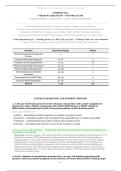
NURSING 602 I-Human Case Study — Dysuria Exam 2026/2027
NURSING 602
I-HUMAN CASE STUDY – DYSURIA EXAM
2026/2027 Edition | 50 Questions | Correct Answers & Rationales
Advanced Health Assessment | Graduate Nursing | i-Human Patients Platform
Clinical Reasoning & Diagnostic Process | Differential Diagnosis | Pharmacological Management
Aligned with NONPF Core Competencies, NCSBN CJMM, CDC STI Treatment Guidelines
Evidence-Based References: IDSA UTI Guidelines, ACOG Practice Bulletins, FDA Safety Alerts
Total Questions: 50 | Passing Score: 75–80% (38–40/50) | Testing Time: 90–120 minutes
Question Types: Single-Best-Answer, Select-All-That-Apply (SATA), Scenario-Based
Section Question Range Points
Clinical Reasoning & Diagnostic 1–7 7
Process
Dysuria Differential Diagnosis 8–16 9
Urinalysis & Lab Interpretation 17–24 8
STI Screening & Risk Assessment 25–31 7
Pharmacological Management 32–38 7
Patient Education & Health 39–43 5
Promotion
Documentation & SOAP Notes 44–46 3
Scenario-Based Integration 47–50 4
TOTAL 1–50 50
CLINICAL REASONING & DIAGNOSTIC PROCESS
1. A 28-year-old female presents to the i-Human virtual clinic with a chief complaint of
dysuria for 3 days. Which component of the OLDCARTS history is MOST critical to
differentiate uncomplicated cystitis from pyelonephritis at this decision point?
Type: single-best-answer
A) Onset — determining whether symptoms were sudden or gradual in onset
B) Location — identifying whether pain is localized to the suprapubic area or radiates to the flank
C) Duration — calculating the exact number of hours since symptom onset
D) Timing — assessing whether dysuria is worse in the morning or evening
Correct Answer: B) Location — identifying whether pain is localized to the suprapubic area
or radiates to the flank
Rationale: Location of pain is the single most discriminating historical feature separating lower UTI
(cystitis) from upper UTI (pyelonephritis). Suprapubic pain with dysuria and urinary frequency
suggests cystitis, while costovertebral angle (flank) pain with or without fever and nausea suggests
pyelonephritis. In the i-Human virtual patient encounter, identifying flank or CVA tenderness is a
critical decision node that shifts management from outpatient oral antibiotics to potentially more
aggressive therapy. The IDSA guidelines emphasize that systemic symptoms (fever, chills, nausea,
vomiting) plus flank pain warrant a diagnosis of pyelonephritis rather than cystitis, fundamentally
altering the treatment plan.
2. In the i-Human virtual patient encounter for a 32-year-old female presenting with
dysuria, which associated symptoms in the History of Present Illness (HPI) would prompt
Page 1
, NURSING 602 I-Human Case Study — Dysuria Exam 2026/2027
you to broaden your differential diagnosis beyond uncomplicated cystitis? Select ALL that
apply.
Type: SATA [Select All That Apply]
A) Vaginal discharge and pruritus
B) Gross hematuria with visible clots
C) Suprapubic tenderness without fever
D) Unilateral flank pain with fever of 101.5°F
E) Polyuria with increased thirst over the past 2 weeks
Correct Answer: A, D, E
Rationale: Vaginal discharge and pruritus (A) suggest vaginitis or STI-related etiology (candidiasis,
trichomoniasis, or chlamydial/gonococcal cervicitis) rather than UTI. Unilateral flank pain with fever
(D) is the classic presentation of pyelonephritis requiring escalation of care. New-onset polyuria with
polydipsia (E) may indicate undiagnosed diabetes mellitus, which predisposes to UTIs and requires
screening with HbA1c or fasting glucose. Suprapubic tenderness without fever (C) is actually consistent
with uncomplicated cystitis and would not broaden the differential. Gross hematuria (B) can occur in
cystitis but visible clots should raise concern for urolithiasis, though this finding alone does not
necessarily broaden the differential beyond what is already considered.
3. During an i-Human virtual patient encounter, a 24-year-old sexually active female reports
dysuria, urinary frequency, and urgency. Her vital signs are: BP 118/74, HR 88, RR 16, Temp
99.0°F. On abdominal exam, there is mild suprapubic tenderness without CVA tenderness.
Which finding on genital examination would MOST strongly support a sexually transmitted
infection (STI) as the primary etiology?
Type: single-best-answer
A) Erythematous urethral meatus with purulent discharge
B) Tender inguinal lymphadenopathy bilaterally
C) Normal-appearing vaginal mucosa with scant clear discharge
D) Atrophic vaginal epithelium with pale mucosa
Correct Answer: A) Erythematous urethral meatus with purulent discharge
Rationale: An erythematous urethral meatus with purulent discharge is pathognomonic for
gonococcal or chlamydial urethritis and represents the strongest evidence for an STI etiology. In the i-
Human decision-making framework, this finding would redirect the provider to order NAAT testing for
Neisseria gonorrhoeae and Chlamydia trachomatis rather than proceeding with UTI-focused
evaluation alone. Tender inguinal lymphadenopathy (B) can occur with several STIs but is less specific.
Normal-appearing vaginal mucosa (C) does not support STI. Atrophic vaginal epithelium (D) is seen in
postmenopausal women with atrophic vaginitis, not in a 24-year-old.
4. A 35-year-old male presents to the i-Human virtual clinic with dysuria and cloudy urine
for 2 days. His temperature is 100.8°F and he reports mild suprapubic discomfort. Which
physical examination technique is MOST appropriate to evaluate for costovertebral angle
(CVA) tenderness, and what does a positive finding indicate?
Type: single-best-answer
A) Percuss the CVA by placing one hand flat over the 12th rib at the costovertebral angle and striking it
with the ulnar surface of the other fist; a positive finding suggests pyelonephritis
B) Palpate deeply in the flank area with both hands; a positive finding suggests renal calculi
C) Percuss directly over the kidneys at the mid-scapular line; a positive finding suggests muscle strain
D) Apply direct pressure to the suprapubic area and observe for referred flank pain; a positive finding
suggests cystitis with referred pain
Correct Answer: A) Percuss the CVA by placing one hand flat over the 12th rib at the
costovertebral angle and striking it with the ulnar surface of the other fist; a positive finding
suggests pyelonephritis
Rationale: The correct technique for assessing CVA tenderness involves placing one hand flat over the
costovertebral angle at the 12th rib and using the fist of the other hand to deliver a firm percussion
strike. A positive result — pain upon percussion — suggests renal inflammation consistent with
Page 2
, NURSING 602 I-Human Case Study — Dysuria Exam 2026/2027
pyelonephritis. In the i-Human encounter, this is a critical physical exam decision point; a positive CVA
tenderness finding combined with fever would shift the diagnosis from uncomplicated lower UTI to
pyelonephritis, altering antibiotic selection and duration of therapy. Direct flank palpation (B) is less
reliable than percussion for detecting renal inflammation.
5. In the i-Human virtual patient encounter for a 22-year-old college student presenting with
dysuria, the advanced practice nurse must select the initial diagnostic approach. According
to evidence-based guidelines, which of the following is the MOST appropriate first
diagnostic step for an uncomplicated presentation of dysuria in a nonpregnant
premenopausal female?
Type: single-best-answer
A) Urinalysis with microscopy followed by urine culture and sensitivity
B) Empiric antibiotic therapy based on clinical diagnosis alone without laboratory confirmation
C) Nucleic acid amplification testing (NAAT) for gonorrhea and chlamydia as the sole initial test
D) Urinalysis with microscopy only, reserving culture for treatment failures
Correct Answer: A) Urinalysis with microscopy followed by urine culture and sensitivity
Rationale: Current evidence supports obtaining a urinalysis with microscopy as the initial diagnostic
test for dysuria evaluation. While some guidelines suggest that uncomplicated cystitis in healthy
premenopausal women can be treated empirically, the i-Human virtual patient encounter is designed
to teach systematic diagnostic reasoning. Urinalysis identifies pyuria (WBC >5-10/hpf), bacteriuria,
hematuria, and nitrite production. A follow-up urine culture and sensitivity is essential to guide
antibiotic selection, especially given rising E. coli resistance rates (exceeding 20% for TMP-SMX in
many regions per IDSA 2023 data). NAAT for STIs (C) should be obtained concurrently in sexually
active patients but is not the sole initial test. Empiric treatment without any testing (B) is inappropriate
in the educational i-Human context.
6. A 45-year-old female with a history of recurrent UTIs presents to the i-Human clinic with
dysuria, frequency, and low-grade fever of 99.6°F. Her vitals are otherwise stable. During
the virtual encounter, which data-gathering strategy BEST aligns with the OLDCARTS
framework for characterizing her current episode?
Type: single-best-answer
A) Focusing exclusively on the urinary symptoms to maintain clinical efficiency
B) Systematically exploring Onset, Location, Duration, Character, Aggravating factors, Relieving factors,
Timing, and Severity for each symptom, including associated systemic symptoms
C) Relying on the patient's self-report of 'another UTI' without structured history-taking
D) Obtaining only a medication allergy history and proceeding directly to prescribing
Correct Answer: B) Systematically exploring Onset, Location, Duration, Character,
Aggravating factors, Relieving factors, Timing, and Severity for each symptom, including
associated systemic symptoms
Rationale: The OLDCARTS mnemonic provides a structured, comprehensive approach to history-
taking that ensures no critical element is missed. For this patient with recurrent UTIs, systematically
evaluating each element is essential because a change in character (e.g., new flank pain), severity (e.g.,
higher fever), or aggravating factors may suggest a different or more serious diagnosis such as
pyelonephritis or a renal abscess. In the i-Human framework, using OLDCARTS demonstrates clinical
reasoning competency and is evaluated as a key performance indicator. Focusing only on urinary
symptoms (A) misses systemic clues, and accepting 'another UTI' without structured assessment (C)
introduces cognitive bias and diagnostic error risk.
7. During an i-Human virtual patient encounter, a 50-year-old postmenopausal woman
presents with dysuria and vaginal dryness. Her vital signs are: BP 130/82, HR 76, RR 18,
Temp 98.4°F, SpO2 98%. On examination, the vaginal mucosa appears pale and thin with
petechiae. Which clinical reasoning process BEST explains why empiric antibiotics for UTI
would be inappropriate as the initial intervention?
Type: single-best-answer
A) Her normal temperature excludes the possibility of a urinary tract infection
Page 3
NURSING 602
I-HUMAN CASE STUDY – DYSURIA EXAM
2026/2027 Edition | 50 Questions | Correct Answers & Rationales
Advanced Health Assessment | Graduate Nursing | i-Human Patients Platform
Clinical Reasoning & Diagnostic Process | Differential Diagnosis | Pharmacological Management
Aligned with NONPF Core Competencies, NCSBN CJMM, CDC STI Treatment Guidelines
Evidence-Based References: IDSA UTI Guidelines, ACOG Practice Bulletins, FDA Safety Alerts
Total Questions: 50 | Passing Score: 75–80% (38–40/50) | Testing Time: 90–120 minutes
Question Types: Single-Best-Answer, Select-All-That-Apply (SATA), Scenario-Based
Section Question Range Points
Clinical Reasoning & Diagnostic 1–7 7
Process
Dysuria Differential Diagnosis 8–16 9
Urinalysis & Lab Interpretation 17–24 8
STI Screening & Risk Assessment 25–31 7
Pharmacological Management 32–38 7
Patient Education & Health 39–43 5
Promotion
Documentation & SOAP Notes 44–46 3
Scenario-Based Integration 47–50 4
TOTAL 1–50 50
CLINICAL REASONING & DIAGNOSTIC PROCESS
1. A 28-year-old female presents to the i-Human virtual clinic with a chief complaint of
dysuria for 3 days. Which component of the OLDCARTS history is MOST critical to
differentiate uncomplicated cystitis from pyelonephritis at this decision point?
Type: single-best-answer
A) Onset — determining whether symptoms were sudden or gradual in onset
B) Location — identifying whether pain is localized to the suprapubic area or radiates to the flank
C) Duration — calculating the exact number of hours since symptom onset
D) Timing — assessing whether dysuria is worse in the morning or evening
Correct Answer: B) Location — identifying whether pain is localized to the suprapubic area
or radiates to the flank
Rationale: Location of pain is the single most discriminating historical feature separating lower UTI
(cystitis) from upper UTI (pyelonephritis). Suprapubic pain with dysuria and urinary frequency
suggests cystitis, while costovertebral angle (flank) pain with or without fever and nausea suggests
pyelonephritis. In the i-Human virtual patient encounter, identifying flank or CVA tenderness is a
critical decision node that shifts management from outpatient oral antibiotics to potentially more
aggressive therapy. The IDSA guidelines emphasize that systemic symptoms (fever, chills, nausea,
vomiting) plus flank pain warrant a diagnosis of pyelonephritis rather than cystitis, fundamentally
altering the treatment plan.
2. In the i-Human virtual patient encounter for a 32-year-old female presenting with
dysuria, which associated symptoms in the History of Present Illness (HPI) would prompt
Page 1
, NURSING 602 I-Human Case Study — Dysuria Exam 2026/2027
you to broaden your differential diagnosis beyond uncomplicated cystitis? Select ALL that
apply.
Type: SATA [Select All That Apply]
A) Vaginal discharge and pruritus
B) Gross hematuria with visible clots
C) Suprapubic tenderness without fever
D) Unilateral flank pain with fever of 101.5°F
E) Polyuria with increased thirst over the past 2 weeks
Correct Answer: A, D, E
Rationale: Vaginal discharge and pruritus (A) suggest vaginitis or STI-related etiology (candidiasis,
trichomoniasis, or chlamydial/gonococcal cervicitis) rather than UTI. Unilateral flank pain with fever
(D) is the classic presentation of pyelonephritis requiring escalation of care. New-onset polyuria with
polydipsia (E) may indicate undiagnosed diabetes mellitus, which predisposes to UTIs and requires
screening with HbA1c or fasting glucose. Suprapubic tenderness without fever (C) is actually consistent
with uncomplicated cystitis and would not broaden the differential. Gross hematuria (B) can occur in
cystitis but visible clots should raise concern for urolithiasis, though this finding alone does not
necessarily broaden the differential beyond what is already considered.
3. During an i-Human virtual patient encounter, a 24-year-old sexually active female reports
dysuria, urinary frequency, and urgency. Her vital signs are: BP 118/74, HR 88, RR 16, Temp
99.0°F. On abdominal exam, there is mild suprapubic tenderness without CVA tenderness.
Which finding on genital examination would MOST strongly support a sexually transmitted
infection (STI) as the primary etiology?
Type: single-best-answer
A) Erythematous urethral meatus with purulent discharge
B) Tender inguinal lymphadenopathy bilaterally
C) Normal-appearing vaginal mucosa with scant clear discharge
D) Atrophic vaginal epithelium with pale mucosa
Correct Answer: A) Erythematous urethral meatus with purulent discharge
Rationale: An erythematous urethral meatus with purulent discharge is pathognomonic for
gonococcal or chlamydial urethritis and represents the strongest evidence for an STI etiology. In the i-
Human decision-making framework, this finding would redirect the provider to order NAAT testing for
Neisseria gonorrhoeae and Chlamydia trachomatis rather than proceeding with UTI-focused
evaluation alone. Tender inguinal lymphadenopathy (B) can occur with several STIs but is less specific.
Normal-appearing vaginal mucosa (C) does not support STI. Atrophic vaginal epithelium (D) is seen in
postmenopausal women with atrophic vaginitis, not in a 24-year-old.
4. A 35-year-old male presents to the i-Human virtual clinic with dysuria and cloudy urine
for 2 days. His temperature is 100.8°F and he reports mild suprapubic discomfort. Which
physical examination technique is MOST appropriate to evaluate for costovertebral angle
(CVA) tenderness, and what does a positive finding indicate?
Type: single-best-answer
A) Percuss the CVA by placing one hand flat over the 12th rib at the costovertebral angle and striking it
with the ulnar surface of the other fist; a positive finding suggests pyelonephritis
B) Palpate deeply in the flank area with both hands; a positive finding suggests renal calculi
C) Percuss directly over the kidneys at the mid-scapular line; a positive finding suggests muscle strain
D) Apply direct pressure to the suprapubic area and observe for referred flank pain; a positive finding
suggests cystitis with referred pain
Correct Answer: A) Percuss the CVA by placing one hand flat over the 12th rib at the
costovertebral angle and striking it with the ulnar surface of the other fist; a positive finding
suggests pyelonephritis
Rationale: The correct technique for assessing CVA tenderness involves placing one hand flat over the
costovertebral angle at the 12th rib and using the fist of the other hand to deliver a firm percussion
strike. A positive result — pain upon percussion — suggests renal inflammation consistent with
Page 2
, NURSING 602 I-Human Case Study — Dysuria Exam 2026/2027
pyelonephritis. In the i-Human encounter, this is a critical physical exam decision point; a positive CVA
tenderness finding combined with fever would shift the diagnosis from uncomplicated lower UTI to
pyelonephritis, altering antibiotic selection and duration of therapy. Direct flank palpation (B) is less
reliable than percussion for detecting renal inflammation.
5. In the i-Human virtual patient encounter for a 22-year-old college student presenting with
dysuria, the advanced practice nurse must select the initial diagnostic approach. According
to evidence-based guidelines, which of the following is the MOST appropriate first
diagnostic step for an uncomplicated presentation of dysuria in a nonpregnant
premenopausal female?
Type: single-best-answer
A) Urinalysis with microscopy followed by urine culture and sensitivity
B) Empiric antibiotic therapy based on clinical diagnosis alone without laboratory confirmation
C) Nucleic acid amplification testing (NAAT) for gonorrhea and chlamydia as the sole initial test
D) Urinalysis with microscopy only, reserving culture for treatment failures
Correct Answer: A) Urinalysis with microscopy followed by urine culture and sensitivity
Rationale: Current evidence supports obtaining a urinalysis with microscopy as the initial diagnostic
test for dysuria evaluation. While some guidelines suggest that uncomplicated cystitis in healthy
premenopausal women can be treated empirically, the i-Human virtual patient encounter is designed
to teach systematic diagnostic reasoning. Urinalysis identifies pyuria (WBC >5-10/hpf), bacteriuria,
hematuria, and nitrite production. A follow-up urine culture and sensitivity is essential to guide
antibiotic selection, especially given rising E. coli resistance rates (exceeding 20% for TMP-SMX in
many regions per IDSA 2023 data). NAAT for STIs (C) should be obtained concurrently in sexually
active patients but is not the sole initial test. Empiric treatment without any testing (B) is inappropriate
in the educational i-Human context.
6. A 45-year-old female with a history of recurrent UTIs presents to the i-Human clinic with
dysuria, frequency, and low-grade fever of 99.6°F. Her vitals are otherwise stable. During
the virtual encounter, which data-gathering strategy BEST aligns with the OLDCARTS
framework for characterizing her current episode?
Type: single-best-answer
A) Focusing exclusively on the urinary symptoms to maintain clinical efficiency
B) Systematically exploring Onset, Location, Duration, Character, Aggravating factors, Relieving factors,
Timing, and Severity for each symptom, including associated systemic symptoms
C) Relying on the patient's self-report of 'another UTI' without structured history-taking
D) Obtaining only a medication allergy history and proceeding directly to prescribing
Correct Answer: B) Systematically exploring Onset, Location, Duration, Character,
Aggravating factors, Relieving factors, Timing, and Severity for each symptom, including
associated systemic symptoms
Rationale: The OLDCARTS mnemonic provides a structured, comprehensive approach to history-
taking that ensures no critical element is missed. For this patient with recurrent UTIs, systematically
evaluating each element is essential because a change in character (e.g., new flank pain), severity (e.g.,
higher fever), or aggravating factors may suggest a different or more serious diagnosis such as
pyelonephritis or a renal abscess. In the i-Human framework, using OLDCARTS demonstrates clinical
reasoning competency and is evaluated as a key performance indicator. Focusing only on urinary
symptoms (A) misses systemic clues, and accepting 'another UTI' without structured assessment (C)
introduces cognitive bias and diagnostic error risk.
7. During an i-Human virtual patient encounter, a 50-year-old postmenopausal woman
presents with dysuria and vaginal dryness. Her vital signs are: BP 130/82, HR 76, RR 18,
Temp 98.4°F, SpO2 98%. On examination, the vaginal mucosa appears pale and thin with
petechiae. Which clinical reasoning process BEST explains why empiric antibiotics for UTI
would be inappropriate as the initial intervention?
Type: single-best-answer
A) Her normal temperature excludes the possibility of a urinary tract infection
Page 3


