

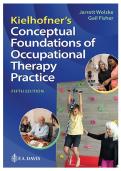
, TESTBANK FOR Kielhofner's Conceptual Foundations of Occupational
Therapy Practice 5th Edition Wolske
Important Notes
The file includes the complete test bank, organized chapter by chapter.
A sample of selected pages has been provided for preview.
All available appendices and Excel files (if included in the original resources) are
provided.
We continuously update our files to ensure you receive the latest and most accurate
editions.
New editions are added regularly – stay connected for updates!
⚠️Note on Answer Keys: If the answer key is not included within the chapter
questions, you will find the complete answers and solutions at the end of each
chapter.
✅ Why Buy From Us?
📚 Complete & organized chapter-by-chapter – no missing content, no guessing.
⚡ Instant digital delivery – get your file the moment you pay, no waiting.
📅 Always up to date – we track new editions so you always get the latest version.
💬 Friendly support – real humans ready to help, anytime you need us.
🔒 Safe & secure – thousands of satisfied students trust us every semester.
🛡️Our Guarantees
💰 Money-Back Guarantee: Not satisfied? We offer a full refund – no questions asked.
🔄 Wrong File? No Problem: Contact us and we will replace it immediately with the
correct version, free of charge.
⏰ 24/7 Support: We are always here – reach out anytime and expect a fast response.
Contact Email:
, Chapter 1 Test Bank
Multiple Choice Questions
1. Which of the following best explains why history is emphasized in Chapter 1?
A. To honor the legacies of those throughout the history of the profession
B. To understand how cultural, social, and political forces shaped the profession’s
development
C. To memorize dates and events for accreditation requirements
D. To separate occupational therapy’s influence from the influence of other health
professions
Correct Answer: B
2. In Chapter 1, paradigms are introduced to:
A. Provide accurate treatment protocols for all clients
B. Explain how knowledge developed in the 20th century
C. Offer a checklist of techniques to use in clinical practice
D. Explain the philosophical foundations and shifts that guide OT practice
Correct Answer: D
3. What are the three primary elements of a profession’s paradigm?
A. Core concepts, values, and skills
B. Core concepts, values, and practice applications
C. Core concepts, beliefs, and skills
D. Core concepts, beliefs, and practical applications
Correct Answer: B
4. Which of the following best describes a conceptual practice model?
A. A philosophical worldview to understand occupation and practice
B. A code of ethics for therapy
C. An interrelated body of theory, evidence, and practical tools used in practice
D. A theoretical understanding of occupation to guide practice
Correct Answer: C
Wolske/Fisher TB Ch 1, pg. 1
,5. According to Kielhofner, a paradigm shift occurs when:
A. New concepts enter the field of occupational therapy
B. A law or policy modifies practices for occupational therapy
C. Conceptual foundations can no longer define or meet practice needs
D. Updates occur to educational standards and expectations
Correct Answer: C
6. Which type of conceptual practice model best meets this definition: A model that
focuses on specific aspects of performance or participation.
A. An Occupation Model
B. Frame of Reference
C. Relationship-Oriented Model
D. Domain of Related Knowledge
Correct Answer: B
True or False
1. True/False: The multi-model approach is considered an eclectic approach.
Correct Answer: False
2. True/False: Conceptual practice models involve a dynamic and ongoing process of
knowledge development.
Correct Answer: True
Short Answer Question
1. In your own words, describe the difference between organizing models and complementary
models. Why is it important to distinguish them?
2. What is the significance of using an occupation model as the foundation of the multi-model
approach?
Wolske/Fisher TB Ch 1, pg. 2
, Chapter 2 Test Bank
Multiple Choice Questions
1. Which intellectual movement provided the ‘blueprint' for occupational therapy’s
foundation?
A. Romanticism
B. Enlightenment
C. Industrial Revolution
D. Modernism
Correct Answer: B
2. The moral treatment movement most strongly emphasized which of the following
principles?
A. Symptom reduction through medical intervention
B. Habit training through repetition of exercises
C. Engagement in meaningful activity within a humane environment
D. Standardized assessment and measurement
Correct answer: C
3. In what year was NSPOT founded?
A. 1908
B. 1912
C. 1917
D. 1923
Correct Answer: C
4. Which Progressive Era movement emphasized creativity and craftsmanship,
influencing early OT practice?
A. Arts and Crafts Movement
B. Women’s Suffrage Movement
C. Mental Hygiene Movement
D. Settlement House Movement
Correct Answer: A
Wolske/Fisher Ch 02 TB, 1
,5. Which of the following founders was an architect who contributed significantly to OT’s
vocational rehabilitation focus?
A. Eleanor Clarke Slagle
B. George Barton
C. Thomas Kidner
D. Susan Tracy
Correct Answer: C
6. Who among the following is not considered an official founder of the profession of
occupational therapy?
A. William Rush Dunton
B. Eleanor Clarke Slagle
C. George Edward Barton
D. Adolf Meyer
Correct answer: D
7. Which of the following is not a core concept of the Early Occupation Paradigm?
A. Occupation consists of moving between modes of doing, believing, resting, and acting
B. Humans are occupational beings
C. The mind and body are inextricably linked
D. Occupation can be used to address idleness and regain lost function
Correct Answer: A
True or False
1. True/False: Early occupational therapists believed idleness could harm both mind and body.
Correct Answer: True
2. 2. True/False: Motivating the person, influencing attitudes and morale, and eliciting physical
activity through mental engagement were primary activities done within the context of
therapy.
Correct Answer: True
Wolske/Fisher Ch 02 TB, 2
, Short Answer Question
1. How did World War I influence the profession of occupational therapy?
2. In six to eight sentences, describe the values of the early occupation paradigm.
Wolske/Fisher Ch 02 TB, 3
, Chapter 3 Test Bank
Multiple Choice Questions
1. What was the main goal of occupational therapists during the Remediation Paradigm?
A. Expand the use of crafts in hospital settings.
B. Add a new level of occupational therapy practitioner: the occupational therapy assistant.
C. Reduce impairments that were interfering with occupational performance.
D. Require newly certified occupational therapists to work after they got married
Correct Answer: C
2. While the efforts of Beatrice Wade and others helped to maintain the profession’s
autonomy from medicine in the 1940’s, how did medicine’s critiques impact the
profession?
A. Occupational therapy education was moved to the master’s level.
B. Occupational therapy began to incorporate the lived experiences of disabled persons with
into treatment planning.
C. Occupational therapists expanded their focus on holistic crafts-oriented therapy for
wounded soldiers.
D. Occupational therapy became more science-based and deficit-oriented.
Correct Answer: D
3. Intervention strategies developed during the remediation paradigm that are part of the
emerging contemporary paradigm include:
A. Recommending adaptive equipment like an adapted spoon to facilitate self-feeding.
B. The therapist prescribing a craft activity that will remediate a specific limitation in
function, even if the patient isn’t interested in crafts.
C. Building the client-therapist relationship by showing empathy.
D. Stacking cones on a tabletop for the full therapy session to improve grasp and reach.
Correct Answer: A
4. Which frame of reference emerged during this paradigm?
A. Dynamic Systems Frame of Reference
B. Biobehavioral Frame of Reference
Wolske/Fisher TB Ch 3, 1
, C. Cognitive Frame of Reference
D. Sensory Integration Frame of Reference
Correct Answer: D
5. Which factor most strongly contributed to the growth of the profession in the 1940s?
A. Expanded use of crafts, games, and gardening to promote enjoyment and recovery
B. Focusing only on working with adults rather than working with both adults and children
C. Soldiers and veterans sustained injuries that responded well to a remediation approach
D. The founding of the Black Caucus of Occupational Therapists
Correct answer: C
6. Which of the following is NOT a reason that the profession expanded during this
paradigm?
A. Passage of Medicare and Medicaid, a U.S. government health insurance policy that paid
for hospital and home-based occupational therapy services.
B. New U.S. laws that required schools to provide occupational therapy to eligible students.
C. Requiring occupational therapy students to complete a master’s degree to enter the field.
D. Expansion of the profession globally to a variety of Eastern and Western countries.
Correct Answer: E
True or False
1. True/False: During the remediation paradigm, some schools dropped the requirement for
students to complete several crafts classes.
Correct Answer: True
2. True/False: AOTA did not approve of the admission of Black students to occupational
therapy programs until the early 1940s.
Correct Answer: True
3. True/False: The World Federation of Occupational Therapists was founded by Western
countries in the 1960s since there weren’t any programs in Latin America until the next
paradigm in the 1980s.
Correct Answer: False
Wolske/Fisher TB Ch 3, 2
, Short Answer Question
1. Describe the limitations and benefits of the remediation paradigm from a patient perspective
and a therapist perspective.
2. Write a paragraph detailing in what ways you believe the conceptual foundations (concepts,
values, and practical applications) of this paradigm persist in today’s practice.
Wolske/Fisher TB Ch 3, 3
Therapy Practice 5th Edition Wolske
Important Notes
The file includes the complete test bank, organized chapter by chapter.
A sample of selected pages has been provided for preview.
All available appendices and Excel files (if included in the original resources) are
provided.
We continuously update our files to ensure you receive the latest and most accurate
editions.
New editions are added regularly – stay connected for updates!
⚠️Note on Answer Keys: If the answer key is not included within the chapter
questions, you will find the complete answers and solutions at the end of each
chapter.
✅ Why Buy From Us?
📚 Complete & organized chapter-by-chapter – no missing content, no guessing.
⚡ Instant digital delivery – get your file the moment you pay, no waiting.
📅 Always up to date – we track new editions so you always get the latest version.
💬 Friendly support – real humans ready to help, anytime you need us.
🔒 Safe & secure – thousands of satisfied students trust us every semester.
🛡️Our Guarantees
💰 Money-Back Guarantee: Not satisfied? We offer a full refund – no questions asked.
🔄 Wrong File? No Problem: Contact us and we will replace it immediately with the
correct version, free of charge.
⏰ 24/7 Support: We are always here – reach out anytime and expect a fast response.
Contact Email:
, Chapter 1 Test Bank
Multiple Choice Questions
1. Which of the following best explains why history is emphasized in Chapter 1?
A. To honor the legacies of those throughout the history of the profession
B. To understand how cultural, social, and political forces shaped the profession’s
development
C. To memorize dates and events for accreditation requirements
D. To separate occupational therapy’s influence from the influence of other health
professions
Correct Answer: B
2. In Chapter 1, paradigms are introduced to:
A. Provide accurate treatment protocols for all clients
B. Explain how knowledge developed in the 20th century
C. Offer a checklist of techniques to use in clinical practice
D. Explain the philosophical foundations and shifts that guide OT practice
Correct Answer: D
3. What are the three primary elements of a profession’s paradigm?
A. Core concepts, values, and skills
B. Core concepts, values, and practice applications
C. Core concepts, beliefs, and skills
D. Core concepts, beliefs, and practical applications
Correct Answer: B
4. Which of the following best describes a conceptual practice model?
A. A philosophical worldview to understand occupation and practice
B. A code of ethics for therapy
C. An interrelated body of theory, evidence, and practical tools used in practice
D. A theoretical understanding of occupation to guide practice
Correct Answer: C
Wolske/Fisher TB Ch 1, pg. 1
,5. According to Kielhofner, a paradigm shift occurs when:
A. New concepts enter the field of occupational therapy
B. A law or policy modifies practices for occupational therapy
C. Conceptual foundations can no longer define or meet practice needs
D. Updates occur to educational standards and expectations
Correct Answer: C
6. Which type of conceptual practice model best meets this definition: A model that
focuses on specific aspects of performance or participation.
A. An Occupation Model
B. Frame of Reference
C. Relationship-Oriented Model
D. Domain of Related Knowledge
Correct Answer: B
True or False
1. True/False: The multi-model approach is considered an eclectic approach.
Correct Answer: False
2. True/False: Conceptual practice models involve a dynamic and ongoing process of
knowledge development.
Correct Answer: True
Short Answer Question
1. In your own words, describe the difference between organizing models and complementary
models. Why is it important to distinguish them?
2. What is the significance of using an occupation model as the foundation of the multi-model
approach?
Wolske/Fisher TB Ch 1, pg. 2
, Chapter 2 Test Bank
Multiple Choice Questions
1. Which intellectual movement provided the ‘blueprint' for occupational therapy’s
foundation?
A. Romanticism
B. Enlightenment
C. Industrial Revolution
D. Modernism
Correct Answer: B
2. The moral treatment movement most strongly emphasized which of the following
principles?
A. Symptom reduction through medical intervention
B. Habit training through repetition of exercises
C. Engagement in meaningful activity within a humane environment
D. Standardized assessment and measurement
Correct answer: C
3. In what year was NSPOT founded?
A. 1908
B. 1912
C. 1917
D. 1923
Correct Answer: C
4. Which Progressive Era movement emphasized creativity and craftsmanship,
influencing early OT practice?
A. Arts and Crafts Movement
B. Women’s Suffrage Movement
C. Mental Hygiene Movement
D. Settlement House Movement
Correct Answer: A
Wolske/Fisher Ch 02 TB, 1
,5. Which of the following founders was an architect who contributed significantly to OT’s
vocational rehabilitation focus?
A. Eleanor Clarke Slagle
B. George Barton
C. Thomas Kidner
D. Susan Tracy
Correct Answer: C
6. Who among the following is not considered an official founder of the profession of
occupational therapy?
A. William Rush Dunton
B. Eleanor Clarke Slagle
C. George Edward Barton
D. Adolf Meyer
Correct answer: D
7. Which of the following is not a core concept of the Early Occupation Paradigm?
A. Occupation consists of moving between modes of doing, believing, resting, and acting
B. Humans are occupational beings
C. The mind and body are inextricably linked
D. Occupation can be used to address idleness and regain lost function
Correct Answer: A
True or False
1. True/False: Early occupational therapists believed idleness could harm both mind and body.
Correct Answer: True
2. 2. True/False: Motivating the person, influencing attitudes and morale, and eliciting physical
activity through mental engagement were primary activities done within the context of
therapy.
Correct Answer: True
Wolske/Fisher Ch 02 TB, 2
, Short Answer Question
1. How did World War I influence the profession of occupational therapy?
2. In six to eight sentences, describe the values of the early occupation paradigm.
Wolske/Fisher Ch 02 TB, 3
, Chapter 3 Test Bank
Multiple Choice Questions
1. What was the main goal of occupational therapists during the Remediation Paradigm?
A. Expand the use of crafts in hospital settings.
B. Add a new level of occupational therapy practitioner: the occupational therapy assistant.
C. Reduce impairments that were interfering with occupational performance.
D. Require newly certified occupational therapists to work after they got married
Correct Answer: C
2. While the efforts of Beatrice Wade and others helped to maintain the profession’s
autonomy from medicine in the 1940’s, how did medicine’s critiques impact the
profession?
A. Occupational therapy education was moved to the master’s level.
B. Occupational therapy began to incorporate the lived experiences of disabled persons with
into treatment planning.
C. Occupational therapists expanded their focus on holistic crafts-oriented therapy for
wounded soldiers.
D. Occupational therapy became more science-based and deficit-oriented.
Correct Answer: D
3. Intervention strategies developed during the remediation paradigm that are part of the
emerging contemporary paradigm include:
A. Recommending adaptive equipment like an adapted spoon to facilitate self-feeding.
B. The therapist prescribing a craft activity that will remediate a specific limitation in
function, even if the patient isn’t interested in crafts.
C. Building the client-therapist relationship by showing empathy.
D. Stacking cones on a tabletop for the full therapy session to improve grasp and reach.
Correct Answer: A
4. Which frame of reference emerged during this paradigm?
A. Dynamic Systems Frame of Reference
B. Biobehavioral Frame of Reference
Wolske/Fisher TB Ch 3, 1
, C. Cognitive Frame of Reference
D. Sensory Integration Frame of Reference
Correct Answer: D
5. Which factor most strongly contributed to the growth of the profession in the 1940s?
A. Expanded use of crafts, games, and gardening to promote enjoyment and recovery
B. Focusing only on working with adults rather than working with both adults and children
C. Soldiers and veterans sustained injuries that responded well to a remediation approach
D. The founding of the Black Caucus of Occupational Therapists
Correct answer: C
6. Which of the following is NOT a reason that the profession expanded during this
paradigm?
A. Passage of Medicare and Medicaid, a U.S. government health insurance policy that paid
for hospital and home-based occupational therapy services.
B. New U.S. laws that required schools to provide occupational therapy to eligible students.
C. Requiring occupational therapy students to complete a master’s degree to enter the field.
D. Expansion of the profession globally to a variety of Eastern and Western countries.
Correct Answer: E
True or False
1. True/False: During the remediation paradigm, some schools dropped the requirement for
students to complete several crafts classes.
Correct Answer: True
2. True/False: AOTA did not approve of the admission of Black students to occupational
therapy programs until the early 1940s.
Correct Answer: True
3. True/False: The World Federation of Occupational Therapists was founded by Western
countries in the 1960s since there weren’t any programs in Latin America until the next
paradigm in the 1980s.
Correct Answer: False
Wolske/Fisher TB Ch 3, 2
, Short Answer Question
1. Describe the limitations and benefits of the remediation paradigm from a patient perspective
and a therapist perspective.
2. Write a paragraph detailing in what ways you believe the conceptual foundations (concepts,
values, and practical applications) of this paradigm persist in today’s practice.
Wolske/Fisher TB Ch 3, 3


