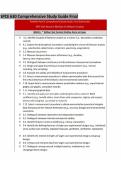
Comprehensive Study Guide Part B :SPCE 630:Comprehensive Study Guide Final(Research Methods for Behavior Analysis) 100% Verified Solution
dentify the goals of behavior analysis as a science (i.e., description, prediction, control) A.2. Explain the philosophical assumptions underlying the science of behavior analysis (e.g., selectionism, determinism, empiricism, parsimony, pragmatism). C.3. Measure occurrence C.4. Measure temporal dimensions of behavior (e.g., duration, latency, inter-response time). C.5. Distinguish between continuous and discontinuous measurement procedures C.6. Design and apply discontinuous measurement procedures (e.g., interval recording, time sampling). C.8. Evaluate the validity and reliability of measurement procedures C.9. Select a measurement procedure to obtain representative data that accounts for the critical dimension of the behavior and environmental constraints C.10. Graph data to communicate relevant quantitative relations (e.g., equal-interval graphs, bar graphs, cumulative records) C.11. Interpret graphed data. E.1. Identify and apply core principles underlying the ethics codes for BACB certificants (e.g., benefit others; treat others with compassion, dignity, and respect; behave with integrity). (as related to research) C.12. Select a measurement procedure to obtain representative procedural integrity data that accounts for relevant dimensions (e.g., accuracy, dosage) and environmental constraints. D.1. Distinguish between dependent and independent variables D.2. Distinguish between internal and external validity. D.3. Identify threats to internal validity (e.g., history, maturation) D.4. Identify the defining features of single-case experimental designs (e.g., individuals serve as their own controls, repeated measures, prediction, verification, replication) D.5. Identify the relative strengths of single-case experimental designs and group designs D.6. Critique and interpret data from single-case experimental designs D.7. Distinguish among reversal, multiple-baseline, multielement, and changingcriterion designs
Document information
- Uploaded on
- May 7, 2026
- Number of pages
- 36
- Written in
- 2025/2026
- Type
- Exam (elaborations)
- Contains
- Questions & answers