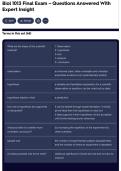
Biol 1013 Final Exam – Questions Answered With
Expert Insight
Save Groups
Terms in this set (68)
What are the steps of the scientific 1. Observation
method? 2. hypothesis
3. test
4. analysis
5. conclusion
observation an informal claim, often unreliable and untested
anecdotal evidence (not systematically tested)
hypothesis a testable and falsifiable explanation for a scientific
observation or question; can be ruled out by data
hypothesis leads to what a prediction.
how can a hypothesis be supported it can be tested through experimentation. if results
or discarded? prove false then the hypothesis is ruled out
if data supports it then hypothesis will be accepted
until further testing shows otherwise
what provides for a better more by increasing the repetition of the experiment by
confident conclusion? other scientists
sample size the number of experimental subjects (people) tests
and the number of times an experiment is repeated
increasing sample size forms what? statistical significance (results are real and not due to
chance)
, control group experiences no experimental intervention or
manipulation
basis for comparison
receives placebo
placebo a fake treatment that mimics the experience of the
experimental groups
scientific theory a hypothesis of the natural world that is supported by
a large body of evidence compiled over time by
numerous researchers. has never been disproveds
how can media reports about the media reports dont have the time, space, and
scientific discoveries become expertise to explain all of the info.
exaggerated? they may be trying to sell a product so they have a
conflict of interest
may give media the wrong idea thinking something is
a cure when its not
An atom contains an equal number of protons and electrons making it neutral
what?
A carbon atom can bond to how carbon can bond up to 4 atoms of hydrogen or other
many hydrogen or other atoms? and atoms because it has 4 electrons
Why?
homeostasis The maintenance of a relatively stable internal
environment, even when the external environment
changes.
cell basic building blocks of life
what are the components of a cell? prokaryotic and eukaryotic
contains DNA
Expert Insight
Save Groups
Terms in this set (68)
What are the steps of the scientific 1. Observation
method? 2. hypothesis
3. test
4. analysis
5. conclusion
observation an informal claim, often unreliable and untested
anecdotal evidence (not systematically tested)
hypothesis a testable and falsifiable explanation for a scientific
observation or question; can be ruled out by data
hypothesis leads to what a prediction.
how can a hypothesis be supported it can be tested through experimentation. if results
or discarded? prove false then the hypothesis is ruled out
if data supports it then hypothesis will be accepted
until further testing shows otherwise
what provides for a better more by increasing the repetition of the experiment by
confident conclusion? other scientists
sample size the number of experimental subjects (people) tests
and the number of times an experiment is repeated
increasing sample size forms what? statistical significance (results are real and not due to
chance)
, control group experiences no experimental intervention or
manipulation
basis for comparison
receives placebo
placebo a fake treatment that mimics the experience of the
experimental groups
scientific theory a hypothesis of the natural world that is supported by
a large body of evidence compiled over time by
numerous researchers. has never been disproveds
how can media reports about the media reports dont have the time, space, and
scientific discoveries become expertise to explain all of the info.
exaggerated? they may be trying to sell a product so they have a
conflict of interest
may give media the wrong idea thinking something is
a cure when its not
An atom contains an equal number of protons and electrons making it neutral
what?
A carbon atom can bond to how carbon can bond up to 4 atoms of hydrogen or other
many hydrogen or other atoms? and atoms because it has 4 electrons
Why?
homeostasis The maintenance of a relatively stable internal
environment, even when the external environment
changes.
cell basic building blocks of life
what are the components of a cell? prokaryotic and eukaryotic
contains DNA