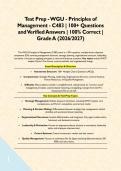
Test Prep - WGU - Principles of
Management - C483 | 100+ Questions
and Verified Answers | 100% Correct |
Grade A (2026/2027)
This WGU Principles of Management (C483) exam is a 100+-question, multiple-choice objective
assessment (OA) covering management functions, strategic planning, organizational structure, leadership,
and ethics. It focuses on applying principles to real-world business scenarios. Key topics include SWOT
analysis, Porter's Five Forces, control methods, and organizational change.
Exam Description & Overview
• Assessment Structure: 100+ Multiple Choice Questions (MCQ).
• Competencies: Strategic Planning, Leadership, Organizational Structure, Control Systems,
Human Resources, and Quality Management.
• Difficulty: Many students consider it straightforward, relying heavily on "common sense"
management principles, scenario-based reasoning, and applying concepts from the Pre-
Assessment (PA) to the OA.
Key Concepts & Test Prep Topics
• Strategic Management: Defines long-term directions, including SWOT analysis, core
competencies, and Porter’s competitive environment model.
• Planning & Decision Making: Differentiates between strategic (top management), tactical
(middle), and operational (lower) planning.
• Organizational Structures: Involves differentiation and integration. Key types include matrix,
functional, and divisional structures.
• Leadership & Motivation: Focuses on expectancy theory (choices in motivation), leadership
styles, and employee empowerment.
• Control Systems: Covers bureaucratic, market, and clan control.
• Quality Management: Focuses on techniques like Six Sigma (reducing defects/variation), ISO
9000, and value chains.
1
, Q1. A firm deliberately offers unique products in its industry to gain a competitive advantage.
Which type of strategy is this? [Multiple Choice]
A) Differentiation
B) Customization
C) Standardization
D) Valorization
Answer: Differentiation
Explanation: Offering unique products to create a competitive advantage is the essence of a differentiation
strategy—the firm seeks to be perceived as distinct so customers will prefer it. "Standardization" seeks
uniformity and cost reduction, not uniqueness. "Valorization" is not a standard strategic term in this
context. "Customization" tailors products to individual customers, which can be a type of differentiation
but the broader established strategy name is differentiation.
Q2. Core competencies denote the skills or expertise that form the roots of an organization's
competitiveness. [True/False]
A) True
B) False
Answer: True
Explanation: Core competencies are the specific skills, technologies, or expertise that an organization
performs especially well and that form the foundation of its competitive advantage. These capabilities are
the ‘roots’ of how a firm competes successfully.
Q3. A small business owner dreams of franchising and becoming the nation’s top provider.
Which term best describes this long-term dream? [Multiple Choice]
A) Strategic vision
B) Strategic mission
C) Strategic planning
D) Strategic management
Answer: Strategic vision
Explanation: An owner’s long-standing dream to expand nationally and become the best provider
describes a strategic vision—a future-oriented picture of where the organization aspires to be. A "strategic
mission" states the organization’s present purpose and scope. "Strategic planning" is the process of setting
goals and allocating resources to reach objectives, while "strategic management" is the implementation
and ongoing oversight of strategy; neither term precisely captures a future-oriented dream the way
"vision" does.
2
, Q4. Happy Inc., a family-entertainment firm, acquires a broadcasting company to strengthen
its distribution. What corporate strategy does this represent? [Multiple Choice]
A) Vertical integration
B) Strategic alliances
C) Networking
D) Horizontal benchmarking
Answer: Vertical integration
Explanation: When a company acquires a distribution or broadcasting network to control downstream
distribution, it is practicing vertical integration—taking ownership of another stage in its supply chain.
"Strategic alliances" involve cooperation without ownership, "networking" is informal relationship-
building, and "horizontal benchmarking" involves comparing similar firms across the same stage, not
acquiring a distribution channel.
Q5. What is a likely result when an effective value chain is created? [Multiple Choice]
A) Profit margins are increased.
B) A mission statement is developed.
C) Customized products are standardized.
D) Total quality management is not required.
Answer: Profit margins are increased.
Explanation: An effective value chain reduces costs or increases the value delivered to customers, which
typically raises profitability by widening the gap between price and cost. Developing a mission statement is
a strategic communications activity, standardizing customized products is a design decision that can
reduce differentiation, and claiming TQM is not required contradicts the continuous-improvement logic
that typically accompanies effective value chains.
Q6. Industry and market analysis, competitor analysis, and social analysis are examples of
which step in the strategic planning process? [Multiple Choice]
A) Analysis of external opportunities and threats
B) Analysis of internal strengths and weaknesses
C) Analysis of mission, vision, and goals
D) Analysis of management implementation
Answer: Analysis of external opportunities and threats
Explanation: Industry and market analysis, competitor analysis, and social analysis all examine factors
outside the organization that can help or hinder strategy; these are classic external opportunities and
threats. "Analysis of internal strengths and weaknesses" focuses on inside capabilities, not external forces.
3
, "Analysis of mission, vision, and goals" is an early internal clarification step, and "Analysis of management
implementation" examines execution rather than environmental scanning.
Q7. At Six Sigma quality (99.99966% defect-free), approximately how many defects per million
opportunities remain? [Multiple Choice]
A) Less than 3.4
B) Less than 4.4
C) Less than 5.3
D) Less than 6.6
Answer: Less than 3.4
Explanation: Six Sigma targets process performance near perfection; a process that is defect-free
99.99966% of the time corresponds to about 3.4 defects per million opportunities—hence "less than 3.4."
Numbers like 4.4, 5.3, or 6.6 are higher defect rates and do not reflect the Six Sigma standard, which is
specifically associated with the very low defects-per-million benchmark.
Q8. A value chain ends with the delivery of products or services. [True/False]
A) True
B) False
Answer: True
Explanation: A value chain describes the sequence of activities that transform raw materials into final
offerings. The final stage of that sequence is delivering the finished products or services to customers,
because the chain’s purpose is to add value until the customer receives the offering.
Q9. An effective value chain decreases a company's profit margins. [True/False]
A) True
B) False
Answer: False
Explanation: An effective value chain improves how activities create and capture value (through cost
reductions, faster cycles, or better customer offerings). Those improvements generally raise the company’s
profit margins rather than decrease them.
Q10. What term denotes the skills or expertise that constitute the roots of competitiveness in
an organization? [Multiple Choice]
A) Core competencies
B) Products and services
C) Strategic values
4
Management - C483 | 100+ Questions
and Verified Answers | 100% Correct |
Grade A (2026/2027)
This WGU Principles of Management (C483) exam is a 100+-question, multiple-choice objective
assessment (OA) covering management functions, strategic planning, organizational structure, leadership,
and ethics. It focuses on applying principles to real-world business scenarios. Key topics include SWOT
analysis, Porter's Five Forces, control methods, and organizational change.
Exam Description & Overview
• Assessment Structure: 100+ Multiple Choice Questions (MCQ).
• Competencies: Strategic Planning, Leadership, Organizational Structure, Control Systems,
Human Resources, and Quality Management.
• Difficulty: Many students consider it straightforward, relying heavily on "common sense"
management principles, scenario-based reasoning, and applying concepts from the Pre-
Assessment (PA) to the OA.
Key Concepts & Test Prep Topics
• Strategic Management: Defines long-term directions, including SWOT analysis, core
competencies, and Porter’s competitive environment model.
• Planning & Decision Making: Differentiates between strategic (top management), tactical
(middle), and operational (lower) planning.
• Organizational Structures: Involves differentiation and integration. Key types include matrix,
functional, and divisional structures.
• Leadership & Motivation: Focuses on expectancy theory (choices in motivation), leadership
styles, and employee empowerment.
• Control Systems: Covers bureaucratic, market, and clan control.
• Quality Management: Focuses on techniques like Six Sigma (reducing defects/variation), ISO
9000, and value chains.
1
, Q1. A firm deliberately offers unique products in its industry to gain a competitive advantage.
Which type of strategy is this? [Multiple Choice]
A) Differentiation
B) Customization
C) Standardization
D) Valorization
Answer: Differentiation
Explanation: Offering unique products to create a competitive advantage is the essence of a differentiation
strategy—the firm seeks to be perceived as distinct so customers will prefer it. "Standardization" seeks
uniformity and cost reduction, not uniqueness. "Valorization" is not a standard strategic term in this
context. "Customization" tailors products to individual customers, which can be a type of differentiation
but the broader established strategy name is differentiation.
Q2. Core competencies denote the skills or expertise that form the roots of an organization's
competitiveness. [True/False]
A) True
B) False
Answer: True
Explanation: Core competencies are the specific skills, technologies, or expertise that an organization
performs especially well and that form the foundation of its competitive advantage. These capabilities are
the ‘roots’ of how a firm competes successfully.
Q3. A small business owner dreams of franchising and becoming the nation’s top provider.
Which term best describes this long-term dream? [Multiple Choice]
A) Strategic vision
B) Strategic mission
C) Strategic planning
D) Strategic management
Answer: Strategic vision
Explanation: An owner’s long-standing dream to expand nationally and become the best provider
describes a strategic vision—a future-oriented picture of where the organization aspires to be. A "strategic
mission" states the organization’s present purpose and scope. "Strategic planning" is the process of setting
goals and allocating resources to reach objectives, while "strategic management" is the implementation
and ongoing oversight of strategy; neither term precisely captures a future-oriented dream the way
"vision" does.
2
, Q4. Happy Inc., a family-entertainment firm, acquires a broadcasting company to strengthen
its distribution. What corporate strategy does this represent? [Multiple Choice]
A) Vertical integration
B) Strategic alliances
C) Networking
D) Horizontal benchmarking
Answer: Vertical integration
Explanation: When a company acquires a distribution or broadcasting network to control downstream
distribution, it is practicing vertical integration—taking ownership of another stage in its supply chain.
"Strategic alliances" involve cooperation without ownership, "networking" is informal relationship-
building, and "horizontal benchmarking" involves comparing similar firms across the same stage, not
acquiring a distribution channel.
Q5. What is a likely result when an effective value chain is created? [Multiple Choice]
A) Profit margins are increased.
B) A mission statement is developed.
C) Customized products are standardized.
D) Total quality management is not required.
Answer: Profit margins are increased.
Explanation: An effective value chain reduces costs or increases the value delivered to customers, which
typically raises profitability by widening the gap between price and cost. Developing a mission statement is
a strategic communications activity, standardizing customized products is a design decision that can
reduce differentiation, and claiming TQM is not required contradicts the continuous-improvement logic
that typically accompanies effective value chains.
Q6. Industry and market analysis, competitor analysis, and social analysis are examples of
which step in the strategic planning process? [Multiple Choice]
A) Analysis of external opportunities and threats
B) Analysis of internal strengths and weaknesses
C) Analysis of mission, vision, and goals
D) Analysis of management implementation
Answer: Analysis of external opportunities and threats
Explanation: Industry and market analysis, competitor analysis, and social analysis all examine factors
outside the organization that can help or hinder strategy; these are classic external opportunities and
threats. "Analysis of internal strengths and weaknesses" focuses on inside capabilities, not external forces.
3
, "Analysis of mission, vision, and goals" is an early internal clarification step, and "Analysis of management
implementation" examines execution rather than environmental scanning.
Q7. At Six Sigma quality (99.99966% defect-free), approximately how many defects per million
opportunities remain? [Multiple Choice]
A) Less than 3.4
B) Less than 4.4
C) Less than 5.3
D) Less than 6.6
Answer: Less than 3.4
Explanation: Six Sigma targets process performance near perfection; a process that is defect-free
99.99966% of the time corresponds to about 3.4 defects per million opportunities—hence "less than 3.4."
Numbers like 4.4, 5.3, or 6.6 are higher defect rates and do not reflect the Six Sigma standard, which is
specifically associated with the very low defects-per-million benchmark.
Q8. A value chain ends with the delivery of products or services. [True/False]
A) True
B) False
Answer: True
Explanation: A value chain describes the sequence of activities that transform raw materials into final
offerings. The final stage of that sequence is delivering the finished products or services to customers,
because the chain’s purpose is to add value until the customer receives the offering.
Q9. An effective value chain decreases a company's profit margins. [True/False]
A) True
B) False
Answer: False
Explanation: An effective value chain improves how activities create and capture value (through cost
reductions, faster cycles, or better customer offerings). Those improvements generally raise the company’s
profit margins rather than decrease them.
Q10. What term denotes the skills or expertise that constitute the roots of competitiveness in
an organization? [Multiple Choice]
A) Core competencies
B) Products and services
C) Strategic values
4