
• Verkeerd document? Gratis ruilen
  • Geschreven door studenten die geslaagd zijn
  • Direct beschikbaar na je betaling
  • Online lezen of als PDF
Verkopen
Kies je studieland
Kies je taal
Document preview thumbnail
Voorbeeld 2 van de 11 pagina's
Samenvatting

Summary Afrikaans FAL

Document preview thumbnail
Voorbeeld 2 van de 11 pagina's

This document introduces the basics of the Afrikaans terminology that students from the juinor grades all the way up until the senior grades will need to become familiar with. This document introduces the topic and provides you with detailed English definitions! Improve your Afrikaans today and do not miss out on this opportunity!

Voorbeeld van de inhoud

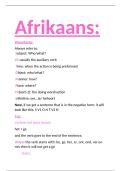
Afrikaans:
Woordorde:
Always refer to:
Subject: Who/what?
V1:usually the auxiliary verb
Time: when the action is being preformed
Object: who/what?
Manner: how?
Place: where?
V2(verb 2): the doing word/action
Infinitive: om…te/ behoort
Now, if we get a sentence that is in the negative form, it will
look like this: S V1 O N T V2 N
Tye:
Verlede tyd (past tense):
het + ge
and the verb goes to the end of the sentence,
Unless the verb starts with: be, ge, her, er, ont, ond, ver en
mis then it will not get a ge
Rules:

,  Words that change: is-was; sal-sou; wil-wou; kan-kon;
moet-moes, when you get these words, you don’t need
to change the sentence, only change the word.
 If the verb is het, you will add another het and take it to
the end of the sentence and change it to gehad.
 If there is a verb and a preposition, it will become:
preposition+ge-verb (ingekom)
 If given the helping verbs gaan, laat and kom, they will
go to the end of the sentence before the verb
 If you can do both verbs at the same time, the first one
gets a ge, if you cant do both they both get a ge.
 The words: as, wanner, dan en nou change to “toe”,
(Jeremy is bly as hy vir sara sien-jeremy was blye to hy
vir sara sien)
 If the sentence contains an infinitive you just need to
replace the verb with “het” and after that you add in the
place then the verb + -ge and your infinitive will always
come last
(Pierce bly in die bed om te rus- Pierce het in die bed gebly
om to rus)
Toekomende tyd:
Sal in the place of the verb and the verb moves to the end of
the sentence.
Rules:
Has the word “wil, moet en kan” as the verb, sal will take its
place and it will go just before the verb.


Documentinformatie

Schooljaar
200
Geüpload op
6 mei 2026
Aantal pagina's
11
Geschreven in
2025/2026
Type
Samenvatting
$3.86

Verkeerd document? Gratis ruilen Binnen 14 dagen na aankoop en voor het downloaden kan je een ander document kiezen. Je kan het bedrag gewoon opnieuw besteden.
Geschreven door studenten die geslaagd zijn
Direct beschikbaar na je betaling
Online lezen of als PDF

Verkocht
0
Volgers
0
Items
10
Laatst verkocht
-


Waarom studenten kiezen voor Stuvia

Gemaakt door medestudenten, geverifieerd door reviews

Kwaliteit die je kunt vertrouwen: geschreven door studenten die slaagden en beoordeeld door anderen die dit document gebruikten.

Niet tevreden? Kies een ander document

Geen zorgen! Je kunt voor hetzelfde geld direct een ander document kiezen dat beter past bij wat je zoekt.

Betaal zoals je wilt, start meteen met leren

Geen abonnement, geen verplichtingen. Betaal zoals je gewend bent via Bancontact, iDeal of creditcard en download je PDF-document meteen.

Student with book image

“Gekocht, gedownload en geslaagd. Zo eenvoudig kan het zijn.”

Alisha Student

Bezig met je bronvermelding?

Maak nauwkeurige citaten in APA, MLA en Harvard met onze gratis bronnengenerator.

Bezig met je bronvermelding?

Veelgestelde vragen
