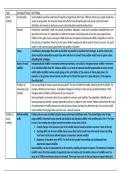
Topic Sociologist/Theory Key findings
Social Functionalists Social solidarity would be undermined if equality of opportunity didn't exist. Without meritocracy, people would view
mobility society as being unfair, the most able would not fulfil the most demanding jobs and society could not function
effectively. Any barriers to meritocracy (such as discrimination) would be dysfunctional.
Marxists Meritocracy is essentially a myth, not actually in existence. Education is a key way to reproduce inequalities from one
generation to the next. It is impossible for children from lower class backgrounds to have the same opportunities.
Children of the upper classes and upper middle classes do not experience downward mobility. Inequality is in-built to
the structure of capitalism. There has to be ‘factory fodder’ (people only able to work in factory) to survive. The ‘good
society’ is not based on equal opportunities but equality of outcome.
Young A meritocracy encourages those who earned their top position to maintain their privileges. A society ruled by the
above would be undesirable because those who feel they’ve ‘earned’ their position would have no qualms about
defending their privileges.
Nature of social Intergenerational mobility- movement between generations, can facilitate, Intragenerational mobility- movement
mobility of an individual within their life. Absolute ability is as a result of improved wealth/opportunities in society overall,
whilst relative mobility involves people going up the social ladder at the expense of others going down. For
example, in the grammar school system only the top % of those that pass the 11 plus will get in, at the expense
those that don't.
Problems of How can sociologists measure social class accurately? The rich can hide their wealth, obscuring levels of mobility. For
measuring social example, offshoring to tax havens). Occupations disappear or decline in status and pay (proletarianization). With
mobility intergenerational mobility, which parent do you compare to?
Some sociologists use income rather than occupation to measure social mobility. The population is divided up into
income groups and whether a younger generation ends up in a higher or lower income. Weber would criticise this type
of measurement on mobility because we must also look at status (and party) to determine class. You can have a high
income without having high status and vice versa - mutually exclusive.
Studies on Oxford mobility Fathers and sons were classified using the seven-point Hope-Goldthorpe scale. They found higher rates of long-
social study range mobility (movement across several class ladders) and absolute mobility in the working class. Over 1/4 of men
mobility in class 1 has working class origins (moved from bottom to top class). Due to:
1. Overall changes in the economy (size of the middle class increased) and there was more ‘room at the top’
2. Declining birth rate in lower middle classes means they had to recruit from other social classes (recruiting
from lower social classes allowed people to experience upward mobility)
3. Expansion of education since WW2. For the first time people from working class backgrounds had
experienced upward mobility.
Social mobility was due to improvements in the economy, enabling all classes to improve. The existence of absolute
mobility means that their equality of opportunity does not really exist, the relative chances of mobility were the
same as in 1908 but meritocracy had not increased. There was more room at the top/improved opportunities but
Social Functionalists Social solidarity would be undermined if equality of opportunity didn't exist. Without meritocracy, people would view
mobility society as being unfair, the most able would not fulfil the most demanding jobs and society could not function
effectively. Any barriers to meritocracy (such as discrimination) would be dysfunctional.
Marxists Meritocracy is essentially a myth, not actually in existence. Education is a key way to reproduce inequalities from one
generation to the next. It is impossible for children from lower class backgrounds to have the same opportunities.
Children of the upper classes and upper middle classes do not experience downward mobility. Inequality is in-built to
the structure of capitalism. There has to be ‘factory fodder’ (people only able to work in factory) to survive. The ‘good
society’ is not based on equal opportunities but equality of outcome.
Young A meritocracy encourages those who earned their top position to maintain their privileges. A society ruled by the
above would be undesirable because those who feel they’ve ‘earned’ their position would have no qualms about
defending their privileges.
Nature of social Intergenerational mobility- movement between generations, can facilitate, Intragenerational mobility- movement
mobility of an individual within their life. Absolute ability is as a result of improved wealth/opportunities in society overall,
whilst relative mobility involves people going up the social ladder at the expense of others going down. For
example, in the grammar school system only the top % of those that pass the 11 plus will get in, at the expense
those that don't.
Problems of How can sociologists measure social class accurately? The rich can hide their wealth, obscuring levels of mobility. For
measuring social example, offshoring to tax havens). Occupations disappear or decline in status and pay (proletarianization). With
mobility intergenerational mobility, which parent do you compare to?
Some sociologists use income rather than occupation to measure social mobility. The population is divided up into
income groups and whether a younger generation ends up in a higher or lower income. Weber would criticise this type
of measurement on mobility because we must also look at status (and party) to determine class. You can have a high
income without having high status and vice versa - mutually exclusive.
Studies on Oxford mobility Fathers and sons were classified using the seven-point Hope-Goldthorpe scale. They found higher rates of long-
social study range mobility (movement across several class ladders) and absolute mobility in the working class. Over 1/4 of men
mobility in class 1 has working class origins (moved from bottom to top class). Due to:
1. Overall changes in the economy (size of the middle class increased) and there was more ‘room at the top’
2. Declining birth rate in lower middle classes means they had to recruit from other social classes (recruiting
from lower social classes allowed people to experience upward mobility)
3. Expansion of education since WW2. For the first time people from working class backgrounds had
experienced upward mobility.
Social mobility was due to improvements in the economy, enabling all classes to improve. The existence of absolute
mobility means that their equality of opportunity does not really exist, the relative chances of mobility were the
same as in 1908 but meritocracy had not increased. There was more room at the top/improved opportunities but