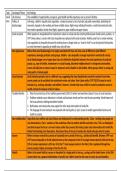
Topic Sociologist/Theory Key findings
Social Life chances The availability of opportunities, prospects, good health and life expectancy over a person's lifetime.
class Politics of Left-wing: a belief in equality state regulation, a mixed economy (a mix of private and public ownership), abolishing the
disadvantage monarchy. Appeals to the working and lower middle classes. Right-wing: individual freedom, a small interventionist state,
free market capitalism (similar New Right). Appeals to upper middle and upper classes.
Social exclusion When people are marginalised from mainstream values in society and also control political power (trade unions, parties). In
1997 (New Labour), concern with class inequality was replaced with social exclusion. Neither party has to contain working
class opposition to inequality because the working class no longer exist as a ‘class for itself’ so can be ignored. Both parties
are only interested in appealing to middle class who still vote.
New Egalitarians Believe that social disadvantage is no longer associated with class, but new areas of differences (and different
experiences) amongst particular social groups. Giddens - class inequality no longer important in meritocratic society.
Social disadvantages are no longer about class, but distinctive disparities between the social experiences of particular
groups e.g., type of families, homeowner’s vs social housing, disorderly neighbourhood’s vs integrated communities,
secure well paid jobs vs insecure casual or temporary work, disabled vs able bodied, ethnic groups, elderly vs young and
male pupil’s vs female pupils.
Social inclusion Social inclusion presents class in a different way, suggesting that class dissatisfaction would be resolved if and when
poorer people can be socialised into mainstream norms and values. New Labour policy (1997-2010) focused on social
inclusion (e.g., training, education, and welfare). However, it denies that class conflict is rooted in production access to
wealth, instead it is because of lack of values.
Troubled families 1. Was the narrow focus of the coalition government (2010-15) which narrowed New Labour’s focus of social exclusion.
2. Problems related to poor behaviour in schools and bad exam results are the result of poor parenting. Would improve if
the local authority challenged problem families.
3. Both labour and conservative now support for other state intervention in family life.
4. The language of social exclusion was replaced with social justice (a ‘just’ access to wealth opportunities fairness and
health in society).
New traditionalists Argue that class conflicts and class divisions are fundamental to understanding society. Chavs - working class people are
now demonised as ‘chavs’, members of the underclass reliant on welfare benefits and petty crime. This is an ideological
narrative because the focus is on moral values rather than poverty this invites greater state intervention into family life.
Rather than blaming chavs themselves, they blame those at the top of society who decide who gets what in society.
Income Refers to money received by a person or household over a period of time e.g., salaries and benefits. Between 1999- and
1997-income inequality in the UK widened more so than compared to the US. Average income raised by 36% but the top
10% of earners experienced a 62% rise. UK is the 5th most unequal society in the West, this is explained through low
earners paying a higher percentage of tax than the rich.
Wealth Refers to the assets held by a person or household at a single point in time e.g., savings and the family home. In the 20th
century there was a gradual redistribution of wealth, but it didn't extend to the mass of society (tax and benefits).
, Resolution foundation (2021) top 1% own 23% of the nation's wealth. This is due to the stock market and increased
property prices. Half of the population shared only 10% of total wealth in 1986, reduced to 6% in 2003. Wealth is much
more unequally distributed than income.
Decline of the An increase in income inequalities and the middle classes has meant that there is no longer a homogeneous working class
working class with shared interests. Working class living standards have also increased even if not at the same rate as the wealthy so they
don't feel a need to fight the system, leading to a decline in people seeing themselves as a ‘class for itself’.
Reasons for 1. Globalisation - increase in economic migrants lowers wages - supply of workers greater than demand (can pay
economic minimum wages).
inequality 2. Technology - high tech industries have enabled an elite to acquire greater wealth - increased profits for elite and lower
production costs = less workers and global market.
3. Financialization - London City traders enabled an elite of financers to gain greater wealth - use financial skills to
increase wealth.
4. Decline of trade unions - working class have no organisational means to demand higher wages.
5. Govt distribution policies- taxation is regressive (poor pay higher percentage of income on tax than rich) rather than
progressive (rich pay higher percentage of income tax than poor), via VAT, fuel tax etc.
6. Political capture- policies are aimed at only those succeeding in society i.e., we don't have high wealth taxes e.g., low
inheritance tax - wealth past on.
Health Life expectancy has increased over the past 50 years, but there is the health gap between social class. People living in
poorest areas die 7 years earlier on average than those living in the richest neighbourhoods. Although, recent data shows
that life expectancy has declined by six months. Cheaper food is often unhealthier, leads to obesity and health issues and
lower living standards including poor housing conditions.
Education Kynaston argues that meritocracy is undermined in the UK by the existence of private schools e.g., %0% of Westminster
public school go to Oxbridge. High-status jobs e.g., MPs, CEOs, medics, and judges are disproportionally recruited from
private schools, and this leads to an educational apartheid. Parentocracy- middle class parents can use material and cultural
capital.
Individualised Class exists as an economic category or an influence, but people respond to this as individuals rather than as a collective
society? group. BUT class still influences outcomes. 58% of people following a higher education routes have parents in the
professional classes. The majority of students who took assistant courses (i.e., given financial support) were from
unskilled backgrounds.
Gend Gender and work The vast majority of women agree with the statement that they have full equality with men and have full freedoms.
er However, when asked whether there is currently social inequality between men and women their response (70%) is the
same. In the 20th century women ceased to work upon marriage. Grint and Nixon argue that increased rate of employment
for married women and mothers is the biggest change in occupational activity. The UK labour forces split is nearly equal each
day men (53%) and women (47%). BUT these figures disguise disparities between full time and paid work. The 1970 Equal
Pay Act and 1975 Sex Discrimination Act institutionalise women's equality. BUT the success of this even today is debatable
Social Life chances The availability of opportunities, prospects, good health and life expectancy over a person's lifetime.
class Politics of Left-wing: a belief in equality state regulation, a mixed economy (a mix of private and public ownership), abolishing the
disadvantage monarchy. Appeals to the working and lower middle classes. Right-wing: individual freedom, a small interventionist state,
free market capitalism (similar New Right). Appeals to upper middle and upper classes.
Social exclusion When people are marginalised from mainstream values in society and also control political power (trade unions, parties). In
1997 (New Labour), concern with class inequality was replaced with social exclusion. Neither party has to contain working
class opposition to inequality because the working class no longer exist as a ‘class for itself’ so can be ignored. Both parties
are only interested in appealing to middle class who still vote.
New Egalitarians Believe that social disadvantage is no longer associated with class, but new areas of differences (and different
experiences) amongst particular social groups. Giddens - class inequality no longer important in meritocratic society.
Social disadvantages are no longer about class, but distinctive disparities between the social experiences of particular
groups e.g., type of families, homeowner’s vs social housing, disorderly neighbourhood’s vs integrated communities,
secure well paid jobs vs insecure casual or temporary work, disabled vs able bodied, ethnic groups, elderly vs young and
male pupil’s vs female pupils.
Social inclusion Social inclusion presents class in a different way, suggesting that class dissatisfaction would be resolved if and when
poorer people can be socialised into mainstream norms and values. New Labour policy (1997-2010) focused on social
inclusion (e.g., training, education, and welfare). However, it denies that class conflict is rooted in production access to
wealth, instead it is because of lack of values.
Troubled families 1. Was the narrow focus of the coalition government (2010-15) which narrowed New Labour’s focus of social exclusion.
2. Problems related to poor behaviour in schools and bad exam results are the result of poor parenting. Would improve if
the local authority challenged problem families.
3. Both labour and conservative now support for other state intervention in family life.
4. The language of social exclusion was replaced with social justice (a ‘just’ access to wealth opportunities fairness and
health in society).
New traditionalists Argue that class conflicts and class divisions are fundamental to understanding society. Chavs - working class people are
now demonised as ‘chavs’, members of the underclass reliant on welfare benefits and petty crime. This is an ideological
narrative because the focus is on moral values rather than poverty this invites greater state intervention into family life.
Rather than blaming chavs themselves, they blame those at the top of society who decide who gets what in society.
Income Refers to money received by a person or household over a period of time e.g., salaries and benefits. Between 1999- and
1997-income inequality in the UK widened more so than compared to the US. Average income raised by 36% but the top
10% of earners experienced a 62% rise. UK is the 5th most unequal society in the West, this is explained through low
earners paying a higher percentage of tax than the rich.
Wealth Refers to the assets held by a person or household at a single point in time e.g., savings and the family home. In the 20th
century there was a gradual redistribution of wealth, but it didn't extend to the mass of society (tax and benefits).
, Resolution foundation (2021) top 1% own 23% of the nation's wealth. This is due to the stock market and increased
property prices. Half of the population shared only 10% of total wealth in 1986, reduced to 6% in 2003. Wealth is much
more unequally distributed than income.
Decline of the An increase in income inequalities and the middle classes has meant that there is no longer a homogeneous working class
working class with shared interests. Working class living standards have also increased even if not at the same rate as the wealthy so they
don't feel a need to fight the system, leading to a decline in people seeing themselves as a ‘class for itself’.
Reasons for 1. Globalisation - increase in economic migrants lowers wages - supply of workers greater than demand (can pay
economic minimum wages).
inequality 2. Technology - high tech industries have enabled an elite to acquire greater wealth - increased profits for elite and lower
production costs = less workers and global market.
3. Financialization - London City traders enabled an elite of financers to gain greater wealth - use financial skills to
increase wealth.
4. Decline of trade unions - working class have no organisational means to demand higher wages.
5. Govt distribution policies- taxation is regressive (poor pay higher percentage of income on tax than rich) rather than
progressive (rich pay higher percentage of income tax than poor), via VAT, fuel tax etc.
6. Political capture- policies are aimed at only those succeeding in society i.e., we don't have high wealth taxes e.g., low
inheritance tax - wealth past on.
Health Life expectancy has increased over the past 50 years, but there is the health gap between social class. People living in
poorest areas die 7 years earlier on average than those living in the richest neighbourhoods. Although, recent data shows
that life expectancy has declined by six months. Cheaper food is often unhealthier, leads to obesity and health issues and
lower living standards including poor housing conditions.
Education Kynaston argues that meritocracy is undermined in the UK by the existence of private schools e.g., %0% of Westminster
public school go to Oxbridge. High-status jobs e.g., MPs, CEOs, medics, and judges are disproportionally recruited from
private schools, and this leads to an educational apartheid. Parentocracy- middle class parents can use material and cultural
capital.
Individualised Class exists as an economic category or an influence, but people respond to this as individuals rather than as a collective
society? group. BUT class still influences outcomes. 58% of people following a higher education routes have parents in the
professional classes. The majority of students who took assistant courses (i.e., given financial support) were from
unskilled backgrounds.
Gend Gender and work The vast majority of women agree with the statement that they have full equality with men and have full freedoms.
er However, when asked whether there is currently social inequality between men and women their response (70%) is the
same. In the 20th century women ceased to work upon marriage. Grint and Nixon argue that increased rate of employment
for married women and mothers is the biggest change in occupational activity. The UK labour forces split is nearly equal each
day men (53%) and women (47%). BUT these figures disguise disparities between full time and paid work. The 1970 Equal
Pay Act and 1975 Sex Discrimination Act institutionalise women's equality. BUT the success of this even today is debatable